Question
L, C and R represent the physical quantities inductance, capacitance and resistance respectively. Which of the following combinations have dimensions of frequency?

  1. $\frac{1}{\text{RC}}$

  2. $\frac{\text{R}}{\text{L}}$

  3. $\frac{1}{\sqrt{\text{LC}}}$

  4. $\text{C}/\text{L}$

Answer

  1. $\frac{1}{\text{RC}}$

  2. $\frac{\text{R}}{\text{L}}$

  3. $\frac{1}{\sqrt{\text{LC}}}$

Explanation:

þ Time constant t = RC in RC circuit

frequency $=\frac{1}{\tau}=\frac{1}{\text{RC}} \ ...(\text{i})$

þ Time constant in LR circuit is $\tau=\frac{\text{L}}{\text{RC}}$

frequency $\frac{1}{\tau}=\frac{\text{R}}{\text{L}} \ ...(\text{ii})$

þ eq. (i) & (ii) multiply

frequency $=\frac{1}{\text{LC}}$

frequency $=\frac{1}{\sqrt{2\text{C}}}$

Need a full question paper?

Generate a complete, print-ready paper with questions like this in minutes — across 16+ boards, with answer keys.

Start Generating Free

Similar questions

In the relation $y = a\cos (\omega t - kx)$, the dimensional formula for $k$ is
A hollow sphere and a solid sphere having same mass and same radii are rolled down a rough inclined plane:
  1. The hollow sphere reaches the bottom first.
  2. The solid sphere reaches the bottom with greater speed.
  3. The solid sphere reaches the bottom with greater kinetic energy.
  4. The two spheres will reach the bottom with same linear momentum.
A liquid wets a solid completely. The meniscus of the liquid in a sufficiently long tube is
A particle is released from rest from a tower of height $3\, h$. The ratio of times to fall  equal heights $h$, i.e., $t_1 : t_2 : t_3$ is
A car is moving along a straight line, say $OP$ in given figure. It moves from $O$ to $P$ in $18\; s$ and returns from $P$ to $\mathrm{Q}$ in $6.0\; s$. What are the average velocity and average speed of the car in going from $O$ to $P$ and back to $Q?$
Electric field in a certain region is given by $\overrightarrow{ E }=\left(\frac{ A }{ x ^2} \hat{ i }+\frac{ B }{ y ^3} \hat{ j }\right)$. The $SI$ unit of $A$ and $B$ are
A mass at the end of a spring executes harmonic motion about an equilibrium position with an amplitude $A.$ Its speed as it passes through the equilibrium position is $V.$ If extended $2A$ and released, the speed of the mass passing through the equilibrium position will be
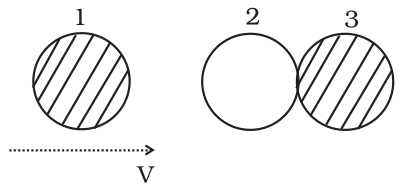
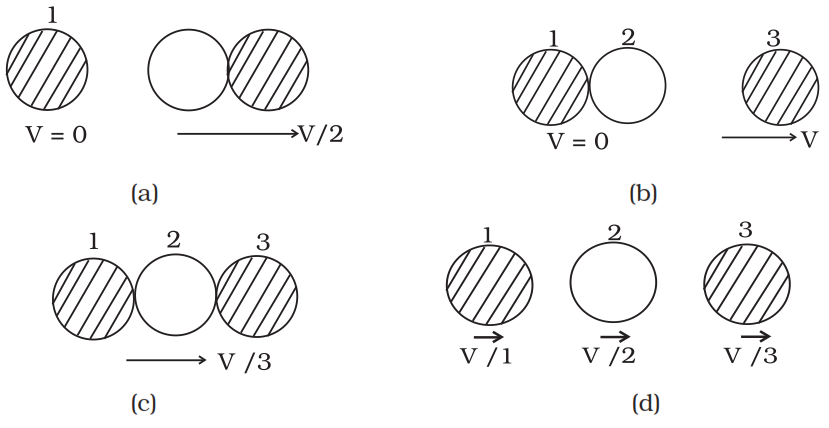
Two identical ball bearings in contact with each other and resting on a frictionless table are hit head-on by another ball bearing of the same mass moving initially with a speed V as shown in:If the collision is elastic, which of the following is a possible result after collision?
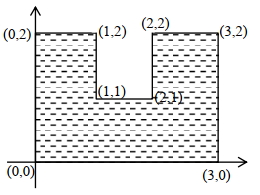
A uniform thin metal plate of mass $10 \mathrm{~kg}$ with dimensions is shown. The ratio of $x$ and $y$ coordinates of center of mass of plate in $\frac{n}{9}$. The value of $n$ is $\qquad$
A frame of reference that is accelerated with respect to an inertial frame of reference is called a non-inertial frame of reference. A coordinate system fixed on a circular disc rotating about a fixed axis with a constant angular velocity $\omega$ is an example of a non-intertial fiame of reference. The relationship between the force $\vec{F}_{\text {rot }}$ experienced by a particle of nass in moving on the rotating disc and the force $\vec{F}_{\text {in }}$ experienced by the particle in an inertial frame of reference is

$\vec{F}_{\text {rot }}=\vec{F}_{\text {in }}+2 m\left(\vec{v}_{\text {rot }} \times \vec{\omega}\right)+m(\vec{\omega} \times \vec{r}) \times \vec{\omega},$

where $\vec{v}_{\text {rot }}$ is the velocity of the particle in the rotating frame of reference and $\bar{r}$ is the position vector of the particle with respect to the centre of the disc.

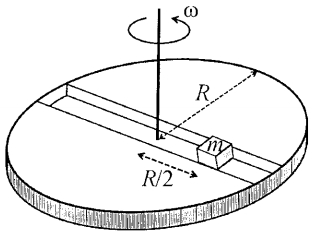
Now consider a smooth slot along a diameter of a disc of radius $R$ rotating counter-clockwise with a constant angular speed $\omega$ about its vertical axis through its center. We assign a coordinate system with the origin at the center of the disc, the $x$-axis along the slot, the $y$-axis perpendicular to the slot and the $z$-axis along the rotation axis $(\vec{\omega}=\omega \hat{k})$. A sm a $1$ block of mass $m$ is gently placed in the slot at $\vec{r}=(R / 2) \hat{i}$ at $t=0$ and is constrained to move only along the slot.

(Image)

($1$) The distance $r$ of the block at time $t$ is

($A$) $\frac{R}{4}\left(e^{\omega t}+e^{-\omega t}\right)$   ($B$) $\frac{R}{2} \cos \omega t$   ($C$) $\frac{R}{4}\left(e^{2 \omega t}+e^{-2 \omega t}\right)$

($D$) $\frac{F}{2} \cos 2 \omega t$

($2$) The net reaction of the disc on the block is

($A$) $\frac{1}{2} m \omega^2 R\left(e^{2 \omega t}-e^{-2 \omega t}\right) \hat{j}+m g \hat{k}$

($B$) $\frac{1}{2} m \omega^2 R\left(e^{\omega t}-e^{-a t t}\right) j+m g k$

($C$) $-m \omega^2 R \cos \omega t \hat{j}-m g \hat{k}$

($D$) $m \omega^2 R \sin \omega t \hat{j}-m g \hat{k}$

Give the answer quetioin ($1$) ($2$)