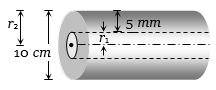
Length of a hollow tube is $5\,m$, it’s outer diameter is $10\, cm$ and thickness of it’s wall is $5\, mm$. If resistivity of the material of the tube is $1.7 \times 10^{-8} \,\Omega m$ then resistance of tube will be
Medium
Download our app for free and get started
(a) By using $R = \rho .\frac{l}{A};$ here $A = \pi (r_2^2 - r_1^2)$
Outer radius $r_2 = 5\,cm$
Inner radius $r_1 = 5 -0.5 = 4.5\, cm$
So $R = 1.7 \times {10^{ - 8}} \times \frac{5}{{\pi \{ {{(5 \times {{10}^{ - 2}})}^2} - {{(4.5 \times {{10}^{ - 2}})}^2}\} }}$
$ = 5.6 \times {10^{ - 5}}\,\Omega $
Outer radius $r_2 = 5\,cm$
Inner radius $r_1 = 5 -0.5 = 4.5\, cm$
So $R = 1.7 \times {10^{ - 8}} \times \frac{5}{{\pi \{ {{(5 \times {{10}^{ - 2}})}^2} - {{(4.5 \times {{10}^{ - 2}})}^2}\} }}$
$ = 5.6 \times {10^{ - 5}}\,\Omega $

Download our appand get started for free
Experience the future of education. Simply download our apps or reach out to us for more information. Let's shape the future of learning together!No signup needed.*
Similar Questions
- 1A current of $2\, A$ passing through conductor produces $80\, J$ of heat in $10$ seconds. The resistance of the conductor is ............ $\Omega$View Solution
- 2View SolutionOhm's law fails in
- 3Assume a hypothetical wire in which free electron density changes with temperature in proportionality $n\ \alpha \ T$ assuming $\tau $(Relaxation time of collision) and dimensions of wire remain unchanged with increasing temperature. Which one of the resistance $v/s$ temperature graph is trueView Solution
- 4A wire of length $100\, cm$ is connected to a cell of emf $2\,V$ and negligible internal resistance. The resistance of the wire is $3\,\Omega $. The additional resistance required to produce a potential difference of $1\, mV/cm$ is ............. $\Omega$View Solution
- 5A current of $2.0$ ampere passes through a cell of $e.m.f$. $1.5\, volts$ having internal resistance of $0.15\, ohm$. The potential difference measured, in $volts$, across both the ends of the cell will beView Solution
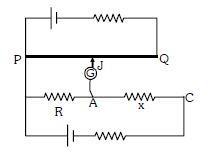
- 6Circuit for the measurement of resistance by potentiometer is shown. The galvanometer is first connected at point $A$ and zero deflection is observed at length $P J = 10\ cm$ . In second case it is connected at point $C$ and zero deflection is observed at a length $30\ cm$ from $P$ . Then the unknown resistance $X$ isView Solution
- 7View SolutionTwo wires of the same material are given. The first wire is twice as long as the second and has twice the diameter of the second. The resistance of the first will be
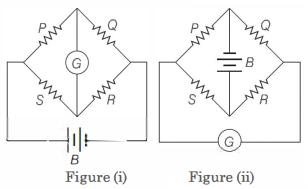
- 8Figure $(i)$ below shows a Wheatstone's bridge in which $P, Q, R$ and $S$ are fixed resistances, $G$ is a galvanometer and $B$ is a battery. For this particular case, the galvanometer shows zero deflection. Now, only the positions of $B$ and $G$ are interchanged, as shown in figure $(ii)$. The new deflection of the galvanometerView Solution
- 9View SolutionThe reciprocal of resistance is
- 10A potential difference of $10 \,V$ is applied across a conductor of $1000 \,\Omega$. The number of electrons flowing through the conductor in $300 \,s$ is ..........View Solution