Length of a string tied to two rigid supports is $40 cm$. Maximum length (wavelength in $cm$) of a stationary wave produced on it is ... $cm$
AIEEE 2002, Easy


Download our appand get started for free
Experience the future of education. Simply download our apps or reach out to us for more information. Let's shape the future of learning together!No signup needed.*
Similar Questions
- 1The persistence of sound in a room after the source of sound is turned off is called reverberation. The measure of reverberation time is the time required for sound intensity to decrease by $60 \,dB$. It is given that the intensity of sound falls off as $I_0 \exp \left(-c_1 \alpha\right)$ where $I_0$ is the initial intensity, $c_1$ is a dimensionless constant with value $1 / 4$. Here, $\alpha$ is a positive constant which depends on the speed of sound, volume of the room, reverberation time, and the effective absorbing area $A_e$. The value of $A_e$ is the product of absorbing coefficient (with value between $0$ and $1,1$ being a perfect absorber) and the area of the room. For a concert hall of volume $600 \,m ^3$, the value of $A_e$ (in $m ^2$ ) required to give a reverberation time of $1 s$ is closest to (speed of sound in air $=340 \,m / s$ )View Solution
- 2A travelling wave is partly reflected and partly transmitted from a rigid boundary. Let $a_i, a_r$ and $a_t$ be the amplitude of incident wave, reflected wave and transmitted wave and $I_i, I_r$ and $I_t$ be the corresponding intensities. Then choose the correct alternativesView Solution
- 3If separation between screen and source is increased by $2\%$ what would be the effect on the intensityView Solution
- 4For a certain organ pipe, three successive resonance frequencies are observed at $425,595,$ and $765 \,Hz$ respectively, Taking the speed of sound in air to be $340 \,m / s$ the fundamental frequency of the pipe (in $Hz$ ) is .........View Solution
- 5View SolutionWhen a stationary wave is formed then its frequency is
- 6Two closed pipe produce $10$ beats per second when emitting their fundamental nodes. If their length are in ratio of $25 : 26$. Then their fundamental frequency in $Hz$, areView Solution
- 7Equation of a progressive wave is given by $y = 4\sin \left\{ {\pi \left( {\frac{t}{5} - \frac{x}{9}} \right) + \frac{\pi }{6}} \right\}$. Then which of the following is correctView Solution
- 8Two vibrating tuning forks produce progressive waves given by ${Y_1} = 4\sin 500\pi t$ and ${Y_2} = 2\sin 506\pi t.$ Number of beats produced per minute isView Solution
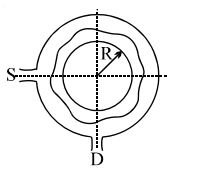
- 9A narrow tube is bent in the form of a circle of radius $R,$ as shown in the figure. Two small holes $S$ and $D$ are made in the tube at the positions right angle to each other. A source placed at $S$ generated a wave of intensity $I_0$ which is equally divided into two parts : One part travels along the longer path, while the other travels along the shorter path. Both the part waves meet at the point $D$ where a detector is placed The maximum value of $\lambda$ to produce a maxima at $D$ is given byView Solution
- 10A wave disturbance in a medium is described by $y(x,\,t) = 0.02\cos \,\left( {50\,\pi t + \frac{\pi }{2}} \right)\cos (10\pi x)$, where $ x$ and $y$ are in metres and $t$ in secondsView Solution