MCQ
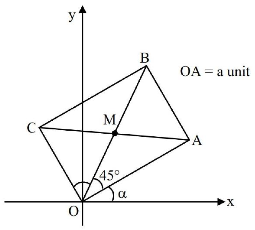
Let a be the length of a side of a square OABC with O being the origin. Its side OA makes an acute angle $\alpha$ with the positive x-axis and the equations of its diagonals are $(\sqrt{3}+1) x+(\sqrt{3}-1) y=0$ and $(\sqrt{3}-1) x-(\sqrt{3}+1) y+8 \sqrt{3}=0$. Then $\mathrm{a}^{2}$ is equal to
  • 48
  • B
    32
  • C
    16
  • D
    24

Answer

Correct option: A.
48
(A) 48
Image
Slope of diagonal $\mathrm{OB}=\frac{\sqrt{3}+1}{1-\sqrt{3}}$
\begin{equation*}
=\tan 105^{\circ}
\end{equation*}
$\therefore \alpha=60^{\circ}$
$\therefore \mathrm{A}\left(\operatorname{acos} 60^{\circ}, \mathrm{asin} 60^{\circ}\right)$
$\therefore \mathrm{A}\left(\frac{\mathrm{a}}{2}, \frac{\sqrt{3} \mathrm{a}}{2}\right)$
A Lies on other diagonal
$\therefore\left(\frac{\sqrt{3}-1}{2}\right) a-\left(\frac{\sqrt{3}+1}{2}\right) \cdot \sqrt{3} a+8 \sqrt{3}=0$
$\mathrm{a}\left[\frac{\sqrt{3}-1-3-\sqrt{3}}{2}\right]=-8 \sqrt{3}$
$a=4 \sqrt{3}$
$\therefore \mathrm{a}^{2}=48$

Need a full question paper?

Generate a complete, print-ready paper with questions like this in minutes — across 16+ boards, with answer keys.

Start Generating Free

Similar questions

If $x$ is real, then the maximum and minimum values of the expression $\frac{{{x^2} - 3x + 4}}{{{x^2} + 3x + 4}}$ will be
If $a,\,b,\,c$ are non-coplanar vectors and $\lambda $ is a real number then $[\lambda (a + b)\,\,\,\,{\lambda ^2}b\,\,\,\,\,\lambda c] = \left[ {a\,\,b + c\,\,b} \right]$ for
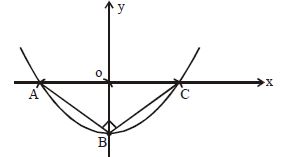
If graph of $y = ax^2 + bx + c$ as follows

$\Delta ABC$ is right angled osceles triangle with hypotenuse $AC = 4\sqrt 2\ units$ then minimum value of $ax^2 + bx + c$ is

Let $\vec{a}, \vec{b}$ and $\vec{c}$ be three units vectors such that $\overrightarrow{\mathrm{a}}+\overrightarrow{\mathrm{b}}+\overrightarrow{\mathrm{c}}=\overrightarrow{0} .$ If $\lambda=\overrightarrow{\mathrm{a}} \cdot \overrightarrow{\mathrm{b}}+\overrightarrow{\mathrm{b}} \cdot \overrightarrow{\mathrm{c}}+\overrightarrow{\mathrm{c}} \cdot \overrightarrow{\mathrm{a}} $ and $\overrightarrow{\mathrm{d}}=\overrightarrow{\mathrm{a}} \times \overrightarrow{\mathrm{b}}+\overrightarrow{\mathrm{b}} \times \overrightarrow{\mathrm{c}}+\overrightarrow{\mathrm{c}} \times \overrightarrow{\mathrm{a}},$ then the ordered pair $(\lambda, {\mathrm{\vec d}})$ is equal to 
The number of common tangents to two circles ${x^2} + {y^2} = 4$ and ${x^2} - {y^2} - 8x + 12 = 0$ is
The greatest and least value of $\sin x\cos x$ are
If the normal at an end of a latus rectum of an ellipse passes through an extremity of the minor axis, then the eccentricity $e$ of the ellipse satisfies
Let $g$ be a differentiable function such that $\int_0^x g(t) d t=x-\int_0^x \operatorname{tg}(t) d t, x \geq 0$ and let $y=y(x)$ satisfy the differential equation $\frac{d y}{d x}-y \tan x=$ $2(x+1) \sec x g(x), x \in\left[0, \frac{\pi}{2}\right)$. If $y(0)=0$, then $y \left(\frac{\pi}{3}\right)$ is equal to
If the system of linear equations $x+y+3 z=0$

$x+3 y+k^{2} z=0$

$3 x+y+3 z=0$

has a non-zero solution $(x, y, z)$ for some $k \in R ,$ then $x +\left(\frac{ y }{ z }\right)$ is equal to

Consider the set of all $7-$digit numbers formed by the digits $0,1,2,3,4,5,6$, each chosen exactly once. If a number is randomly drawn from this set, the probability that it is divisible by $4$ is