Question
Let a source of alternating e.m.f. $\text{E} = \text{E}_\circ\sin\omega\text{t}$ be connected to a circuit containing a pure inductance L. If I is the value of instantaneous current in the circuit, then $\text{I}=\text{I}_\circ\sin\Big(\omega\text{t}-\frac{\pi}{2}\Big).$ The inductive reactance limits the current in a purely inductive circuit and is given by $\text{X}_\text{L}= \text{W}_\text{L}.$
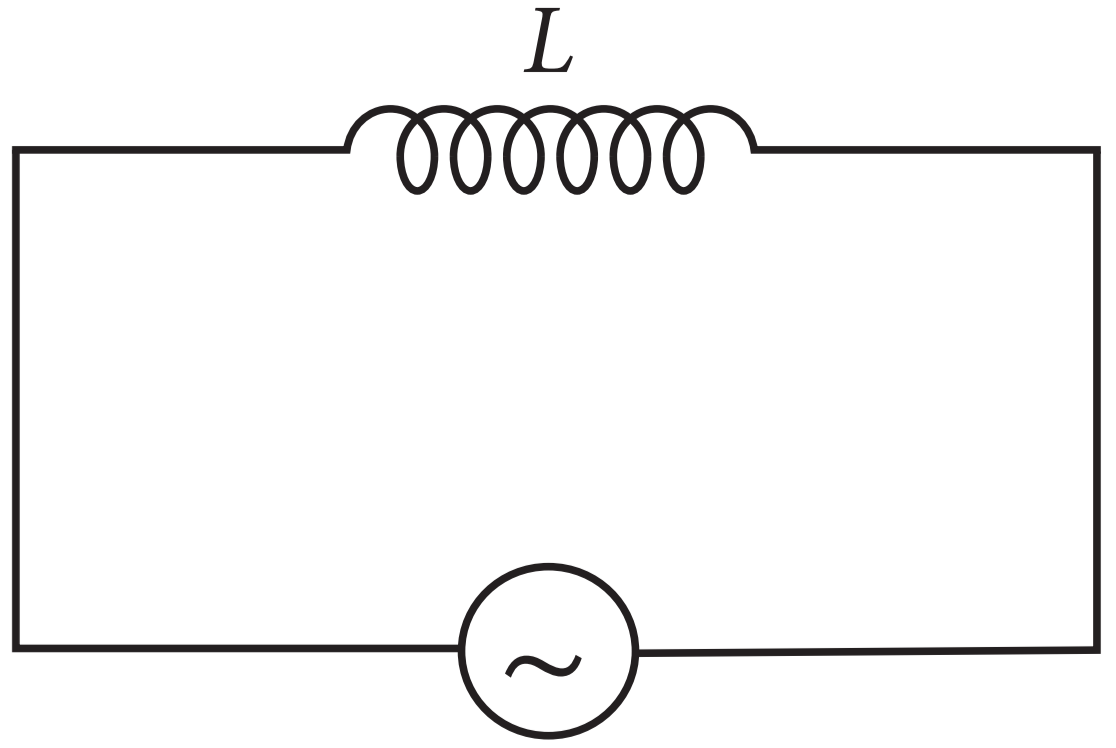
  1. A 100 hertz a.c. is flowing in a 14mH coil. The reactance is:
  1. $15\Omega$
  2. $7.7\Omega$
  3. $8.8\Omega$
  4. $10\Omega$
  1. In a pure inductive circuit, resistance to the flow of current is offered by:
  1. Resistor
  2. Inductor
  3. Capacitor
  4. Resistor and inductor
  1. In a inductive circuit, by what value of phase angle does alternating current lags behind e.m.f.?
  1. 45º
  2. 90º
  3. 120º
  4. 75º
  1. How much inductance should be connected to 200V, 50Hz a.c. supply so that a maximum current of 0.9A flows through it?
  1. 5H
  2. 1H
  3. 10H
  4. 4.5H
  1. The maximum value of current when inductance of 2H is connected to 150V, 50Hz supply is:
  1. 0.337A
  2. 0.721A
  3. 1.521A
  4. 2.522A

Answer

  1. (c) $8.8\Omega$
Explanation:

Inductive reactance,

$\text{X}_\text{L}= \text{W}_\text{L}=2\pi\mu\text{L}$

$=2\pi\times100\times14\times10^{-3}$

$\text{X}_\text{L}=8.8\Omega$
  1. (b) Inductor
  2. (b) 90º
Explanation:

In an inductor vol tag: leads the current by $\frac{\pi}{2}$ or current lags the voltage by $\frac{\pi}{2}.$
  1. (b) 1H
Explanation:

The current in the inductor coil is given by,

$\text{I}_0=\frac{\text{E}_0}{\text{X}_\text{L}}=\frac{\sqrt{2}\text{E}_\text{V}}{2\pi\mu\text{L}}$

$\text{L}=\frac{\sqrt{2}\text{E}_\text{V}}{2\pi\mu\text{I}_0}=\frac{1.414\times200}{2\times3.14\times50\times0.9}=1\text{H}$
  1. (a) 0.337A
Explanation:

Inductive reactance,

$\text{X}_\text{L}= \text{W}_\text{L}=2\pi\mu\text{L}$

$=2\pi\times3.14\times50\times2=628\Omega$

$\text{I}_0=\frac{\text{E}_0}{\text{X}_\text{L}}$

$\Rightarrow\text{I}_0=\frac{\sqrt{2}\times\text{E}_\text{V}}{\text{X}_\text{L}}=\frac{\sqrt{2}\times150}{628}=0.337\text{A}$

Need a full question paper?

Generate a complete, print-ready paper with questions like this in minutes — across 16+ boards, with answer keys.

Start Generating Free

Similar questions

Complete the following table:
Car Model
Driver X
Reaction time 0.20s
Driver Y
Reaction time 0.30s
$A ($deceleration on hard braking $= 6.0m/s^2)$
Speed = 54km/h
Braking distance
a = ...
Total stopping distance
b = ...
Speed = 72km/h
Braking distance
c = ...
Total stopping distance
d = ...
$B ($deceleration on hard braking $= 7.5m/s^2)$
Speed = 54km/h
Breaking distance
e = ...
Total stopping distance
f = ...
Speed 72km/h
Braking distance
g = ...
Total stopping distance
h = ...

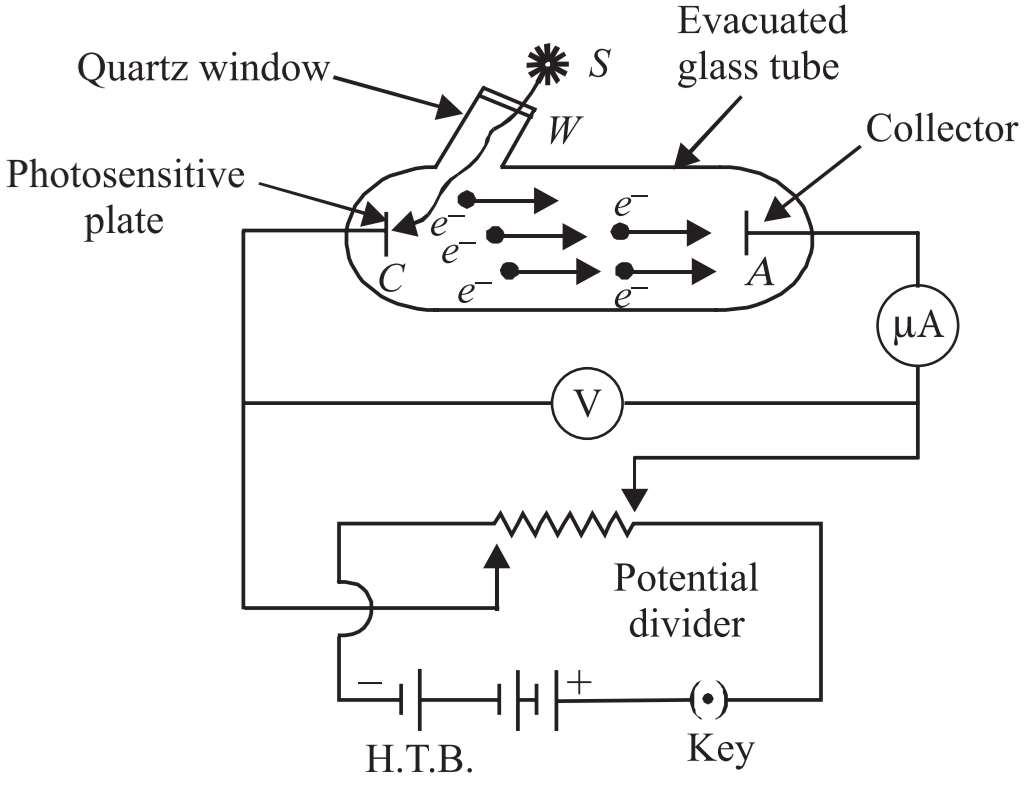
To study photoelectric effect, an emitting electrode C of a photosensitive material is kept at negative potential and collecting electrode A is kept at positive potential in an evacuated tube. When light of sufficiently high frequency falls on emitting electrode, photoelectrons are emitted which travel directly to collecting electrode and hence an electric current called photoelectric current starts flowing in the circuit, which is directly proportional to the number of photoelectrons emitted by emitting electrode C.

While demonstrating the existence of electromagnetic waves, Hertz found that high voltage sparks passed across the metal electrodes of the detector loop more easily when the cathode was illuminated by ultraviolet light from an arc lamp. The ultraviolet light falling on the metal surface caused the emission of negatively charged particles, which are now known to be electrons, into the surrounding space and hence enhanced the high voltage sparks.
  1. Cathode rays were discovered by:
  1. Maxwell Clerk James.
  2. Heinrich Hertz.
  3. William Crookes.
  4. J. J. Thomson.
  1. Cathode rays consists of:
  1. Photons
  2. Electrons
  3. Pistons
  4. $\alpha$-particles
  1. Who discovered the charge on an electron for the frist time?
  1. Millikan
  2. Thomson
  3. Kelvin
  4. Coulomb
  1. The dual nature oflight is exhibited by:
  1. Diffraction and photoelectric effect.
  2. Photoelectric effect.
  3. Refraction and interference.
  4. Diffraction and reflection.
  1. ln the phenomenon of electric discharge through gases at low pressure, the coloured glow in the tube appears as a result of:
  1. Collisions between the charged particles emitted from the cathode and the atoms of the gas.
  2. Collision between different electrons of the atoms of the gas.
  3. Excitation of electrons in the atoms.
  4. Collision between the atoms of the gas.
Suppose in an imaginary world the angular momentum is quantized to be even integral multiples of $\frac{\text{h}}{2\pi}$ What is the longest possible wavelength emitted by hydrogen atoms in visible range in such a world according to Bohr's model?
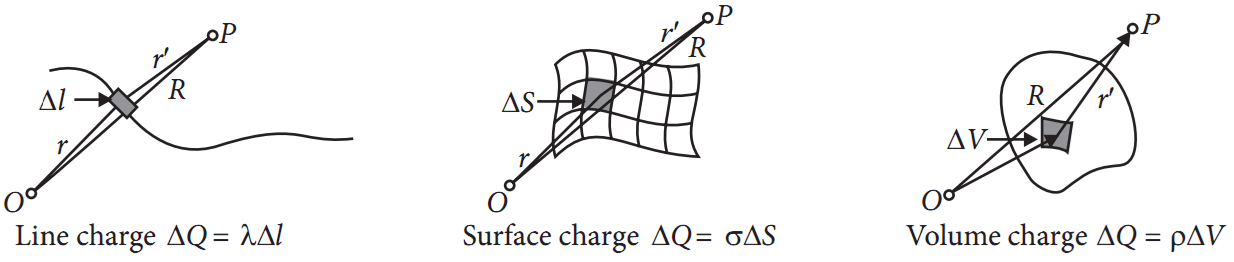
ln practice, we deal with charges much greater in magnitude than the charge on an electron, so we can ignore the quantum nature of charges and imagine that the charge is spread in a region in a continuous manner. Such a charge distribution is known as continuous charge distribution. There are three types of continuous charge distribution : (i) Line charge distribution (ii) Surface charge distribution (iii) Volume charge distribution as shown in figure.
  1. Statement 1: Gauss's law can't be used to calculate an electric field near an electric dipole.
Statement 2: Electric dipole don't have symmetrical charge distribution.
  1. Statement 1 and statement 2 are true.
  2. Statement 1 is false but statement 2 is true.
  3. Statement 1 is true but statement 2 is false.
  4. Both statements are false.
  1. An electric charge of $8.85 \times 10^{-13}C$ is placed at the centre of a sphere of radius 1m. The electric flux through the sphere is:
  1. $0.2NC^{-1} m^2$
  2. $0.1NC^{-1} m^2$
  3. $0.3NC^{-1} m^2$
  4. $0.01NC^{-1} m^2$
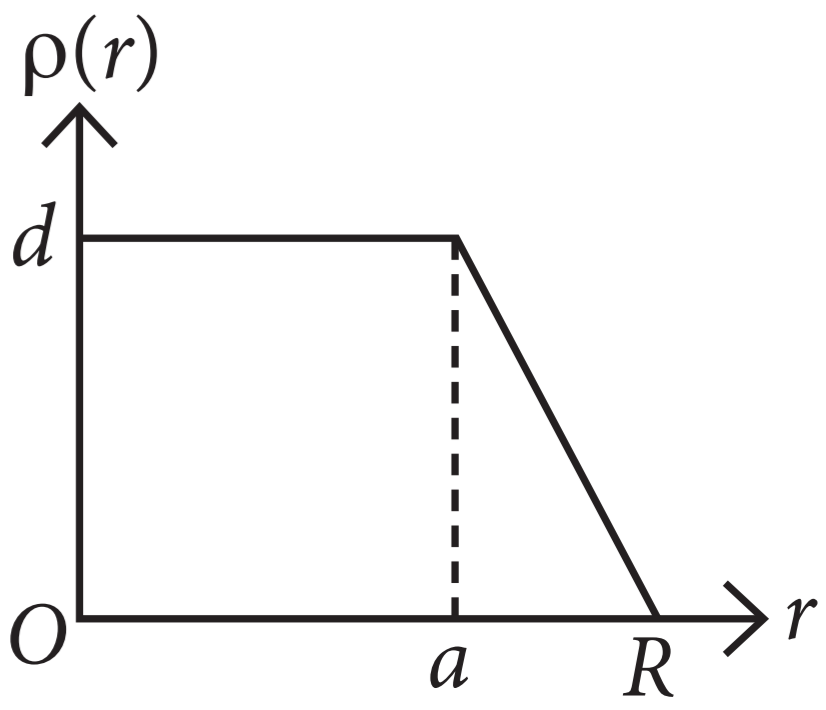
  1. The electric field within the nucleus is generally observed to be linearly dependent on r. So,
  1. a = 0
  2. $\text{a}=\frac{\text{R}}{2}$
  3. a = R
  4. $\text{a}=\frac{\text{2R}}{3}$
  1. What charge would be required to electrify a sphere of radius 25cm so as to get a surface charge density of $\frac{3}{\pi}\text{Cm}^{-2}?$
  1. 0.75C
  2. 7.5C
  3. 75C
  4. Zero
  1. The SI unit of linear charge density is:
  1. Cm
  2. $Cm^{-1}$
  3. $Cm^{-2}$
  4. $Cm^{-3}$
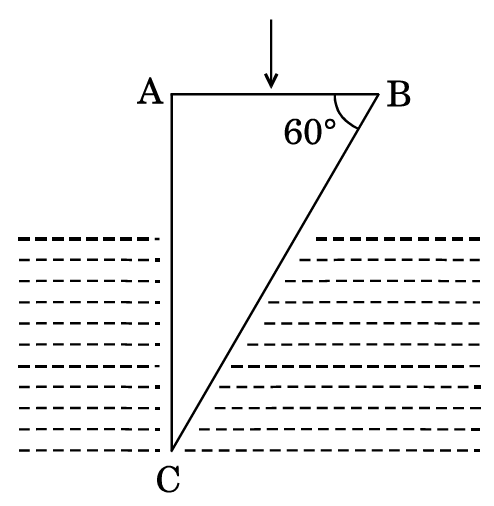
  1. A ray of light is incident normally on the face AB of a right-angled glass prism of refractive index $_{a}\mu_{g} =1.5$The prism is partly immersed in a liquid of unknown refractive index. Find the value of refractive index of the liquid so that the ray grazes along the face BC after refraction through the prism.
  1. Trace the path of the rays if it were incident normally on the face AC.
A police jeep is chasing a culprit going on a motorbike. The motorbike crosses a turning at a speed of 72km/h. The jeep follows it at a speed of 90km/h, crossing the turning ten seconds later than the bike. Assuming that they travel at constant speeds, how far from the turning will the jeep catch up with the bike?
  1. A small compass needle of magnetic moment ‘m’ is free to turn about an axis perpendicular to the direction of uniform magnetic field ‘B’. The moment of inertia of the needle about the axis is ‘I’. The needle is slightly disturbed from its stable position and then released. Prove that it executes simple harmonic motion. Hence deduce the expression for its time period.
  2. A compass needle, free to turn in a vertical plane orients itself with its axis vertical at a certain place on the earth. Find out the values of (i) horizontal component of earth’s magnetic field and (ii) angle of dip at the place.
The moon rotates about the earth in such a way that only one hemisphere of the moon faces the earth. Can we ever see the ''other face'' of the moon from the earth? Can a person on the moon ever see all the faces of the earth?
A silver ball of radius 4.8cm is suspended by a thread in a vacuum chamber. Ultraviolet light of wavelength 200 run is incident on the ball for some time during which a total light energy of $1.0 \times 10^{-7}J$ falls on the surface. Assuming that on the average one photon out of every ten thousand is able to eject a photoelectron, find the electric potential et the surface of the bell assuming zero potential at infinity. What is the potential at the centre of the bell?
A hot body is placed in a closed room maintained at a lower temperature. Is the number of photons in the room increasing?