Question
Suppose in an imaginary world the angular momentum is quantized to be even integral multiples of $\frac{\text{h}}{2\pi}$ What is the longest possible wavelength emitted by hydrogen atoms in visible range in such a world according to Bohr's model?

Answer

Even quantum numbers are allowed,
$\text{n}_1=2,\text{n}_2=4\xrightarrow{\ \ \ }$ For minimum energy or for longest possible wavelength.
$\text{E}=13.6\bigg(\frac{1}{\text{n}^2_1}-\frac{1}{\text{n}^2_2}\bigg)$
$\text{E}=13.6\Big(\frac{1}{2^2}-\frac{1}{4^2}\Big)=2.55$
$2.55=\frac{\text{hc}}{\lambda}$
$\lambda=\frac{\text{hc}}{2.55}=\frac{1242}{2.55}$
$\lambda=487.05\text{nm}=487\text{nm}$

Need a full question paper?

Generate a complete, print-ready paper with questions like this in minutes — across 16+ boards, with answer keys.

Start Generating Free

Similar questions

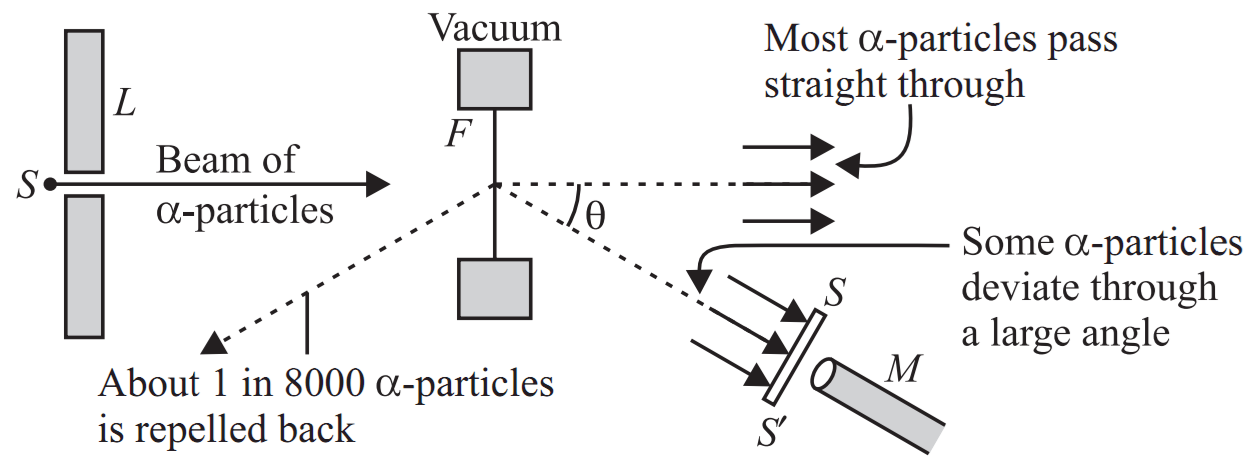
In 1911, Rutherford, along with his assistants, H. Geiger and E. Marsden, performed the alpha particle scattering experiment. H. Geiger and E. Marsden took radioactive source $(^{214}_{83}\text{Bi})$ for $\alpha$- particles. A collimated beam of $\alpha$-particles of energy 5.5 MeV was allowed to fall on $2.1 \times 10^{-7}$ m thick gold foil. The $\alpha$-particles were observed through a rotatable detector consisting of a Zinc sulphide screen and microscope. It was found that CL-particles got scattered. These scattered $\alpha$-particles produced scintillations on the zinc sulphide screen. Observations of this experiment are as follows?
Most of the $\alpha$-particles passed through the foil without deflection.
Only about 0.14% of the incident $\alpha$-particles scattered by more than 1º
Only about one $\alpha$-particle in every 8000 $\alpha$-particles deflected by more than 90º
These observations led to many arguments and conclusions which laid down the structure of the nuclear model of an atom.
  1. Rutherford's atomic model can be visualised as.
  1. Gold foil used in Geiger-Marsden experiment is about $10^{-8}m$ thick. This ensures.
  1. Gold foil's gravitational pull is small or possible.
  2. Gold foil is deflected when $\alpha$-particle stream is not incident centrally over it.
  3. Gold foil provides no resistance to passage of $\alpha$-particles.
  4. Most $\alpha$-particle will not suffer more than 1º scattering during passage through gold foil.
  1. In Geiger-Marsden scattering experiment, the trajectory traced by an $\alpha$-particle depends on.
  1. Number of collision.
  2. Number of scattered $\alpha$- particles.
  3. Impact parameter.
  4. None of these.
  1. In the Geiger-Marsden scattering experiment, in case of head-on collision, the impact parameter should be.
  1. Maximum
  2. Minimum
  3. Infinite
  4. zero
  1. The fact only a small fraction of the number of incident particles rebound back in Rutherford scattering indicates that.
  1. Number of $\alpha$-particles undergoing head-on-collision is small.
  2. Mass of the atom is concentrated in a small volume.
  3. Mass of the atom is concentrated in a large volume.
  4. Both (a) and (b).
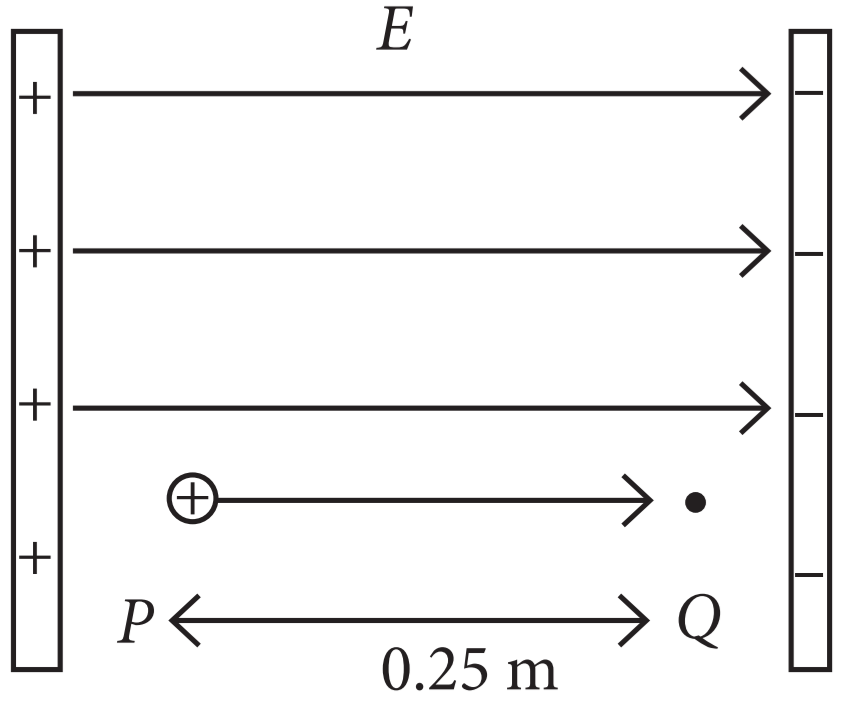
Potential difference $(\triangle\text{V})$ between two points A and B separated by a distance x, in a uniform electric field E is given by $\triangle\text{V}=-\text{Ex},$ where xis measured parallel to the field lines. If a charge $q_0$ moves from P to Q, the change in potential energy $(\triangle\text{U})$ is given as $\triangle\text{U}=-\text{q}_0\triangle\text{V}.$ A proton is released from rest in uniform electric field of magnitude $4.0 \times 10^8Vm^{-1}$ directed along the positive X-axis. The proton undergoes a displacement of 0.25m in the direction of E. Mass of a proton $= 1.66 \times 10^{-27}kg$ and charge of proton $= 1.6 \times 10^{-19}C.$
  1. The change in electric potential of the proton between the points A and B is:
  1. $-1 \times 10^8V$
  2. $1 \times 10^8V$
  3. $6.4 \times 10^{-19}V$
  4. $-6.4 \times 10^{-19}V$
  1. The change in electric potential energy of the proton for displacement from A to B is:
  1. $1.6 \times 10^{11}J$
  2. $0.5 \times 10^{23}J$
  3. $-1.6 \times 10^{-11}J$
  4. $3.2 \times 10^{22}J$
  1. The mutual electrostatic potential energy between two protons which are at a distance of $9 \times 10^{-15}$m, in $_{92}U^{235}$ nucleus is:
  1. $1.56 \times 10^{-14}J$
  2. $5.5 \times 10^{-14}J$
  3. $2.56 \times 10^{-14}J$
  4. $4.56 \times 10^{-14}J$
  1. If a system consistsoftwocharges 4mC and -3mC with no external field placed at (-5cm, 0, 0) and (5cm, 0, 0) respectively. The amount of work required to separate the two charges infinitely away from each other is:
  1. -1.1J
  2. 2J
  3. 2.5J
  4. 3J
  1. As the proton moves from P to Q, then:
  1. The potential energy of proton decreases.
  2. The potential energy of proton increases.
  3. The proton loses kinetic energy.
  4. Total energy of the proton increases.
A magnetic field set up using Helmholtz coils (described in Exercise 4.16) is uniform in a small region and has a magnitude of 0.75 T. In the same region, a uniform electrostatic field is maintained in a direction normal to the common axis of the coils. A narrow beam of (single species) charged particles all accelerated through 15 kV enters this region in a direction perpendicular to both the axis of the coils and the electrostatic field. If the beam remains undeflected when the electrostatic field is $9.0 \times 10^{–5} V m^{–1},$ make a simple guess as to what the beam contains. Why is the answer not unique?
If an automobile engine is overheated, it is cooled by putting water on it. It is advised that the water should be put slowly with engine running. Explain the reason.
After a good meal at a party you wash your hands and find that you have forgotten to bring your handkerchief. You shake your hands vigorously to remove the water as much as you can. Why is water removed in this process?
ln Young's double slit experiment, the width of the central bright fringe is equal to the distance between the first dark fringes on the two sides of the central bright fringe.
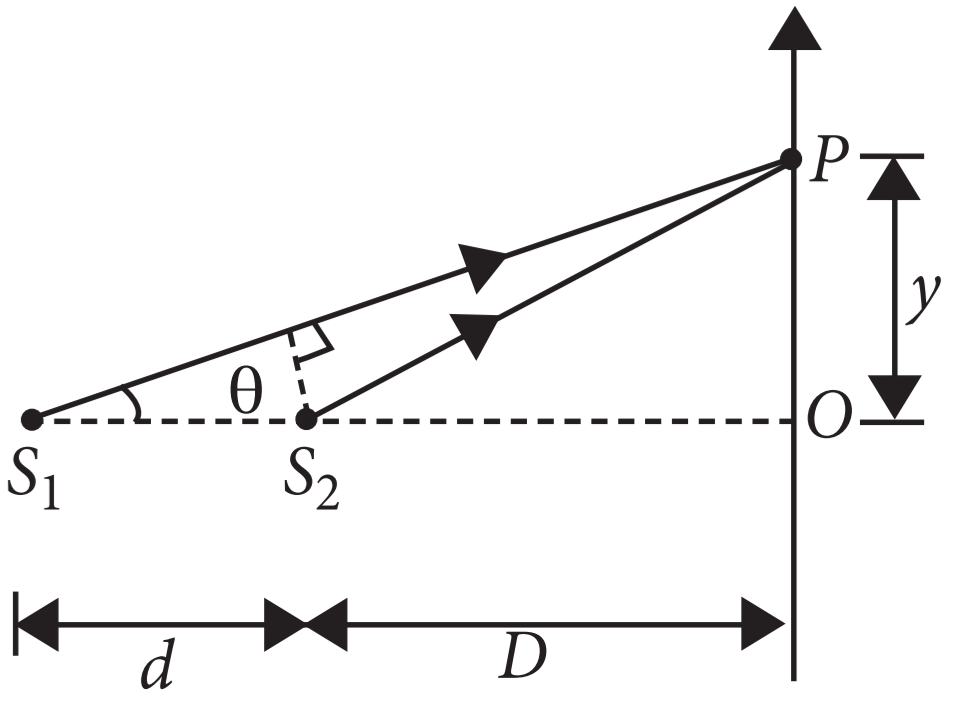
ln given figure below a screen is placed normal to the tine joining the two point coherent source $S_1$ and $S_2.$ The interference pattern consists of concentric circles.
  1. The optical path difference at P is:
  1. $\text{d}\Big[1+\frac{\text{y}^2}{2\text{D}}\Big]$
  2. $\text{d}\Big[1+\frac{2\text{D}}{\text{y}^2}\Big]$
  3. $\text{d}\Big[1-\frac{\text{y}^2}{2\text{D}^2}\Big]$
  4. $\text{d}\Big[2\text{D}-\frac{1}{\text{y}^2}\Big]$
  1. Find the radius of the $n^{th}$ bright fringe.
  1. $\text{D}\sqrt{1\Big(1-\frac{\text{n}\lambda}{\text{d}}\Big)}$
  2. $\text{D}\sqrt{2\Big(1-\frac{\text{n}\lambda}{\text{d}}\Big)}$
  3. $2\text{D}\sqrt{2\Big(1-\frac{\text{n}\lambda}{\text{d}}\Big)}$
  4. $\text{D}\sqrt{2\Big(1-\frac{\text{n}\lambda}{2\text{d}}\Big)}$
  1. If $\text{d}=0.5\text{mm}.\lambda=5000\mathring{\text{A}}$ and D = 100cm, find the value of n for the closest second bright fringe.
  1. $888$
  2. $830$
  3. $914$
  4. $998$
  1. The coherence of two light sources means that the light waves emitted have.
  1. Same frequency.
  2. Same intensity.
  3. Constant phase difference.
  4. Same velocity.
  1. The phenomenon of interference is shown by:
  1. Longitudinal mechanical waves only.
  2. Transverse mechanical waves only.
  3. Electromagnetic waves only.
  4. All of these.
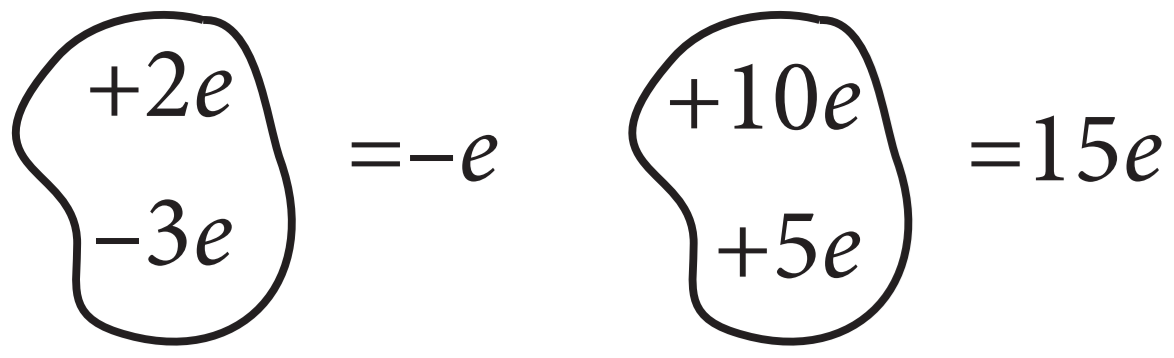
Smallest charge that can exist in nature is the charge of an electron. During friction, it is only the transfer of electrons which makes the body charged. Hence, net charge on any body is an integral multiple of charge of an electron$ [1.6 x 10^{-19}C]$ i.e. q = ± ne Where $n = 1, 2, 3, 4,....$

Hence, no body can have a charge represented as 1.1 e, 2. 7e, $\frac{3}{5}\text{e,}$ etc. Recently, it has been discovered that elementary particles such as protons or neutrons are composed of more elemental units called quarks.
  1. Which of the following properties is not satisfied by an electric charge?
  1. Total charge conservation.
  2. Quantization of charge.
  3. Two types of charge.
  4. Circular line of force.
  1. Which one of the following charges is possible?
  1. $5.8 \times 10^{-18}C$
  2. $3.2 \times 10^{-18}C$
  3. $4.5 \times 10^{-19}C$
  4. $8.6 \times 10^{-18}C$
  1. If a charge on a body is 1nC, then how many electrons are present on the body?
  1. $6.25 \times 10^{27}$
  2. $1.16 \times 10^{19}$
  3. $6.25 \times 10^{28}$
  4. $6.25 \times 10^9$
  1. If a body gives out $10^9$ electrons every second, how much time is required to get a total charge of 1C from it?
  1. 190.19 years
  2. 150.12 years
  3. 198.19 years
  4. 188.21 years
  1. A polythene piece rubbed with wool is found to have a negative charge of $3.2 \times 10^{-7}\ C$. Calculate the number of electrons transferred.
  1. $2 \times 10^{12}$
  2. $3 \times 10^{12}$
  3. $2 \times 10^{14}$
  4. $3 \times 10^{14}$
If a mosquito is dipped into water and released, it is not able to fly till it is dry again. Explain.
A person's skin is more severely burnt when put in contact with 1g of steam at 100°C than when put in contact with 1g of water at 100°C. Explain.
In an electromagnetic wave both the electric and magnetic fields are perpendicular to the direction of propagation, that is why electromagnetic waves are transverse in nature. Electromagnetic waves carry energy as they travel through space and this energy is shared equally by the electric and magnetic fields. Energy density of an electromagnetic waves is the energy in unit volume of the space through which the wave travels.
(i) The electromagnetic waves propagated perpendicular to both $\vec{E}$ and $\vec{B}$. The electromagnetic waves travel in the direction of
(a) $\vec{E} \cdot \vec{B}$
(b) $\vec{B} \cdot \vec{E}$
(c) $\vec{E} \times \vec{B}$
(d) $\vec{B} \times \vec{E}$

(ii) Fundamental particle in an electromagnetic wave is
(a) photon (b) phonon (c) electron (d) proton

(iii) Electromagnetic waves are transverse in nature is evident by
(a) diffraction (b) interference (c) polarisation (d) reflection

OR

The electric and magnetic fields of an electromagnetic waves are
(a) in opposite phase and parallel to each other
(b) in phase and parallel to each other.
(c) in phase and perpendicular to each other
(d) in opposite phase and perpendicular to each other

(iv) d) in opposite phase and perpendicular to each other
(a) frequency (b) wavelength (c) velocity (d) all these depend on each other