MCQ
Let $\mathrm{f}: R \rightarrow R$ be function defined as

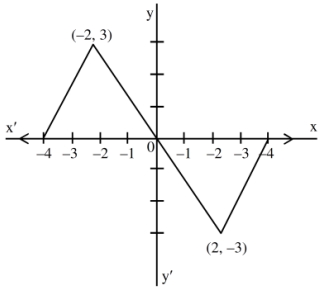
$f ( x )=\left\{\begin{array}{cc}3\left(1-\frac{| x |}{2}\right) & \text { if }| x | \leq 2 \text { } \\ 0 & \text { if }| x |>2 \text { }\end{array}\right.$ Let $g: R \rightarrow R$ be given by $g(x)=f(x+2)-f(x-2)$. If $n$ and $m$ denote the number of points in $R$ where $\mathrm{g}$ is not continuous and not differentiable, respectively, then $\mathrm{n}+\mathrm{m}$ is equal to $....$

  • $4$
  • B
    $3$
  • C
    $2$
  • D
    $1$

Answer

Correct option: A.
$4$
a
$f(x-2)\rightarrow =\frac{3 x}{2} \quad\quad -4 \leq x \leq-2$

$\quad \quad \quad \quad \quad \quad -\frac{3 x}{2} \quad -2\,$

$\quad \quad \quad \quad \quad \quad 0 \quad \quad \quad x \in(-\infty,-4) \cup(0,+\infty)$

$f(x+2)\rightarrow\frac{3 x}{2}+6 \quad \quad 0 \leq x \leq 2$

$\quad \quad \quad \quad \quad -\frac{3 x}{2}+6 \quad 2\,<\,x \leq 4$

$\quad \quad \quad \quad \quad 0 \quad \quad \quad \quad x \in(-\infty, 0) \cup(4,+\infty)$

$g(x)=f(x+2)-f(x-2) \rightarrow\frac{3 x}{2}+6 \quad -4 \leq x \leq-2$

$\quad \quad \quad \quad \quad \quad \quad \quad \quad \quad \quad \quad \quad -\frac{3 x}{2} \quad \quad -2\, < \,x\, < \,2$

$\quad \quad \quad \quad \quad \quad \quad \quad \quad \quad \quad \quad \quad \quad \frac{3 x}{2}-6\quad \quad 2 \leq x \leq 4$

$\quad \quad \quad \quad \quad \quad \quad \quad \quad \quad \quad \quad \quad 0 \quad \quad \quad \quad x \in(-\infty,-4) \cup(4,+\infty)$

$n=0$

$m=4 \Rightarrow(n+m=4)$

Need a full question paper?

Generate a complete, print-ready paper with questions like this in minutes — across 16+ boards, with answer keys.

Start Generating Free

Similar questions

The probability distribution of a discrete random variable $X$ is given below :
$X$0123
$P(X)$$\frac{4}{k}$$\frac{6}{k}$$\frac{4}{k}$$\frac{2}{k}$
The value of $k$ is
If the position vectors of two point $ P $ and $Q $ are respectively $9i - j + 5k$ and $i + 3j + 5k$, and the line segment $PQ$  intersects the $ YOZ$  plane at a point $ R,$  the $PR : RQ$ is equal to
If $a = - 3i + 7j + 5k,$ $b = - 3i + 7j - 3k$, $c = 7i - 5j - 3k$ are the three coterminous edges of a parallelopiped, then its volume is
$\left| {\,\begin{array}{*{20}{c}}5&3&{ - 1}\\{ - 7}&x&{ - 3}\\9&6&{ - 2}\end{array}\,} \right| = 0$, then $ x$ is equal to
Let $y=y(x)$ be a solution curve of the differential equation, $\left(1-x^2 y^2\right) d x=y d x+x d y$.If the line $x =1$ intersects the curve $y = y ( x )$ at $y =2$ and the line $x =2$ intersects the curve $y=y(x)$ at $y=\alpha$, then a value of $\alpha$ is
$\int\text{x}^{\sin\text{x}}\Big(\frac{\sin\text{x}}{\text{x}}+\cos\text{x}\cdot\log\text{x}\Big)\text{dx}$ is equal to:
  1. $\text{x}^{\sin\text{x}}+\text{C}$
  2. $\text{x}^{\sin\text{x}}\cos\text{x}+\text{C}$
  3. $\frac{(\text{x}^{\sin\text{x}})^2}{2}+\text{C}$
  4. None of these.
$\int_0^{2\pi } {\frac{{\sin 2\theta }}{{a - b\,\cos \theta }}\,d\theta = } $
Solve system of linear equations, using matrix method. $x-y+z=4$ ; $2 x+y-3 z=0$ ; $x+y+z=2$
If the resultant of two forces is of magnitude  $ P$  and equal to one of them and perpendicular to it, then the other force is
A differential equation representing the family of parabolas with axis parallel to $\mathrm{y}$-axis and whose length of latus rectum is the distance of the point $(2,-3)$ form the line $3 x+4 y=5$, is given by :