MCQ
Let $\mathrm{f}:(0, \infty) \rightarrow \mathbf{R}$ be a function which is differentiable at all points of its domain and satisfies the condition $x^{2} f^{\prime}(x)=2 x f(x)+3$, with $f(1)=4$. Then $2 f(2)$ is equal to:
  • A
    29
  • B
    19
  • 39
  • D
    23

Answer

Correct option: C.
39
(C)
Sol. $x^{2} f^{\prime}(x)-2 x f(x)=3$
$\left(\frac{x^{2} f^{\prime}(x)-2 x f(x)}{\left(x^{2}\right)^{2}}\right)=\frac{3}{\left(x^{2}\right)^{2}}$
$\Rightarrow \frac{\mathrm{d}}{\mathrm{dx}}\left(\frac{\mathrm{f}(\mathrm{x})}{\mathrm{x}^{2}}\right)=\frac{3}{\mathrm{x}^{4}}$
Integrating both sides
$\frac{f(x)}{x^{2}}=-\frac{1}{x^{3}}+C$
$f(x)=-\frac{1}{x}+C x^{2}$
put $\mathrm{x}=1$
$4=-1+C \Rightarrow C=5$
$f(x)=-\frac{1}{x}+5 x^{2}$
Now $2 \times f(2)=2 \times\left[-\frac{1}{2}+5 \times 2^{2}\right]$
$=39$

Need a full question paper?

Generate a complete, print-ready paper with questions like this in minutes — across 16+ boards, with answer keys.
Start Generating Free

Similar questions

Let $\mathrm{C}$ be a circle with radius $\sqrt{10}$ units and centre at the origin. Let the line $x+y=2$ intersects the circle $\mathrm{C}$ at the points $\mathrm{P}$ and $\mathrm{Q}$. Let $\mathrm{MN}$ be a chord of $C$ of length $2$ unit and slope $-1$ . Then, a distance (in units) between the chord $PQ$ and the chord $MN$ is
Let $(1+2 x)^{20}=a_0+a_1 x+a_2 x^2+\ldots+a_{20} x^{20}$.Then $3 a_0+2 a_1+3 a_2+2 a_3+3 a_4+2 a_5+\ldots+2 a_{19}+3 a_{20}$ equals
If $z, iz$ and $z + iz$ are the vertices of a triangle whose area is $2$ units, then the value of $|z|$ is
The differential coefficient of ${a^x} + \log x.\sin x$ is
The lines $ax + by + c = 0$, where $3a + 2b + 4c = 0$ are concurrent at the point
The vector $\vec{a}=-\hat{i}+2 \hat{j}+\hat{k}$ is rotated through a right angle, passing through the $y$-axis in its way and the resulting vector is $\vec{b}$. Then the projection of $3 \vec{a}+\sqrt{2} \vec{b}$ on $\vec{c}=5 \hat{i}+4 \hat{j}+3 \hat{k}$ is
Let $f:R \to R$ be a continuously differentiable function such that $f\left( 2 \right) = 6$ and $f'\left( 2 \right) = \frac{1}{{48}}$. If $\int_6^{f\left( x \right)} {4{t^3}} \,dt = \left( {x - 2} \right)\,g\left( x \right)$, then $\mathop {\lim }\limits_{x \to 2} \,g\left( x \right)$ is equal to
$\lim _{x \rightarrow \frac{\pi}{4}} \frac{\int_2^{\sec ^2 x} f(t) d t}{x^2-\frac{\pi^2}{16}}$ equals
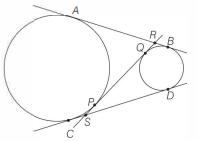
Suppose $S_1$ and $S_2$ are two unequal circles, $A B$ and $C D$ are the direct common tangents to these circles. A transverse common tangent $P Q$ cuts $A B$ in $R$ and $C D$ in $S$. If $A B=10$, then $R S$ is
$\mathop {\lim }\limits_{n \to \infty } n\cos \left( {\frac{\pi }{{4n}}} \right)\sin \left( {\frac{\pi }{{4n}}} \right) = k$, then $k$ is equal to