Question
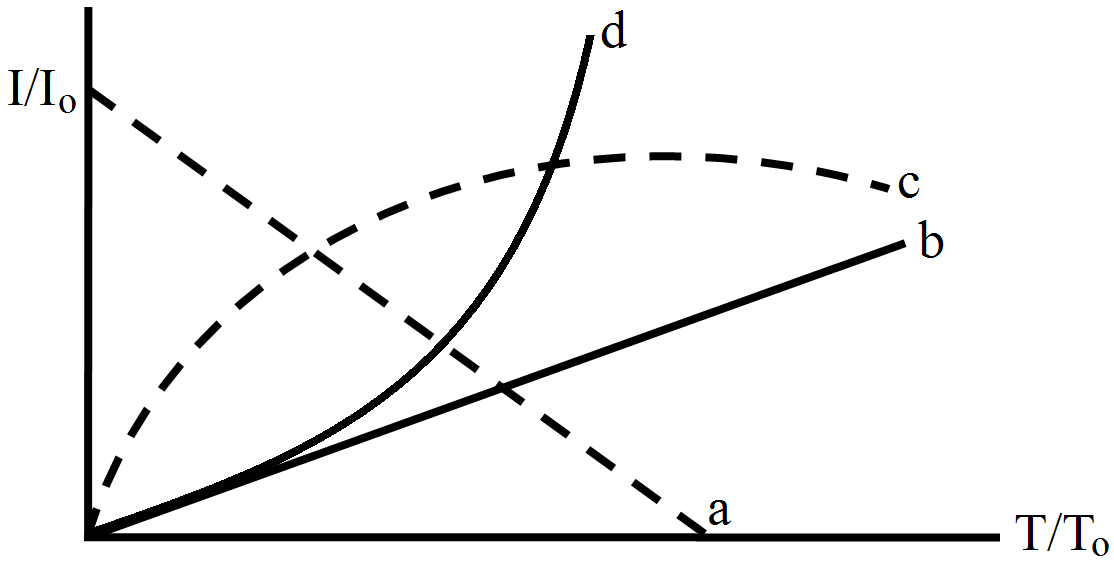
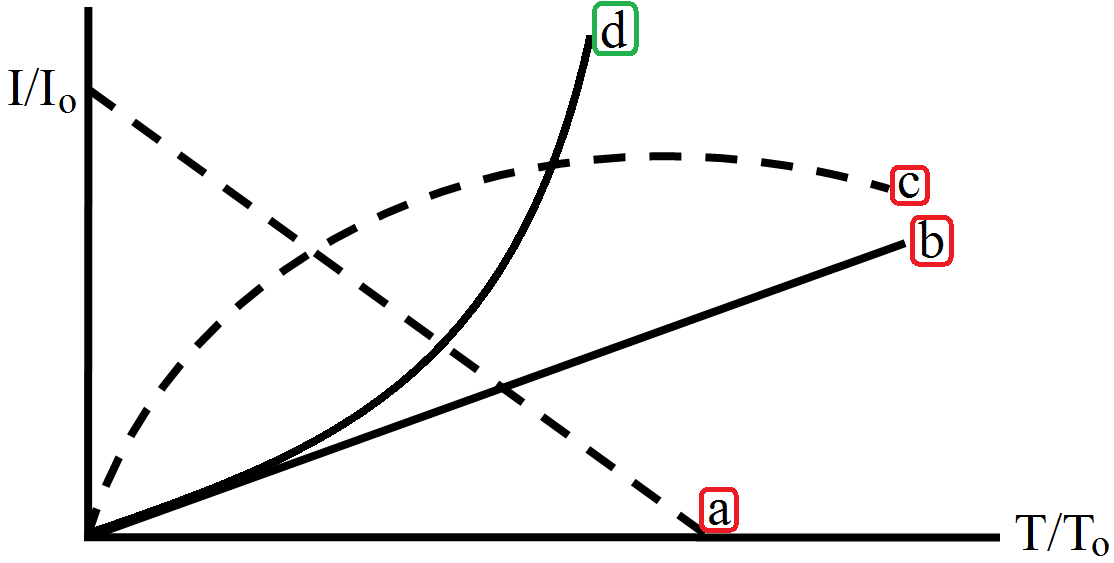
Let $\text{i}_0$ be the thermionic current from a metal surface when the absolute temperature of the surface is $\text{T}_0$. The temperature is slowly increased and the thermionic current is measured as a function of temperature. Which of the following plots may represent the variation in $\Big(\frac{\text{i}}{\text{i}_0}\Big)$ against $\Big(\frac{\text{T}}{\text{T}_0}\Big)?$
Answer

  1.  

Explanation:
Since the thermionic current is directly proportional to the square of the temperature of the surface emitting thermions, the graph is parabolic.

Need a full question paper?

Generate a complete, print-ready paper with questions like this in minutes — across 16+ boards, with answer keys.

Start Generating Free

Similar questions

A small coin is placed on a record rotating at $33\frac{1}{3}$ rev/ minute. The coin does not slip on the record. Where does it get the required centripetal force from?
If the earth's magnetic field has a magnitude $3.4 \times 10^{-5} T$ at the magnetic equator of the earth what would be its value at the earth's geomagnetic poles?
In motor vehicles, a convex mirror is attached near the driver's seat to give him the view of the traffic behind. What is the special function of this convex mirror which a plane mirror can not do?
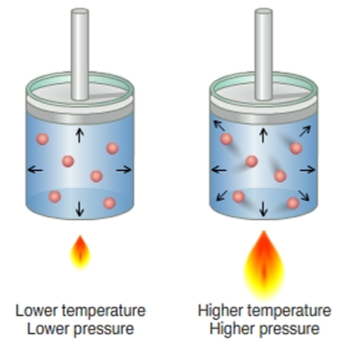
In a gas the particles are always in a state of random motion, all the particles move at different speed constantly colliding and changing their speed and direction, as speed increases it will result in an increase in its kinetic energy.
Image
1. If the temperature of the gas increases from 300 K to 600 K then the average kinetic energy becomes:
(a) same    (b) becomes double    (c) becomes half    (d) become triple
2. What is the average velocity of the molecules of an ideal gas?
(a) Infinite    (b) Same    (c) Increase    (d) Zero
3. Cooking gas containers are kept in a lorry moving with uniform speed. The temperature of the gas molecules inside will ___________.
(a) decrease    (b) Rises    (c) increase    (d) remains same
4. Find the ratio of average kinetic energy per molecule of Oxygen and Hydrogen:
(a) $1: 1$    (b) $4: 1$    (c) $1: 2$    (d) $1: 4$
OR
The velocities of the three molecules are $3 v , 4 v$, and 5 v . calculate their root mean square velocity?
(a) 4.0 v   (b) 4.02 v    (c) 4.08 v    (d) 4.04 v
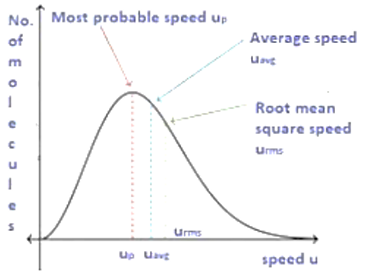
Root mean square velocity (RMS value)is the square root of the mean of squares of the velocity of individual gas molecules and the Average velocity is the arithmetic mean of the velocities of different molecules of a gas at a given temperature.
Image
1. Moon has no atmosphere because:
(a) the escape velocity of the moon’s surface is more than the r.m.s velocity of all molecules
(b) it is far away from the surface of the earth
(c) the r.m.s. velocity of all the gas molecules is more than the escape velocity of the moon’s surface
(d) its surface temperature is $10^{\circ} C$
2. For an ideal gas, $\frac{C_P}{C_V}$ is
(a) $\leq 1$    (b) none of these    (c) $>1$    (d) $<1$
3. The root means square velocity of hydrogen is $\sqrt{5}$ times that of nitrogen. If $T$ is the temperature of the gas then:
(a) $T\left(H_2\right)=T\left(N_2\right)$    (b) $T \left( H _2\right)< T \left( N _2\right)$
(c) $T \left( H _2\right) \neq T \left( N _2\right)$    (d) $T \left( H _2\right)> T \left( N _2\right)$
4. Suppose the temperature of the gas is tripled and $N _2$ molecules dissociate into an atom. Then what will be the rms speed of atom:
(a) $v_0 \sqrt{2}$    (b) $v_0 \sqrt{6}$    (c) $v_0 \sqrt{3}$    (d) $v_0$
OR
The velocities of the molecules are $v , 2 v , 3 v , 4 v \& 5 v$. The RMS speed will be:
(a) 11 v    (b) $v (12)^{11}$   (c) v    (d) $v (11)^{12}$
A ladder is resting with one end on a vertical wall and the other end on a horizontal floor. Is it more likely to slip when a man stands near the bottom or near the top?
Read the passage given below and answer the following questions from $i$ to $v.$ When an object follows a circular path at a constant speed, the motion of the object is called uniform circular motion. The word “uniform” refers to the speed, which is uniform (constant) throughout the motion. Suppose an object is moving with uniform speed $v$ in a circle of radius $R$ Since the velocity of the object is changing continuously in direction, the object undergoes acceleration. Let us find the magnitude and the direction of this acceleration. Thus, the acceleration of an object moving with speed v in a circle of radius $R$ has a magnitude $V^2/R$ and is always directed towards the centre. This is why this acceleration is called centripetal acceleration (a term proposed by Newton). A thorough analysis of centripetal acceleration was first published in $1673$ by the Dutch scientist Christiaan Huygens $(1629-1695)$ but it was probably known to Newton also some years earlier. “Centripetal” comes from a Greek term which means ‘centre-seeking’. Since $v$ and $R$ are constant, the magnitude of the centripetal acceleration is also constant. However, the direction changes pointing always towards the centre. Therefore, a centripetal acceleration is not a constant vector. We can express centripetal acceleration ac in terms of angular speed as $\text{a}_\text{c}=\omega^2\text{R}$ The time taken by an object to make one revolution is known as its time period T and the number of revolution made in one second is called its frequency $v (=1/T).$ However, during this time the distance moved by the object is $\text{s}=2\pi\text{R}.$ Therefore, $\text{v}=2\pi\frac{\text{R}}{\text{T}}=2\pi\text{ Rv}$ In terms of frequency n, we have $\omega=2\pi\text{v}$
$\text{V}=2\pi\text{ RV}$
$\text{ac}=4\pi^2\text{v}^2\text{R}$
  1. SI unit of angular velocity is
  1. Rev/ sec
  2. $m/ s$
  3. $m/ s^2$ 
  4. None of these
  1. A centripetal acceleration is not a constant vector. True or false?
  1. True
  2. False
  1. Define Uniform circular motion
  2. What is meaning of word centripetal?
  3. What is centripetal acceleration? Give its relation with angular velocity
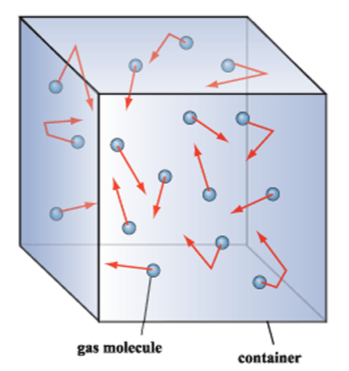
Gas molecules move in random motion inside the container. The pressure exerted by the gas is due to the continuous collision of the molecules against the walls of the container. Due to this continuous collision, the walls experience a continuous force which is equal to the total momentum imparted to the walls per second.
Image
1. If the mass of each molecule is halved and speed is doubled, find the ratio of initial and final pressure:
(a) $1: 16$ (b) $1: 4$ (c) $1: 8$ (d) $1: 2$
2. The pressure exerted by the gases is:
(a) inversely proportional to the density
(b) inversely proportional to the square of the density
(c) directly proportional to the density
(d) directly proportional to the square of the density
3. If the force of attraction between the molecules suddenly disappears, then what will be the change in pressure:
(a) pressure increase
(b) pressure decrease
(c) pressure remains constant
(d) pressure falls
4. If the pressure of a given gas is halved at a certain temperature. what will be its volume:
(a) becomes triple (b) becomes double (c) remains constant (d) becomes half
OR
Dimension formula for R ?
(a) $M ^1 L^2 T^2 K^{-1}$ (b) $M ^1 L^1 T^{-1}$
(c) $M ^{-1} L^0 T^1$ (d) $M ^1 L^2 T^{-2} K^{-1}$
No part of India is situated on the equator. Is it possible to have a geostationary satellite which always remains over New Delhi?
Read the passage given below and answer the following questions from 1 to 5. First Law of Thermodynamics The first law of thermodynamics is the general law of conservation of energy applied to any system in which energy transfer from or to the surroundings (through heat and work) is taken into account. It states that the energy supplied to the system goes in partly to increase the internal energy of the system and the rest in work on the environment. Mathematically, $\triangle\text{Q}=\triangle\text{U}+\triangle\text{W}$ where $\triangle\text{Q}$ is the heat supplied to the system, $\triangle\text{W}$ is the work done by the system and $\triangle\text{U}$ is the change in internal energy of the system. $\triangle\text{Q}$ and $\triangle\text{W}$ depend on the path taken to go from initial to final states, but the combination $\triangle\text{Q}​​-​​\triangle\text{W}$ is path independent.
  1. The first law of thermodynamics is concerned with conservation of:
  1. Number of molecules
  2. Number of moles
  3. Energy
  4. Temperature
  1. Which of the following is not a path function?
  1. $\triangle\text{Q}$
  2. $\triangle\text{Q}​​+\triangle\text{W}$
  3. $\triangle\text{W}$
  4. $\triangle\text{Q}​​-​​\triangle\text{W}$
  1. An electric heater supplies heat to a system at a rate of 120W. If system performs work at a rate of $80 J s^{-1}$, the rate of increase in internal energy is:
  1. $30 J s^{-1}$
  2. $40 J s^{-1}$
  3. $50 J s^{-1}$
  4. $60 J s^{-1}$
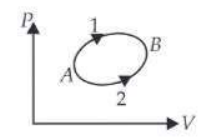
  1. Asystem goes from A to B by two different paths in the P - V diagram as shown in figure. Heat given to the system in path 1 is 1100 J, the work done by the system along path 1 is more than path 2 by 150 J. The heat exchanged by the system in path 2 is:
  1. 800 J
  2. 750 J
  3. 1050 J
  4. 950 J
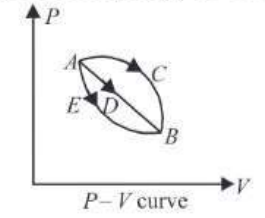
  1. A certain mass of gas is carried from A to B, along three paths via ACB, ADB and AEB. Which one of the following is correct?
  1. Work done via path ACB is minimum.
  2. Work done via path ADB is maximum.
  3. Work done via path ACB is maximum.
  4. Work done via path AEB is maximum.