Question
Gas molecules move in random motion inside the container. The pressure exerted by the gas is due to the continuous collision of the molecules against the walls of the container. Due to this continuous collision, the walls experience a continuous force which is equal to the total momentum imparted to the walls per second.
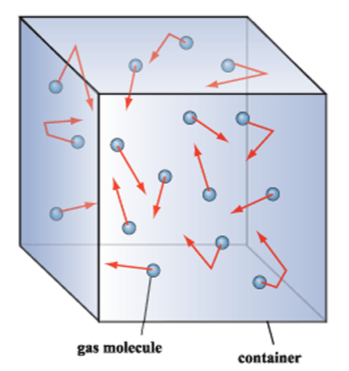
Image
1. If the mass of each molecule is halved and speed is doubled, find the ratio of initial and final pressure:
(a) $1: 16$ (b) $1: 4$ (c) $1: 8$ (d) $1: 2$
2. The pressure exerted by the gases is:
(a) inversely proportional to the density
(b) inversely proportional to the square of the density
(c) directly proportional to the density
(d) directly proportional to the square of the density
3. If the force of attraction between the molecules suddenly disappears, then what will be the change in pressure:
(a) pressure increase
(b) pressure decrease
(c) pressure remains constant
(d) pressure falls
4. If the pressure of a given gas is halved at a certain temperature. what will be its volume:
(a) becomes triple (b) becomes double (c) remains constant (d) becomes half
OR
Dimension formula for R ?
(a) $M ^1 L^2 T^2 K^{-1}$ (b) $M ^1 L^1 T^{-1}$
(c) $M ^{-1} L^0 T^1$ (d) $M ^1 L^2 T^{-2} K^{-1}$
Answer

1. (d) $1: 2$
Explanation: 1:2
2. (c) directly proportional to the density
Explanation: directly proportional to the density
3. (a) pressure increase
Explanation: pressure increase
4. (b) becomes double
Explanation: becomes double
OR
(d) $M ^1 L^2 T^{-2} K^{-1}$
Explanation: $M ^1 L^2 T^{-2} K^{-1}$

Need a full question paper?

Generate a complete, print-ready paper with questions like this in minutes — across 16+ boards, with answer keys.

Start Generating Free

Similar questions

An elevator is descending with uniform acceleration. To measure the acceleration, a person in the elevator drops a coin at the moment the elevator starts. The coin is 6ft above the floor of the elevator at the time it is dropped. The person observes that the coin strikes the floor in 1 second. Calculate from these data the acceleration of the elevator.
A plumb bob is hung from the ceiling of a train compartment. If the train moves with an acceleration 'a' along a straight horizontal track, the string supporting the bob makes an angle $\tan^{-1}\Big(\frac{\text{a}}{\text{g}}\Big)$ with the normal to the ceiling. Suppose the train moves on an inclined straight track with uniform velocity. If the angle of incline is $\tan^{-1}\Big(\frac{\text{a}}{\text{g}}\Big),$ the string again makes the same angle with the normal to the ceiling. Can a person sitting inside the compartment tell by looking at the plumb line whether the train is accelerated on a horizontal straight track or it is going on an incline? If yes, how? If no, suggest a method to do so.
The half-life of ${ }^{226} \mathrm{Ra}$ is 1602 y . Calculate the activity of 0.1 g of $\mathrm{RaCl}_2$ in which all the radium is in the form of ${ }^{226} \mathrm{Ra}$. Taken atomic weight of Ra to be $226 \mathrm{~g} / \mathrm{mol}^{-1}$ and that of Cl to be $35.5 \mathrm{~g} / \mathrm{mol}^{-1}$.
Read the passage given below and answer the following questions from 1 to 5. When a body is subjected to a deforming force, a restoring force is developed in the body. This restoring force is equal in magnitude but opposite in direction to the applied force. The restoring force per unit area is known as stress. If F is the force applied normal to the cross–section and A is the area of cross section of the body. Magnitude of the stress $=\frac{\text{F}}{\text{A}}$ The SI unit of stress is $N-m^{-2}$ or Pascal (Pa) and its dimensional formula is $[ML^{-1} T^{-2}]$. The restoring force per unit area in this case is called tensile stress. If the cylinder is compressed under the action of applied forces, the restoring force per unit area is known as compressive stress. Tensile or compressive stress can also be termed as longitudinal stress. In both the cases, there is a change in the length of the cylinder. The change in the length ΔL to the original length L of the body is known as longitudinal strain. The restoring force per unit area developed due to the applied tangential force is known as tangential or shearing stress.
  1. Restoring force per unit area is called as:
  1. Stress
  2. Strain
  3. Modulus of elasticity
  4. None of these
  1. Ratio of change in dimension to original dimension is called:
  1. Stress
  2. Strain
  3. Modulus of elasticity
  4. None of these
  1. Define shear stress.
  1. Define stress. Give its SI unit and dimension.
  1. Define strain. Give its SI unit and dimension
Read the passage given below and answer the following questions from 1 to 5. Work
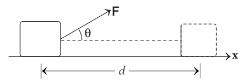
A farmer ploughing the field, a construction worker carrying bricks, a student studying for a competitive examination, an artist painting a beautiful landscape, all are said to be working. In physics, however, the word ‘Work’ covers a definite and precise meaning. Work refers to the force and the displacement over which it acts. Consider a constant force F acting on an object of mass m. The object undergoes a displacement d in the positive x-direction as shown in figure.

 The work done by the force is defined to be the product of component of the force in the direction of the displacement and the magnitude of this displacement, thus
$\text{W}=(\text{F}\cos\theta) \text{ D}=\text{F}.\text{D}.$
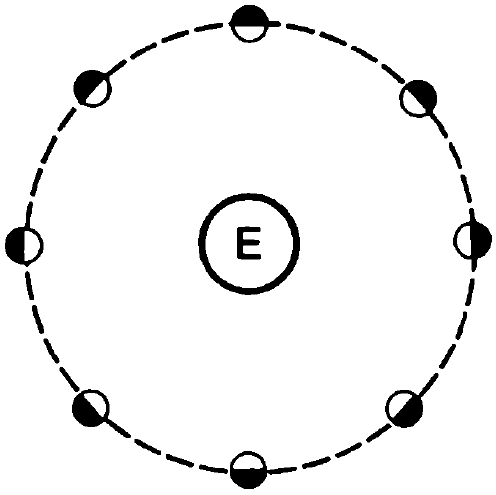
  1. The earth is moving around the sun in a circular orbit, is acted upon by a force and hence work done on the earth by the force is:
  1. zero
  2. positive
  3. negative
  4. None of the above
  1. In which case, work done will be zero?
  1. A weight-lifter while holding a weight of 100 kg on his shoulders for 1 min
  2. A locomotive against gravity is running on a level plane with a speed of 60 kmh - 1
  3. A person holding a suitcase on his head and standing at a bus terminal
  4. All of the above
  1. Find the angle between force $\text{F}=(3\hat{\text{i}}+4\hat{\text{j}}-5\hat{\text{k}})$ unit and displacement $\text{d}=(5\hat{\text{i}}+4\hat{\text{j}}+3\hat{\text{k}})$ unit.
  1. $\cos ^{-1}(0.49)$
  2. $\cos ^{-1}(0.32)$
  3. $\cos^{-1}(0.60)$
  4. $\cos^{-1}(0.90)$
  1. Which of the following statement(s) is/ are correct for work done to be zero?
  1. I. If the displacement is zero.
  2. II. If force applied is zero.
  3. III. If force and displacement are mutually perpendicular to each other.
(a) Only I (b) I and II
(c) Only II (d) I, II and III
  1. A proton is kept at rest. A positively charged particle is released from rest at a distance d in its field. Consider two experiments; one in which the charged particle is also a proton and in another, a positron. In same time t, the work done on the two moving charged particles is:
  1. same as the same force law is involved in the two experiments
  2. less for the case of a positron, as the positron moves away more rapidly and the force on it weakens
  3. more for the case of a positron, as the positron moves away a larger distance
  4. same as the work is done by charged particle on the stationary proton
The moon rotates about the earth in such a way that only one hemisphere of the moon faces the earth. Can we ever see the ''other face'' of the moon from the earth? Can a person on the moon ever see all the faces of the earth?
The gain factor of an amplifier in increased from 10 to 12 as the load resistance is changed from $4\text{k}\Omega\text{ to }8\text{k}\Omega$ Calculate (a) the amplification factor and (b) the plate resistance.
A van is standing on a frictionless portion of a horizontal road. To start the engine, the vehicle must be set in motion in the forward direction. How can the persons sitting inside the van do it without coming out and pushing from behind?
How will the thermionic current vary if the filament current is increased?
When a glass capillary tube is dipped at one end in water, water rises in the tube. The gravitational potential energy is thus increased. Is it a violation of conservation of energy?