Question
Read the passage given below and answer the following questions from $i$ to $v.$ When an object follows a circular path at a constant speed, the motion of the object is called uniform circular motion. The word “uniform” refers to the speed, which is uniform (constant) throughout the motion. Suppose an object is moving with uniform speed $v$ in a circle of radius $R$ Since the velocity of the object is changing continuously in direction, the object undergoes acceleration. Let us find the magnitude and the direction of this acceleration. Thus, the acceleration of an object moving with speed v in a circle of radius $R$ has a magnitude $V^2/R$ and is always directed towards the centre. This is why this acceleration is called centripetal acceleration (a term proposed by Newton). A thorough analysis of centripetal acceleration was first published in $1673$ by the Dutch scientist Christiaan Huygens $(1629-1695)$ but it was probably known to Newton also some years earlier. “Centripetal” comes from a Greek term which means ‘centre-seeking’. Since $v$ and $R$ are constant, the magnitude of the centripetal acceleration is also constant. However, the direction changes pointing always towards the centre. Therefore, a centripetal acceleration is not a constant vector. We can express centripetal acceleration ac in terms of angular speed as $\text{a}_\text{c}=\omega^2\text{R}$ The time taken by an object to make one revolution is known as its time period T and the number of revolution made in one second is called its frequency $v (=1/T).$ However, during this time the distance moved by the object is $\text{s}=2\pi\text{R}.$ Therefore, $\text{v}=2\pi\frac{\text{R}}{\text{T}}=2\pi\text{ Rv}$ In terms of frequency n, we have $\omega=2\pi\text{v}$
$\text{V}=2\pi\text{ RV}$
$\text{ac}=4\pi^2\text{v}^2\text{R}$
  1. SI unit of angular velocity is
  1. Rev/ sec
  2. $m/ s$
  3. $m/ s^2$ 
  4. None of these
  1. A centripetal acceleration is not a constant vector. True or false?
  1. True
  2. False
  1. Define Uniform circular motion
  2. What is meaning of word centripetal?
  3. What is centripetal acceleration? Give its relation with angular velocity
Answer

  1. (a) Rev/ sec
  2. (a) True
  3. When an object moves in a circular path with uniform speed, its motion is called uniform circular motion.
  4. “Centripetal” comes from a Greek term which means ‘centre-seeking’ i.e. always directed towards centre of a circle.
  5. Acceleration of particle performing uniform circular motion which is always directed towards centre of a circle is called centripetal acceleration. We can express centripetal acceleration ac in terms of angular speed as.
$\omega=2\pi\text{v}$
However, during this time the distance moved by the object is $s = 2\pi R.$ In terms of frequency V, we have
$\omega=2\pi\text{v}$
$\text{V}=2\pi\text{ RV}$
$\text{ac}=4\pi^2\text{v}^2\text{R}$

Need a full question paper?

Generate a complete, print-ready paper with questions like this in minutes — across 16+ boards, with answer keys.

Start Generating Free

Similar questions

The friction coefficient between an athelete's shoes and the ground is 0.90. Suppose a superman wears these shoes and races for 50m. There is no upper limit on his capacity of running at high speeds.
  1. Find the minimum time that he will have to take in completing the 50m starting from rest.
  2. Suppose he takes exactly this minimum time to complete the 50m, what minimum time will he take to stop?
Read the passage given below and answer the following questions from 1 to 5. Acceleration due to gravity The acceleration for any object moving under the sole influence of gravity is known as acceleration due to gravity. So, for an object of mass m, the acceleration experienced by it is usually denoted by the symbol g which is related to F by Newton’s second law by relation F = mg Thus, $\text{g}=\frac{\text{F}}{\text{m}}=\frac{{\text{Gm}_\text{e}}}{\text{R}^2_\text{e}}$ Acceleration g is readily measurable as Re is a known quantity. The measurement ofG by Cavendish’s experiment (or otherwise), combined with knowledge of g and Re enables one to estimate $M_e$ from the above equation. This is the reason why there is a popular statement regarding Cavendish “Cavendish weighed the earth”. The value of g decrease as we go upwards from the earth’s surface or downwards, but it is maximum at its surface.
  1. If g is the acceleration due to gravity at the surface of the earth, the force acting on the particle of mass m placed at the surface is:
  1. mg
  2. $\frac{\text{GmM}\theta}{\text{R}^2_\text{e}}$
  3. Data insufficient
  4. Both (a) and (b)
  1. The weight of a body at the centre of earth is:
  1. same as on the surface of earth
  2. same as on the poles
  3. same as on the equator
  4. None of the above
  1. If the mass of the sun is ten times smaller and gravitational constant G is ten times larger in magnitude, then for earth:
  1. walking on ground would become more easy
  2. acceleration due to gravity on the earth will not change
  3. raindrops will fall much slower
  4. airplanes will have to travel much faster
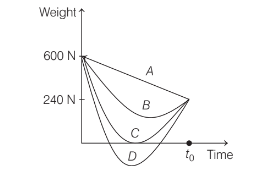
  1. Suppose, the acceleration due to gravity at the earth’s surface is $10 ms^{-2}$ and at the surface of mars, it is $4.0 ms ^{-2}$ 60kg passenger goes from the earth to the mars in a spaceship moving with a constant velocity. Neglect all other objects in the sky. Which curve best represents the weight (net gravitational force) of the passenger as a function of time?
  1. A
  2. B
  3. C
  4. D
  1. If the mass of the earth is doubled and its radius halved, then new acceleration due to the gravity $\acute{\text{g}}$ is:
  1. $\acute{\text{g}}=4\text{g}$
  2. $\acute{\text{g}}=8\text{g}$
  3. $​​\acute{g}=\text{g}$
  4. $\acute{\text{g}}=16\text{g}$
A short magnet produces a deflection of $37°$ in a deflection magnetometer in Tan-A position when placed at a separation of $10cm$ from the needle. Find the ratio of the magnetic moment of the magnet to the earth's horizontal magnetic field.
Complete the following table:
Car Model
Driver X
Reaction time 0.20s
Driver Y
Reaction time 0.30s
A (deceleration on hard braking = $6.0m/s^2$)
Speed = 54km/h
Braking distance
a = ...
Total stopping distance
b = ...
Speed = 72km/h
Braking distance
c = ...
Total stopping distance
d = ...
B (deceleration on hard braking = $7.5m/s^2$)
Speed = 54km/h
Breaking distance
e = ...
Total stopping distance
f = ...
Speed 72km/h
Braking distance
g = ...
Total stopping distance
h = ...
Suppose in an imaginary world the angular momentum is quantized to be even integral multiples of $\frac{\text{h}}{2\pi}$ What is the longest possible wavelength emitted by hydrogen atoms in visible range in such a world according to Bohr's model?
Read the passage given below and answer the following questions from 1 to 5. The property of a body, by virtue of which it tends to regain its original size and shape when the applied force is removed, is known as elasticity and the deformation caused is known as elastic deformation. However, if you apply force to a lump of putty or mud, they have no gross tendency to regain their previous shape, and they get permanently deformed. Such substances are called plastic and this property is called plasticity. Putty and mud are close to ideal plastics. We know that in a solid, each atom or molecule is surrounded by neighboring atoms or molecules. These are bonded together by interatomic or intermolecular forces and stay in a stable equilibrium position. When a solid is deformed, the atoms or molecules are displaced from their equilibrium positions causing a change in the interatomic (or intermolecular) distances. When the deforming force is removed, the interatomic forces tend to drive them back to their original positions. Thus the body regains its original shape and size. Answer the following
  1. Putty and mud are example of:
  1. Ideal plastic
  2. Ideal elastic
  3. Pseudo plastic
  4. None of these
  1. The property of a body, by virtue of which it tends to regain its original size and shape when the applied force is removed, is known as:
  1. Elasticity
  2. Plasticity
  3. Both
  4. None of these
  1. Define elasticity.
  1. Define plasticity.
  1. Explain elastic behavior of solid.
A tungsten cathode and a thoriated-tungsten cathode have the same geometric dimensions and are operated at the same temperature. The thoriated-tungsten cathode gives 5000 times more current than the other cathode. Find the operating temperature. Take relevant data from the previous problem.
No part of India is situated on the equator. Is it possible to have a geostationary satellite which always remains over New Delhi?
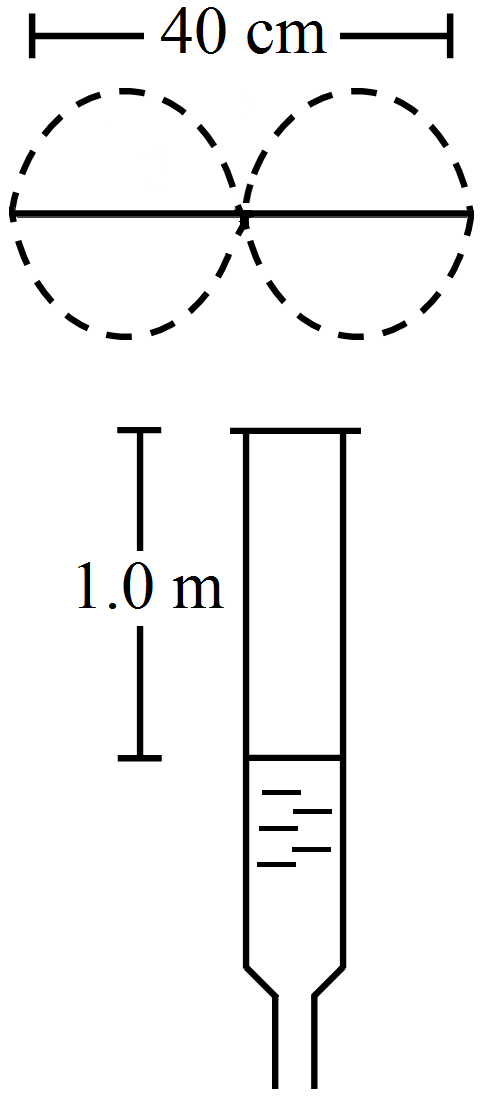
Consider the situation shown in figure. The wire which has a mass of $4.00g$ oscillates in its second harmonic and sets the air column in the tube into vibrations in its fundamental mode. Assuming that the speed of sound in air is $340m/s$, find the tension in the wire.
Read the passage given below and answer the following questions from 1 to 5.
Beats is an interesting phenomenon arising from interference of waves. When two harmonic Sound waves of slightly different frequencies and comparable amplitude are heard at the same time, we hear a sound of similar frequency (the average of two close frequencies), but we hear something else also. We hear audibly distinct waxing and waning of the intensity of the sound, with a frequency equal to the difference in the two close frequencies. Beat frequency is given by
$u = u_1 - u_2$
Artists use this phenomenon often while tuning their instruments with each other. They go on tuning until their sensitive ears do not detect any beats.
Doppler Effect is a wave phenomenon, it holds not only for sound waves but also for electromagnetic waves. However, here we shall consider only sound waves. Doppler Effect is defined as increase or decrease in frequency of sound due to relative motion between source of sound and observer. Frequency increases when source and observer comes towards each other and frequency decreases when source and observer go away from each other .For sound the observed frequency n is given in terms of the source frequency $v_0$ by
$\text{u}=\text{v}_0\frac{\text{v}+\text{v}_0}{\text{v}+\text{vs}}$
Here v is the speed of sound through the medium, is the velocity of observer relative to the medium, and is the source velocity relative to the medium. In using this formula, velocities in the direction OS should be treated as positive and those opposite to it should be taken to be negative. The change in frequency caused by a moving object due to Doppler Effect is used to measure their velocities in diverse areas such as military, medical science, astrophysics, etc. It is also used by police to check over-speeding of vehicles. A sound wave or electromagnetic wave of known frequency is sent towards a moving object. Some part of the wave is reflected from the object and its frequency is detected by the monitoring station. This change in frequency is called Doppler shift. It is used at airports to guide aircraft, and in the military to detect enemy aircraft. Astrophysicists use it to measure the velocities of stars. Doctors use it to study heart beats and blood flow in different parts of the body. Here they use ultrasonic waves, and in common practice, it is called sonography. Ultrasonic waves enter the body of the person, some of them are reflected back, and give information about motion of blood and pulsation of heart valves, as well as pulsation of the heart of the foetus. In the case of heart, the picture generated is called echocardiogram. Answer the following
  1. Beats are heard after superposition of two waves with beat frequency.
  1. $υ = υ_1 - υ_2$
  2. $υ = υ_1 + υ_2$
  3. $υ = (υ_1 - υ_2)/_2$
  4. None of these
  1. When source and observer comes towards each other then frequency heard will.
  1. Increase
  2. Decrease
  3. Remains same
  4. None of these
  1. Define beats.
  1. Define Doppler effect in sound.
  1. Note on applications of Doppler Effect in sound.