MCQ
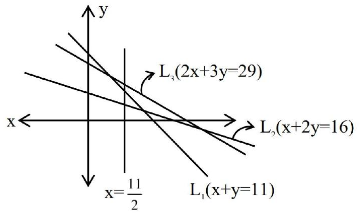
Let the points $\left(\frac{11}{2}, \alpha\right)$ lie on or inside the triangle with sides $\mathrm{x}+\mathrm{y}=11, \mathrm{x}+2 \mathrm{y}=16$ and $2 \mathrm{x}+3 \mathrm{y}=29$. Then the product of the smallest and the largest values of $\alpha$ is equal to :
  • A
    22
  • B
    44
  • 33
  • D
    55

Answer

Correct option: C.
33
(C)
Sol.

Image

Point of intersection of $x=\frac{11}{2}$ with $L_{1} \& L_{3}$ gives, $\alpha_{\min }=\frac{11}{2}$
and $\alpha_{\text {max }}=6$
$\therefore \alpha_{\min } \cdot \alpha_{\max }=\frac{11}{2} \times 6=33$

Need a full question paper?

Generate a complete, print-ready paper with questions like this in minutes — across 16+ boards, with answer keys.

Start Generating Free

Similar questions

Seven chits are numbered $1$ to $7$. Three are drawn one by one with replacement. The probability that the least number on any selected chit is $5$, is
Let ${s_1} = \mathop \sum \limits_{j = 1}^{10} j\left( {j - 1} \right)\left( {\begin{array}{*{20}{c}}{10}\\j\end{array}} \right)\;,$$\;{s_2} = \mathop \sum \limits_{j = 1}^{10} j\;\left( {\begin{array}{*{20}{c}}{10}\\j\end{array}} \right)\;and,$${s_3} = \mathop \sum \limits_{j = 1}^{10} {j^2}\left( {\begin{array}{*{20}{c}}{10}\\j\end{array}} \right)\;,\;$

Statement $-1$:${s_3} = 55 \times {2^9}$

Statement $-2$: ${s_1} = 90 \times {2^8}\;$ and ${s_2} = 10 \times {2^8}$ 

If $f(x) = \frac{x}{{x - 1}}$, then $\frac{{f(a)}}{{f(a + 1)}} = $
The domain of the function $f(x) = \sqrt {\log \frac{1}{{|\sin x|}}} $ is
The sum of the series $\frac{1}{{3 \times 7}} + \frac{1}{{7 \times 11}} + \frac{1}{{11 \times 25}} + ....$ is
$\mathop {\lim }\limits_{x \to 0} \frac{{\sin ({x^{\frac{1}{3}}})\,\ln (1 + 3x)}}{{{{({{\tan }^{ - 1}}\sqrt x )}^2}\left( {{e^{5{x^{\frac{1}{3}}}}} - 1} \right)}} = $
If $x^py^q=(x+y)^{p+q}$,then $\frac {dy}{dx}=$ 
If $\omega $ is a cube root of unity, then a root of the equation $\left| {\begin{array}{*{20}{c}}{x + 1}&\omega &{{\omega ^2}}\\\omega &{x + {\omega ^2}}&1\\{{\omega ^2}}&1&{x + \omega }\end{array}} \right| = 0$ is
If the coefficients of second, third and fourth term in the expansion of ${(1 + x)^{2n}}$ are in $A.P.$, then $2{n^2} - 9n + 7$ is equal to