MCQ
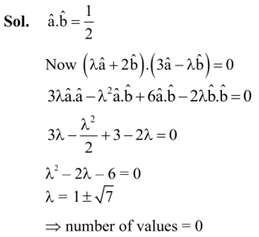
Let $\vec{a}$ and $\vec{b}$ be two unit vectors such that the angle between them is $\frac{\pi}{3}$. If $\lambda \vec{a}+2 \vec{b}$ and $3 \vec{a}-\lambda \vec{b}$ are perpendicular to each other, then the number of values of $\lambda$ in $[-1,3]$ is :
  • A
    3
  • B
    2
  • C
    1
  • D
    0

Answer

Need a full question paper?

Generate a complete, print-ready paper with questions like this in minutes — across 16+ boards, with answer keys.

Start Generating Free

Similar questions

Let $n \in N$ and $[x]$ denote the greatest integer less than or equal to $x$. If the sum of $(n+1)$ terms ${ }^{n} C_{0}, 3 .{ }^{n} C_{1}, 5 .{ }^{n} C_{2}, 7 .{ }^{n} C_{3}, \ldots$ is equal to $2^{100} \cdot 101$, then $2\left[\frac{n-1}{2}\right]$ is equal to $....$
If $\theta \in\left[-\frac{7 \pi}{6}, \frac{4 \pi}{3}\right]$, then the number of solutions of $\sqrt{3} \operatorname{cosec}^{2} \theta-2(\sqrt{3}-1) \operatorname{cosec} \theta-4=0$, is equal to
If $y = a{x^{n + 1}} + b{x^{ - n}},$ then ${x^2}\frac{{{d^2}y}}{{d{x^2}}}$ equals to
Let $f(x)=\left\{\begin{array}{ll}x^2\left|\cos \frac{\pi}{x}\right|, & x \neq 0 \\ 0, & x=0\end{array}, x \in I R\right.$, then $f$ is
Let $[ t ]$ denotes the greatest integer $\leq t$. Then $\frac{2}{\pi} \int \limits_{\pi / 6}^{5 \pi / 6}(8[\operatorname{cosec} x]-5[\cot x]) d x$ is equal to
Area of the region $\left\{(x, y): x^2+(y-2)^2 \leq 4\right.$, $\left.x^2 \geq 2 y\right\}$ is
$\left[ {\int\limits_0^2 {\sqrt {x + \sqrt {x + \sqrt {x + .....\infty } } \,dx} } } \right]$ is equal to (where $[·]$ is $G.I.F.$)
${d \over {dx}}\sqrt {{{1 + \cos 2x} \over {1 - \cos 2x}}} = $
The number of ways in which 21 identical apples can be distributed among three children such that each child gets at least 2 apples, is
Given that $f (x)$ is continuously differentiable on $a \le x \le b$ where $a < b, f (a) < 0$ and $f (b) > 0$, which of the following are always true ?

$(i)$ $f (x)$ is bounded on $a \le x \le b.$

$(ii)$ The equation $f (x) = 0$ has at least one solution in $a < x < b.$

$(iii)$ The maximum and minimum values of $f (x)$ on $a \le x \le b$ occur at points where $f ' (c) = 0$.

$(iv)$ There is at least one point $c$ with $a < c < b$ where $f ' (c) > 0$.

$(v)$ There is at least one point $d$ with $a < d < b$ where $f ' (c) < 0.$