Question
$\text{Let}\ \vec{\text{a}}=4\hat{\text{i}}+5\hat{\text{j}}-\hat{\text{k}},\vec{\text{b}}=\hat{\text{i}}-4\hat{\text{j}}+5\hat{\text{k}}$ and $\vec{\text{c}}=3\hat{\text{i}}+\hat{\text{j}}-\hat{\text{k}}$ Find a vector $\vec{\text{d}}$ which is perpendicular to both $\vec{\text{c}}\ \text{and }\vec{\text{b}}\ \text{and}\ \vec{\text{d}}\cdot\vec{\text{a}}=21.$
Answer

$\vec{\text{a}}=4\hat{\text{i}}+5\hat{\text{j}}-\hat{\text{k}}$
$\vec{\text{b}}=-\hat{\text{i}}-4\hat{\text{j}}+5\hat{\text{k}}$
$\vec{\text{c}}=3\hat{\text{i}}+\hat{\text{j}}-\hat{\text{k}}$
To find vector $\vec{\text{d}}$ such that
$\vec{\text{d}}\cdot\vec{\text{c}}=0$
$\vec{\text{d}}\cdot\vec{\text{b}}=0$
$\vec{\text{d}}\cdot\vec{\text{a}}=21$
$\text{Let}\ \vec{\text{d}}=\text{x}\hat{\text{i}}+\text{y}\hat{\text{j}}+\text{z}\hat{\text{k}}$
$\Big(\text{x}\hat{\text{i}}+\text{y}\hat{\text{j}}+\text{z}\hat{\text{k}}\Big)\cdot\Big(3\hat{\text{i}}+\hat{\text{j}}-\hat{\text{k}}\Big)=0$
$3\text{x}+\text{y}-\text{z}=0\ \ \ ....(1)$
$\Big(\text{x}\hat{\text{i}}+\text{y}\hat{\text{j}}+\text{z}\hat{\text{k}}\Big)\cdot\Big(\hat{\text{i}}+5\hat{\text{j}}-\hat{\text{k}}\Big)=0$
$\text{x}-4\text{y}+5\text{z}=0\ \ \ ....(2)$
$\Big(\text{x}\hat{\text{i}}+\text{y}\hat{\text{j}}+\text{z}\hat{\text{k}}\Big)\cdot\Big(4\hat{\text{i}}+5\hat{\text{j}}-\hat{\text{k}}\Big)=21$
$4\text{x}+5\text{y}-\text{z}=21\ \ \ ....(3)$
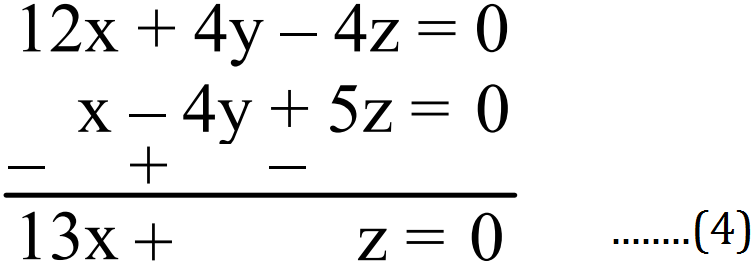
$\text{eq}^\text{n}(1)\times4+\text{eq}^\text{n}(2)$

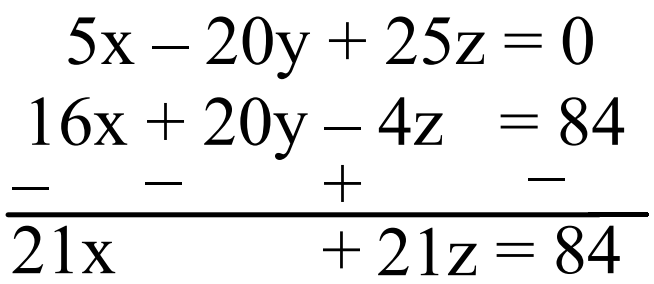
$\text{eq}^\text{n}(2)\times5+\text{eq}^\text{n}(3)\times4$

$21(\text{x}+\text{z})=84$
$\text{x}+\text{z}=4\ \ \ ....(5)$
$\text{eq}.(4)-(5)$
$12\text{x}=-4$
$\text{x}=\frac{-4}{12}=\frac{-1}{3}$
$\text{z}=4-\text{x}$
$\text{z}=4+\frac{1}{3}=\frac{13}{3}$
$\text{Put x}\ \&\ \text{z in }(1)$
$3\text{x}+\text{y}-\text{z}=0$
$3\times\Big(\frac{-1}{3}\Big)+\text{y}-\frac{13}{3}=0$
$\text{y}=\frac{13}{3}+1$
$\text{y}=\frac{16}{3}$
$\vec{\text{d}}=\text{x}\hat{\text{i}}+\text{y}\hat{\text{j}}+\text{z}\hat{\text{k}}$
$\vec{\text{d}}=\frac{-1}{3}\hat{\text{i}}+\frac{16}{3}\hat{\text{j}}+\frac{13}{3}\hat{\text{k}}$

Need a full question paper?

Generate a complete, print-ready paper with questions like this in minutes — across 16+ boards, with answer keys.

Start Generating Free

Similar questions

Solve the following differential equation:
$\cos^2(\text{x}-2\text{y}) = 1-2\frac{\text{dy}}{\text{dx}}$
If $\text{y}=\text{e}^{2\text{x}}(\text{ax}+\text{b}),$ show that $\text{y}_2-\text{4}\text{y}_1+4\text{y}=0$
Evaluate the integral $\int_{0}^{1} \sin ^{-1}\left(\frac{2 x}{1+x^{2}}\right) d x$ using substitution.
If $\vec{\text{a}} \times \vec{\text{b}} = \vec{\text{c}} \times \vec{\text{d}}$ and $\vec{\text{a}} \times \vec{\text{c}} = \vec{\text{b}} \times \vec{\text{d}},$ show that $\vec{\text{a}} - \vec{\text{d}}$ is parallel to $\vec{\text{b}} - \vec{\text{c}},$ where $\vec{\text{a}} \neq \vec{\text{d}}$ and $\vec{\text{b}} \neq \vec{\text{c}}.$
Find $\frac{\text{dy}}{\text{dx}}$ in the following cases: $(x^2 + y^2)^2 = xy$
Evalute the following integrals:
$\int\frac{\sin(\text{x}-\text{a})}{\sin(\text{x}-\text{b})}\text{dx}$
Show that the following curves intersect orthogonally at the indicated points:
$y^2 = 8x$ and $2x^2 + y^2 = 10$ at $\big(1,2\sqrt{2})$
Often it is taken that a truthful person commands, more respect in the society. $A$ man is known to speak the truth $4$ out of $5$ times. He throws a die and reports that it is a six. Find the probability that it is actually a six.Do you also agree that the value of truthfulness leads to more respect in the society?
Evaluate the following integrals:
$\int\limits_{0}^{1}\frac{\tan^{-1}\text{x}}{1+\text{x}^2}\text{ dx}$
Evaluate the following:
$\int\limits^{\frac{\pi}{2}}_0\frac{\tan\text{x dx}}{1+\text{m}^2\tan^2\text{x}}\text{dx}$