Question
$\text{Let}\ \vec{\text{a}}=4\hat{\text{i}}+5\hat{\text{j}}-\hat{\text{k}},\vec{\text{b}}=\hat{\text{i}}-4\hat{\text{j}}+5\hat{\text{k}}$ and $\vec{\text{c}}=3\hat{\text{i}}+\hat{\text{j}}-\hat{\text{k}}$ Find a vector $\vec{\text{d}}$ which is perpendicular to both $\vec{\text{c}}\ \text{and }\vec{\text{b}}\ \text{and}\ \vec{\text{d}}\cdot\vec{\text{a}}=21.$
Answer

$\vec{\text{a}}=4\hat{\text{i}}+5\hat{\text{j}}-\hat{\text{k}}$
$\vec{\text{b}}=\hat{\text{i}}-4\hat{\text{j}}+5\hat{\text{k}}$
$\vec{\text{c}}=3\hat{\text{i}}+\hat{\text{j}}-\hat{\text{k}}$
To find vector $\vec{\text{d}}$ such that
$\vec{\text{d}}\cdot\vec{\text{c}}=0$
$\vec{\text{d}}\cdot\vec{\text{b}}=0$
$\vec{\text{d}}\cdot\vec{\text{a}}=21$
$\text{Let}\ \vec{\text{d}}=\text{x}\hat{\text{i}}+\text{y}\hat{\text{j}}+\text{z}\hat{\text{k}}$
$\Big(\text{x}\hat{\text{i}}+\text{y}\hat{\text{j}}+\text{z}\hat{\text{k}}\Big)\cdot\Big(3\hat{\text{i}}+\hat{\text{j}}-\hat{\text{k}}\Big)=0$
$3\text{x}+\text{y}-\text{z}=0\ \ \ ....(1)$
$\Big(\text{x}\hat{\text{i}}+\text{y}\hat{\text{j}}+\text{z}\hat{\text{k}}\Big)\cdot\Big(\hat{\text{i}}-4\hat{\text{j}}+5\hat{\text{k}}\Big)=0$
$\text{x}-4\text{y}+5\text{z}=0\ \ \ ....(2)$
$\Big(\text{x}\hat{\text{i}}+\text{y}\hat{\text{j}}+\text{z}\hat{\text{k}}\Big)\cdot\Big(4\hat{\text{i}}+5\hat{\text{j}}-\hat{\text{k}}\Big)=21$
$4\text{x}+5\text{y}-\text{z}=21\ \ \ ....(3)$
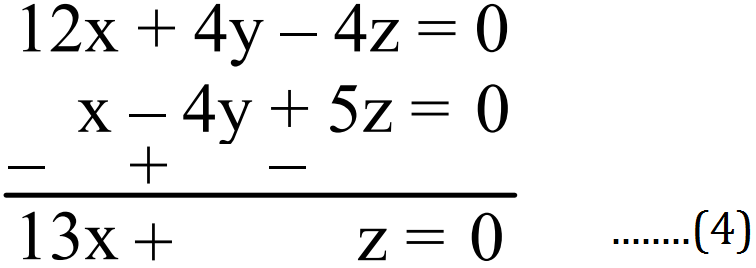
$\text{eq}^\text{n}(1)\times4+\text{eq}^\text{n}(2)$

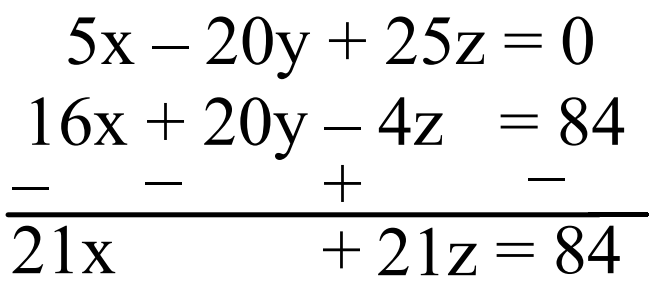
$\text{eq}^\text{n}(2)\times5+\text{eq}^\text{n}(3)\times4$

$21(\text{x}+\text{z})=84$
$\text{x}+\text{z}=4\ \ \ ....(5)$
$\text{eq}.(4)-(5)$
$12\text{x}=-4$
$\text{x}=\frac{-4}{12}=\frac{-1}{3}$
$\text{z}=4-\text{x}$
$\text{z}=4+\frac{1}{3}=\frac{13}{3}$
$\text{Put x}\ \&\ \text{z in }(1)$
$3\text{x}+\text{y}-\text{z}=0$
$3\times\Big(\frac{-1}{3}\Big)+\text{y}-\frac{13}{3}=0$
$\text{y}=\frac{13}{3}+1$
$\text{y}=\frac{16}{3}$
$\vec{\text{d}}=\text{x}\hat{\text{i}}+\text{y}\hat{\text{j}}+\text{z}\hat{\text{k}}$
$\vec{\text{d}}=\frac{-1}{3}\hat{\text{i}}+\frac{16}{3}\hat{\text{j}}+\frac{13}{3}\hat{\text{k}}$

Need a full question paper?

Generate a complete, print-ready paper with questions like this in minutes — across 16+ boards, with answer keys.

Start Generating Free

Similar questions

Prove that the line of section of the planes $5x + 2y - 4z + 2 = 0$ and $2x + 8y + 2z - 1 = 0$ is parallel to the plane $4x - 2y - 5z - 2 = 0.$
Evaluate the following definite integrals:
$\int_{\frac{\pi}{3}}^\limits{\frac{\pi}{4}}(\tan\text{x}+\cot\text{x})^2\text{ dx}$
Differentiate the following functions with respect to x:
$\cos^{-1}\big\{2\text{x}\sqrt{1-\text{x}^2}\big\},\frac{1}{\sqrt{2}}<\text{x}<1$
Find the area of the region bounded by $y^2 = 9x, x = 2, x = 4$ and the $x-$axis in the first quadrant.
$\int\frac{\text{x}^2}{\sqrt{1-\text{x}}}\text{dx}$
Solve the following differential equation:
$\big(\cot^{-1}\text{y} + \text{x}\big)\text{dy}= \big(1 + \text{y}^2\big) \text{dx}$
Differentiate the following functions with respect to x:
$\frac{3\text{x}^2\sin\text{x}}{\sqrt{7-\text{x}^2}}$
A manufacturer produces nuts and bolts. It takes 1 hour of work on machine A and 3 hours on machine B to produce a package of nuts. It takes 3 hours on machine A and 1 hour on machine B to produce a package of bolts. He earns a profit of  17.50 per package on nuts and  7 per package of bolts. How many packages of each should be produced each day so as to maximise his profits if he operates his machines for at the most 12 hours a day? Form the above as a linear programming problem and solve it graphically.
Evaluvate the following intregals
$\int\frac{2\text{x}+1}{\sqrt{\text{x}^2+4\text{x}+3}}\text{dx}$
A bag contains 3 red and 2 black balls. One ball is drawn from it at random. Its colour is noted and then it is put back in the bag. A second draw is made and the same procedure is repeated. Find the probability of drawing,
  1. Two red balls,
  2. Two black balls,
  3. First red and second black ball.