MCQ
Let
$
A=\left\{x \in(0, \pi)-\left\{\frac{\pi}{2}\right\}: \log _{(2 / \pi)}|\sin x|+\log _{(2 / \pi)}|\cos x|=2\right\}
$
and
$B=\{x \geq 0: \sqrt{x}(\sqrt{x}-4)-3|\sqrt{x}-2|+6=0\}$. Then $\mathrm{n}(\mathrm{A} \cup \mathrm{B})$ is equal to:
  • A
    4
  • B
    2
  • 8
  • D
    6

Answer

Correct option: C.
8
(C)
Sol. $\mathrm{A}: \log _{2 \pi}|\sin \mathrm{x}|+\log _{2 \pi}|\cos \mathrm{x}|=2$
$\Rightarrow \log _{2 \pi}(|\sin x . \cos x|)=2$
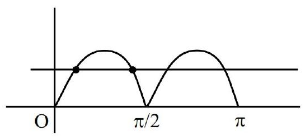
$\Rightarrow|\sin 2 \mathrm{x}|=\frac{8}{\pi^{2}}$

Image

Number of solution 4
B : let $\sqrt{\mathrm{x}}=\mathrm{t}<2$
Then $\sqrt{\mathrm{x}}(\sqrt{\mathrm{x}}-4)+3(\sqrt{\mathrm{x}}-2)+6=0$
$\Rightarrow \mathrm{t}^{2}-4 \mathrm{t}+3 \mathrm{t}-6+6=0$
$\Rightarrow \mathrm{t}^{2}-\mathrm{t}=0, \mathrm{t}=0, \mathrm{t}=1$
$\mathrm{x}=0, \mathrm{x}=1$
again let $\sqrt{\mathrm{x}}=\mathrm{t}>2$
then $\mathrm{t}^{2}-4 \mathrm{t}-3 \mathrm{t}+6+6=0$
$\Rightarrow \mathrm{t}^{2}-7 \mathrm{t}+12=0$
$\Rightarrow \mathrm{t}=3,4$
$\mathrm{x}=9,16$
Total number of solutions
$\mathrm{n}(\mathrm{A} \cup \mathrm{B})=4+4=8$

Need a full question paper?

Generate a complete, print-ready paper with questions like this in minutes — across 16+ boards, with answer keys.

Start Generating Free

Similar questions

Let $A$ be the point $(1,2)$ and $B$ be any point on the curve $x^2+y^2=16$. If the centre of the locus of the point $P$, which divides the line segment $A B$ in the ratio $3: 2$ is the point $C(\alpha, \beta)$, then the length of the line segment $AC$ is
If $\mathrm{A}=\left[\begin{array}{cc}\cos \alpha & -\sin \alpha \\ \sin \alpha & \cos \alpha\end{array}\right],$ then $\mathrm{A}+\mathrm{A}^{\prime}=\mathrm{I},$ if the value of $\alpha$ is
For the function $f(x) = {e^x},a = 0,b = 1$, the value of $ c$ in mean value theorem will be
If ${\tan ^2}\theta - (1 + \sqrt 3 )\tan \theta + \sqrt 3 = 0$, then the general value of $\theta $ is
The harmonic mean of the roots of the equation $(5 + \sqrt 2 ){x^2} - (4 + \sqrt 5 )x + 8 + 2\sqrt 5 = 0$ is
The equation of the locus of all points equidistant from the point $(4,2)$ and the $x$-axis, is
The area of the region $\left\{(x, y):|x-1| \leq y \leq \sqrt{5-x^{2}}\right\}$ is equal to.
The number of real numbers $\lambda$ for which the equality $\frac{\sin (\lambda \alpha) \quad \cos (\lambda \alpha)}{\sin \alpha}=\lambda-1$,holds for all real $\alpha$ which are not integral multiples of $\pi / 2$ is
Let the position vectors of the vertices $A, B$ and $C$ of a triangle be $2 \hat{i}+2 \hat{j}+\hat{k}, \quad \hat{i}+2 \hat{j}+2 \hat{k}$ and $2 \hat{i}+\hat{j}+2 \hat{k}$ respectively. Let $l_1, l_2$ and $l_3$ be the lengths of perpendiculars drawn from the ortho center of the triangle on the sides $\mathrm{AB}, \mathrm{BC}$ and $\mathrm{CA}$ respectively, then $l_1^2+l_2^2+l_3^2$ equals:
Football teams $T_1$ and $T_2$ have to play two games against each other. It is assumed that the outcomes of the two games are independent. The probabilities of $T_1$ winning, drawing and losing a game against $T_2$ are $\frac{1}{2}, \frac{1}{6}$ and $\frac{1}{3}$, respectively. Each team gets $3$ points for a win, $1$ point for a draw and $0$ point for a loss in a game. Let $X$ and $Y$ denote the total points scored ky teams $T_1$ and $T_2$, respectively, after two games.

($1$) $P(X>Y)$ is

($A$) $\frac{1}{4}$    ($B$) $\frac{5}{12}$    ($C$) $\frac{1}{2}$   ($D$) $\frac{7}{12}$

($2$) $P(X=Y)$ is

($A$). $\frac{11}{36}$    ($B$) $\frac{1}{3}$   ($C$) $\frac{13}{36}$    ($D$) $\frac{1}{2}$

Given the answer quetion ($1$) and ($2$)