MCQ
Light from a tungsten filament lamp gives:
- AAbsorption spectrum
- BEmission spectrum
- CAtomic spectrum
- DDiscontinuous spectrum
Explanation:
Light from a tungsten filament lamp has an emission spectrum which is continuous in nature.
Generate a complete, print-ready paper with questions like this in minutes — across 16+ boards, with answer keys.
Total internal reflection of a ray of light is possible when the ( = critical angle, i = angle of incidence)
|
(a) Ray goes from denser medium to rarer medium and |
|
(b) Ray goes from denser medium to rarer medium and |
|
(c) Ray goes from rarer medium to denser medium and |
|
(d) Ray goes from rarer medium to denser medium and |
Assertion : When PN-junction is forward biased then motion of charge carriers at junction is due to diffusion. In reverse biasing. The cause of motion of charge is drifting.
Reason : In the following circuit emitter is reverse biased and collector is forward biased.

|
(a) If both assertion and reason are true and the reason is the correct explanation of the assertion. |
|
(b) If both assertion and reason are true but reason is not the correct explanation of the assertion. |
|
(c) If assertion is true but reason is false. |
|
(d) If the assertion and reason both are false. |
Resistance in the two gaps of a meter bridge are 10 ohm and 30 ohm respectively. If the resistances are interchanged the balance point shifts by
|
(a) 33.3 cm |
(b) 66.67cm |
(c) 25 cm |
(d) 50 cm |
Speed of light is maximum in
|
(a) Water |
(b) Air |
(c) Glass |
(d) Diamond |
The capacitance of a parallel plate condenser does not depend on
|
(a) Area of the plates |
(b) Medium between the plates |
|
(c) Distance between the plates |
(d) Metal of the plates |
Which of the following plots may represent the thermal energy produced in a resistor in a given time as a function of the electric current
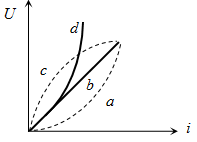
|
(a) a |
(b) b |
(c) c |
(d) d |
A ray of light is incident on a transparent glass slab of refractive index 1.62. The reflected and the refracted rays are mutually perpendicular. The angle of incidence is
|
(a) 58.3o |
(b) 50o |
(c) 35o |
(d) 30o |

