MCQ
light of frequency 1.5 times the threshold frequency is incident on a photosensitive material. what will be photo electric current if fre quency is halved and intensity is doubled:
  • A
    4 times
  • B
    1/4 times
  • zero
  • D
    2 times

Answer

Correct option: C.
zero
(C) 18 pm
The new frequency of light is (1.5/2) =0.75 times the threshold frequency and which is less than it. hence no emission will take place and photoelectric current will be zero.

Need a full question paper?

Generate a complete, print-ready paper with questions like this in minutes — across 16+ boards, with answer keys.

Start Generating Free

Similar questions

Which one does not give cannizzaro's reaction
In the Young's double slit experiment, the intensities at two points $P_1$ and $P_2$ on the screen are respectively $I_1$ and $I_2$. If $P_1$ is located at the centre of a bright fringe and $P_2$ is located at a distance equal to a quarter of fringe width from $P_1$, then $I_1$/$I_2$ is :
Consider the following reactions

$A\xrightarrow[(ii)\;H_3O^+]{(i)\;CH_3MgBr}B\xrightarrow[573\;K]{Cu}2-$methyl $2-$butene

The mass percentage of carbon in $A$ is
Due to the earth's magnetic field, charged cosmic ray particles
A positive charge $q$ is placed in a spherical cavity made in a positively charged sphere. The centres of sphere and cavity are displaced by a small distance $\vec l $ . Force on charge $q$ is :
The wavelength of light in two liquids $‘x' $ and $‘y' $ is $3500 Å$ and $7000 Å$, then the critical angle of $x$ relative to $y$ will be.......$^o$
$E_0$ and $E_H$ respectively represents the average kinetic energy of a molecule of oxygen and hydrogen. If the two gases are at the same temperature, which of the following statement is true?
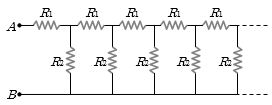
An infinite sequence of resistance is shown in the figure. The resultant resistance between $A$ and $B$ will be, when ${R_1} = 1\,ohm$ and ${R_2} = 2\,ohm$ ............. $\Omega$
Moment of inertia of a sphere of mass $M$ and radius $R$ is $I.$ Keeping $M$ constant if a graph is plotted between $I $ and $R,$ then its form would be
Two metal pieces having a potential difference of $800 \;V$ are $0.02\; m$ apart horizontally. A particle of mass $1.96 \times 10^{-15} \;kg$ is suspended in equilibrium between the plates. If $e$ is the elementary charge, then charge on the particle is