Questions

SECTION - A [PHYSICS - MCQ]

Take a timed test

45 questions · 43 auto-graded MCQ + 2 self-marked written.

MCQ 14 Marks
Point charge q moves in a circle of radius r at constant speed v. What will be the current associated with this uniform circular motion.
  • A
    $q v / \pi r$
  • B
    $2 q v / \pi r$
  • $qv / 2 \pi r$
  • D
    $4 qv / \pi r$.
Answer
Correct option: C.
$qv / 2 \pi r$
(C) $qv / 2 \pi r$
$i=q \times n=q \times \frac{1}{T}=q \times \frac{v}{2 \pi r}$
View full question & answer
MCQ 24 Marks
Which one of the following is not the expression for quality factor for resonance in series RLC ac circuit:
  • A
    $\frac{\omega_0 L}{R}$
  • B
    $\frac{1}{\omega_0 R C}$
  • C
    $\frac{V_L}{V_R}$
  • $\frac{V_L}{V_c}$
Answer
Correct option: D.
$\frac{V_L}{V_c}$
D
View full question & answer
MCQ 34 Marks
It is earier to pull a lawn mower than to push it because
  • A
    pulling is more comfortable than pushing
  • B
    one gets extra energy in pulling
  • C
    pulling makes the lawn mower lights
  • pulling reduces friction of the surface
Answer
Correct option: D.
pulling reduces friction of the surface
D
View full question & answer
MCQ 44 Marks
A beam of light converges at a point P. Now a lens is placed in the path of the convergent beam 12 cm from P. At what point does the beam converge if the lens is a convex lens of focal lenght 20 cm:
  • 7.5 cm from lens
  • B
    8.5 cm from lens
  • C
    9.5 cm from lens
  • D
    6.5 cm from lens
Answer
Correct option: A.
7.5 cm from lens
(A) 7.5 cm from lens
Here, the point $P$ is on the right side of lens acts as a vertual object.
Given, distance of object from the lens $u =12 cm$
Focal length of convex lens $f=+20 cm$ Using Lens formula,
$\frac{1}{v}-\frac{1}{u}=\frac{1}{f} \Rightarrow \frac{1}{v}-\frac{1}{12}=\frac{1}{20}$
$\frac{1}{v}=\frac{1}{20}+\frac{1}{12}=\frac{3+5}{60}=\frac{8}{60}$
$v=7.5 cm$
Thus, the beam converges on the right side of lens at a distance of 7.5 cm .
View full question & answer
MCQ 64 Marks
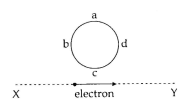
An electron moves on a straight line path XY as shown. The abcd is a coil adjacent to the path of electron. What will be the direction of current, if any, induced in the coil:
Image
  • The current will reverse its direction as the electrons goes past the coil
  • B
    No current induced
  • C
    abcd
  • D
    adcb.
Answer
Correct option: A.
The current will reverse its direction as the electrons goes past the coil
A
View full question & answer
MCQ 74 Marks
The potential energy of a simple harmonic oscillator when the particle is half way to its end point is:
  • A
    $\frac{2}{3} E$
  • B
    $\frac{1}{8} E$
  • $\frac{1}{4} E$
  • D
    $\frac{1}{2} E$
Answer
Correct option: C.
$\frac{1}{4} E$
(C) $\frac{1}{4} E$
Potential energy of simple harmonic oscillator
$=\frac{1}{2} m \omega^2 y^2$
for $y=\frac{a}{2}, P E=\frac{1}{2} m \omega^2 \frac{a^2}{4}$
$\Rightarrow P . E=\frac{1}{4}\left(\frac{1}{2} m \omega^2 a^2\right)=\frac{E}{4}$
View full question & answer
MCQ 84 Marks
A body is falling freely under the action of gravity alone in vacuum. Which of the following quantities remain constant during the fall?
  • A
    Kinetic energy
  • B
    Potential energy
  • Total mechanical energy
  • D
    Total linear momentum
Answer
Correct option: C.
Total mechanical energy
C
View full question & answer
MCQ 94 Marks
Consider the following satements:
Statement I: A particle moving along straight line travels 10 m in third seconds.
Statement II: When a nucleus is formed some energy is released that is known as binding energy.
Statement III: Alternating voltage works with transformer but DC voltage does not:
In the light of above statements choose one correct option from below:
  • A
    Statement III is wrong
  • Statement I is correct if particle starts from rest with constant acceleration 4 m/s2
  • C
    Statement III is correct but Statement II is incorrect
  • D
    Statement I is not possible in any case
Answer
Correct option: B.
Statement I is correct if particle starts from rest with constant acceleration 4 m/s2
B
View full question & answer
MCQ 104 Marks
A particle is dropped from a height H. The de-Broglie wavelenght associated with particle is proportional to
  • A
    Η
  • B
    Η1/2
  • C
    Η0
  • Η-1/2
Answer
Correct option: D.
Η-1/2
(D) Η-1/2
$v=\sqrt{2 g H}$
$\therefore \quad \lambda=\frac{h}{P}=\frac{h}{m v}=\frac{h}{m \sqrt{2 g H}}$
$\Rightarrow \lambda \propto H^{-1 / 2}$
View full question & answer
MCQ 114 Marks
Match the columns a series LCR circuit:
Column IColumn II
i. ImpedanceA. $\omega L-\frac{1}{\omega C}$
ii. ReactanceB. $\frac{1}{\omega C R}$
iii. Power factorC. $\sqrt{R^2+\left(\omega L-\frac{1}{\omega C}\right)^2}$
iv. Q-factorD. $\frac{R}{\sqrt{R^2+\left(\omega L-\frac{1}{\omega C}\right)^2}}$
  • i-C, ii-A, iii-D, iv-B
  • B
    i-B, ii-A, iii-D, iv-D
  • C
    i-C, ii-D, iii-A, iv-B
  • D
    i-C, ii-A, iii-B, iv-D
Answer
Correct option: A.
i-C, ii-A, iii-D, iv-B
A
View full question & answer
MCQ 124 Marks
The amount of work done in increasing the voltage across the plates of a capacitor from 5V to 10V is W. The work done in increasing it from 10V to 15V will be:
  • A
    0.6 W
  • B
    W
  • C
    1.25 W
  • 1.67W
Answer
Correct option: D.
1.67W
(D) 1.67W
$W=\Delta U=\frac{1}{2} C\left(V_2^2-V_1^2\right)$
$\frac{W_1}{W}=\frac{15^2-10^2}{10^2-5^2}=\frac{125}{75}=\frac{5}{3} W=1.67 W$
View full question & answer
MCQ 134 Marks
Two conductors are made of the same material and have the same length conductor A is a solid wire of diameter D conductor B is a hollow tube of outer diameter 2D and inner diameter D. The ratio of resistances of A and B :
  • 3:1
  • B
    1:2
  • C
    1:4
  • D
    1:1
Answer
Correct option: A.
3:1
(A) (3:1)
$R_A=p \frac{L}{\frac{\pi D^2}{4}}, \quad R_B=p \frac{L}{\frac{\pi}{4}\left[(2 D)^2-D^2\right]}$
$\frac{ R _{ A }}{R_{ B }}=\frac{3}{1}$
View full question & answer
MCQ 144 Marks
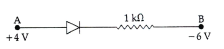
Consider the junction diode as ideal. The value of current flowing through AB is
Image
  • A
    (0 A)
  • 10-2A
  • C
    10-1A
  • D
    10-3A
Answer
Correct option: B.
10-2A
(B)10-2A
In forward bias, resistance of diode will be zero.
$i =\frac{ V _{ A }- V _{ B }}{ R }$
$=\frac{4-(-6)}{1 \times 10^3}$
$i =\frac{10}{10^3}=10^{-2} amp$
View full question & answer
MCQ 154 Marks
The ratio of kinetic energy to the total energy of an electron in a Bohr orbit of the hydrogen atom, is:
  • A
    1:- 2
  • B
    (1:1)
  • C
    2:- 1
  • 1:- 1
Answer
Correct option: D.
1:- 1
D
View full question & answer
MCQ 164 Marks
Taking Bohr radius, $a_0=53 pm$, the radius of $Li ^{2+}$ ion in its ground state on the basis of Bohr model will be
  • A
    53 pm
  • B
    27 pm
  • 18 pm
  • D
    13 pm
Answer
Correct option: C.
18 pm
(C) 18 pm
For a hydrogen like atom
$r_n=0.53 \frac{n^2}{Z}$
For (ground state)
View full question & answer
MCQ 174 Marks
light of frequency 1.5 times the threshold frequency is incident on a photosensitive material. what will be photo electric current if fre quency is halved and intensity is doubled:
  • A
    4 times
  • B
    1/4 times
  • zero
  • D
    2 times
Answer
Correct option: C.
zero
(C) 18 pm
The new frequency of light is (1.5/2) =0.75 times the threshold frequency and which is less than it. hence no emission will take place and photoelectric current will be zero.
View full question & answer
MCQ 184 Marks
When a forward bias is applied to a p-n juction. It:
  • A
    raises the potential barrier
  • B
    reduces the majority carrier current to zero
  • lowers teh potential barrier
  • D
    None of the above
Answer
Correct option: C.
lowers teh potential barrier
C
View full question & answer
MCQ 194 Marks
Two capacitors C1 and C2 are charged to 120 V and 200 V respectively. It is found that connecting them together the potential on each one can be made zero. Then :
  • A
    $5 c_1=3 c_2$
  • B
    $3 c_1=5 c_2$
  • $3 c_1+5 c_2=0$
  • D
    $9 c_1=4 c_2$
Answer
Correct option: C.
$3 c_1+5 c_2=0$
(C) $3 c_1+5 c_2=0$
Use the formula $\theta=\frac{C_1 \times 120+C_2 \times 200}{C_1+C_2}$
View full question & answer
MCQ 204 Marks
Sound waves of wavelenght $\lambda$ travelling in a medium with a speed of v ms-1 enter into another medium where its speed in 2v ms-1. Wavelength of sound waves in the second medium is.
  • A
    $\lambda$
  • B
    $\frac{\lambda}{2}$
  • $2 \lambda$
  • D
    $4 \lambda$
Answer
Correct option: C.
$2 \lambda$
(C) $2 \lambda$
The frequency remains the same, $\lambda$ will be proportional to speed v
View full question & answer
MCQ 214 Marks
Speed of a longitudinal wave in a solid bar is given by(all the symbols have their usual meaning)
  • $v=\sqrt{\frac{Y}{\rho}}$
  • B
    $v=\sqrt{\frac{P}{\rho}}$
  • C
    $v=\sqrt{\frac{\gamma P}{\rho}}$
  • D
    $v=\sqrt{\frac{B}{\rho}}$
Answer
Correct option: A.
$v=\sqrt{\frac{Y}{\rho}}$
A
View full question & answer
MCQ 224 Marks
Degree of freedom for an ideal gas is $n$ and ratio of molar specific heat at constant pressure and constant volumeis $\gamma$ then
  • A
    $n=\frac{\gamma}{2}$
  • $(\gamma-1) n=2$
  • C
    $n+2=\gamma$
  • D
    $(\gamma-1)+n=2$
Answer
Correct option: B.
$(\gamma-1) n=2$
B
View full question & answer
MCQ 234 Marks
At what temperature is the root mean square speed of an atom in an argon gas cylinder equal to the rms speed of a helium gas atom at $20^{\circ} C$ : (Atomic mass of $Ar =39 u$ and $He = 4 u$ )
  • $2.85 \times 10^3 K$
  • B
    $2.52 \times 10^2 K$
  • C
    $4.03 \times 10^3 K$
  • D
    $4.03 \times 10^2 K$
Answer
Correct option: A.
$2.85 \times 10^3 K$
(A) $2.85 \times 10^3 K$
$\sqrt{\frac{3 R T}{39}}=\sqrt{\frac{3 R(273+20)}{4}}$
Gives $T =2.85 \times 10^3 K$
View full question & answer
MCQ 244 Marks
In a thermodyamic process of a fixed mass of a gas is changed in such a manner that the gas releases 20 joules of heat and 8 joules of work was done on the gas. If the initial internal energy of the gas was 30 joules, then the final internal energy will be:
  • A
    2 J
  • B
    42 J
  • 18 J
  • D
    58 J
Answer
Correct option: C.
18 J
(C)18J
$-20-(-8)=U_2-30$
$U _2=18 J$.
View full question & answer
MCQ 254 Marks
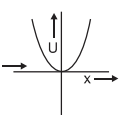
The potential energy function for a particle executing linear simple harmonic motion is given by $U(x)=\frac{1}{2} k x^2$, where k is the force constant of the osicllator. For $k =0.5 Nm ^{-1}$, the graph U (x) versus x is shown in the figure given below.
Image
Find out position of a particle carrying total energy 1 J moving under this potential at which it must turn back to its orignal position.
  • A
    $\pm 0.5 m$
  • B
    $\pm 1 m$
  • $\pm 2 m$
  • D
    $\pm 3 m$
Answer
Correct option: C.
$\pm 2 m$
(C) $\pm 2 m$
Since paticle is at turning point, K = 0 therefore E = 1 = U = (1/2)k x2
putting $k=0.05$, we get $x^2=4$ and $x=+2$ and $x=-2$.
View full question & answer
MCQ 264 Marks
The extension in an elastic wire duo to self weight is (all the symbols have their usual meaning):
  • $\Delta L=\frac{M g L}{2 A Y}$
  • B
    $\Delta L=\frac{M g L}{A Y}$
  • C
    $\Delta L=\frac{2 M g L}{A Y}$
  • D
    $\Delta L=\frac{2 M g L}{3 A Y}$
Answer
Correct option: A.
$\Delta L=\frac{M g L}{2 A Y}$
(A) 18 pm
The self-weight acts at the center of mass of the wire which is middle point. Thus in formula we will take effective length as L/2.
View full question & answer
MCQ 274 Marks
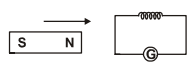
As shown in the figure, a magnet is moved with a fast speed towards a coil at rest. Due to this induced electromotive force, induced current and induced charge in the coil is E, I and Q respectively. If the speed of the magnet is doubled, the incorrect statement is:
Image
Answer
Correct option: D.
(D)Q increases 
Induced charge depends upon change in flux, not the speed.
View full question & answer
MCQ 284 Marks
A charged particle is moving in a uniform magnetic field in a circular path. Radius of circular path is R. When energy of particle is doubled, then new radius will be:
  • A
    3R
  • B
    2R
  • $R \sqrt{2}$
  • D
    $R \sqrt{3}$
Answer
Correct option: C.
$R \sqrt{2}$
(C) $R \sqrt{2}$
$R =\frac{ mV }{ qB }=\frac{\sqrt{2 K m}}{ qB }$
$R \propto \sqrt{ K }$
View full question & answer
MCQ 294 Marks
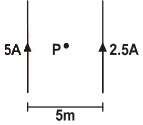
The magnetic field at centre, P will be:
Image
  • A
    $\frac{\mu_0}{4 \pi}$
  • B
    $\frac{\mu_0}{\pi}$
  • $\frac{\mu_0}{2 \pi}$
  • D
    $4 \mu_0 \pi$
Answer
Correct option: C.
$\frac{\mu_0}{2 \pi}$
(C) $\frac{\mu_0}{2 \pi}$
$\frac{\mu_0}{4 \pi} \frac{2(5-2.5)}{25}=\frac{\mu_0}{2 \pi}$
View full question & answer
MCQ 304 Marks
A circular coil of wire consisting of 100 turns, each of radius 8.0 cm carries a current of 0.40 A. What is the magnitude of the magnetif field B at the centre of the coil ?
  • A
    4 T
  • 3.1 x 10⁴ T
  • C
    2 x 10³ T
  • D
    104 T
Answer
Correct option: B.
3.1 x 10⁴ T
(B) 3.1 x 10⁴ T
Here, $n =100, r =8 cm=8 \times 10^{-2} m$ and $\quad I=0.40 A$
The magnetic field B at the centre,
$B=\frac{\mu_o}{4 \pi} \cdot \frac{2 \pi I n}{r}=\frac{10^{-7} \times 2 \times 3.14 \times 0.4 \times 100}{8 \times 10^{-2}}$
$=3.1 \times 10^{-4} T$
View full question & answer
MCQ 314 Marks
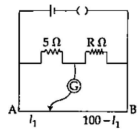
The resisitances in the two arms of the meter bridge are $5 \Omega$ and $R \Omega$, respectively. When the resistance $R$ is shunted with an equal resistance the new balance point is at $1.6 I _1$. The resistance ' $R$ ', is :
Image
  • A
    $10 \Omega$
  • $15 \Omega$
  • C
    $20 \Omega$
  • D
    $25 \Omega$
Answer
Correct option: B.
$15 \Omega$
(B) $15 \Omega$
$\frac{5}{\ell_1}=\frac{ R }{100-\ell_1}...(1)$
By second condition
$\frac{5}{1.6 \ell_1}=\frac{ R / 2}{100-1.6 \ell_1}...(2)$
$1.6=\frac{2\left(100-1.6 \ell_1\right)}{100-1.6 \ell_1}$
$1.6 \times 100-1.6 \ell_1=2\left(100-1.6 \ell_1\right)$
$0.8 \times 100-0.8 \quad \ell_1=100-1.6 \ell_1$
$0.8 \ell_1=100 \times 0.2$
$\ell_1=25$
by eq (1) $\frac{5}{25}=\frac{ R }{75} \quad \Rightarrow R =15 ohm$
View full question & answer
Question 324 Marks
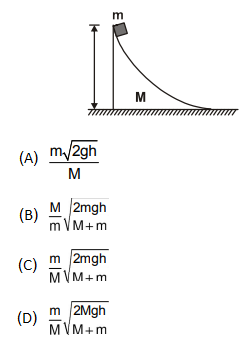
A mass m is placed at a height on the wedge of mass M shown in the figure. The ground is smooth. When the mass m reaches the ground, velocity of the wedge is (assume all smooth surfaces):
Image
Answer
(D)
$mv _1+ Mv _2=0$ where $\quad \frac{1}{2} mv _1^2+\frac{1}{2} Mv _2^2= mgh$
$v _1=-\frac{ M v _2}{m}$ So, $\frac{1}{2} m\left(-\frac{ M v_2}{m}\right)^2+\frac{1}{2} M v_2^2= mgh$
$v_2^2=\left(\frac{M^2}{m}+M\right)=2 m g h$
$v_2=\sqrt{\frac{2 mgh m}{M(M+m)}}=\frac{m}{M} \sqrt{\frac{2 M g h}{M+m}}$
View full question & answer
MCQ 334 Marks
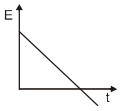
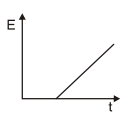
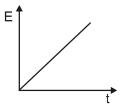
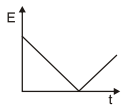
The flux through a loop varies with time according to the relation $0.1\left( t ^2-6 t \right) T - m ^2$ where t is in seconds. The induced emf in the loop varies with time according to the graph :

  • Image
  • B

    Image
  • C

    Image
  • D

    Image
Answer
Correct option: A.

Image
(A)
$e=-\frac{d \phi}{d t}=-(0.1)[2 t-6]$
Now sketch.
View full question & answer
MCQ 344 Marks
An infinite line charge produces a field of 9 x 10⁴ N/C at a distance of 2cm. Calculate the linear charge density.
  • A
    10-5 C / m
  • B
    10-6 C / m
  • 10-7 C / m
  • D
    10-8 C / m
Answer
Correct option: C.
10-7 C / m
(C) 10-7 C / m
Electric field are due to infinite line
charge, $E=\frac{\lambda}{2 \pi \varepsilon_o r}$
$E=\frac{2}{2} \times \frac{\lambda}{2 \pi \varepsilon_o r}=\frac{2 \lambda}{4 \pi \varepsilon_o r}$
putting the values, we get
$9 \times 10^4=\frac{2 \times 9 \times 10^9 \times \lambda}{2 \times 10^{-2}}$
$\lambda=\frac{9 \times 10^4 \times 2 \times 10^{-2}}{2 \times 9 \times 10^9}$
$=10^{-7} Cm ^{-1}$
View full question & answer
MCQ 354 Marks
The density of a non-uniform rod of lenght 1 m is given by $\rho(x)=\alpha\left(1+b x^2\right)$, where $a$ and $b$ are constants and $0 \leq x \leq 1$. The centre of mass of the rod will be at.
  • $\frac{3(2+b)}{4(3+b)}$
  • B
    $\frac{4(2+b)}{3(3+b)}$
  • C
    $\frac{3(3+b)}{4(2+b)}$
  • D
    $\frac{4(3+b)}{3(2+b)}$
Answer
Correct option: A.
$\frac{3(2+b)}{4(3+b)}$
A
View full question & answer
MCQ 364 Marks
A body of mass 0.5 kg travels in a straight line with velocity $v = k x { }^{ 3 / 2 }$ where $k = 5 ~ m ^{-1 / 2} s ^{-1}$. The work done by the net force during its displacement from $x=0$ to $x=2 m$ is:
  • A
    1.5 J
  • 50 J
  • C
    10 J
  • D
    100 J
Answer
Correct option: B.
50 J
(B) 50 J
use work energy theorem
W = $\frac{1}{2}$ m {[v(x = 2)]2-[v(x = 0)2]}
View full question & answer
MCQ 374 Marks
Which one of the following is not correct for circular motion of a particle:
(a) $\overrightarrow{ v }=\overrightarrow{ r } \times \overrightarrow{ \omega }$
(b) net acceleration is $\frac{ v ^2}{ r }$ towards the center
  • A
    only a
  • B
    only b
  • C
    none of a and b
  • both of a and b.
Answer
Correct option: D.
both of a and b.
D
View full question & answer
MCQ 384 Marks
A truck of mass 1400 kg is moving with a velocity of 15 m/s. A resistive force of 250N and an accelerating force 600 N act on it. The distance travelled by the truck in 10 seconds will be:
  • A
    16.25 m
  • 162.5 m
  • C
    1.625 m
  • D
    zero.
Answer
Correct option: B.
162.5 m
(B)162.5 m
$S=15 \times 10+\frac{1}{2} \frac{600-250}{1400} \times 10^2$
$=150+\frac{1}{2} \frac{350}{14}=150+\frac{25}{2}=162.5 m$
View full question & answer
MCQ 394 Marks
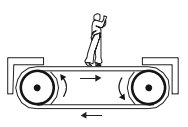
Figure shows a man of mass 55 kg standing stationary with respect to a horizontal conveyor belt that is accelerating with 1 ms-2 The net force acting on the man is:
Image
  • A
    35 N
  • B
    45 N
  • 55 N
  • D
    65 N
Answer
Correct option: C.
55 N
(C) 55 N
As the man is stationary with respect to belt, his acceleration is also 1m/s2.
Net force on him = m a=55 x 1 = 55N
View full question & answer
MCQ 404 Marks
Consider the quantities, pressure, power, energy, impulse, gravitational potential, electrical charge, temperature, area. Out of these, the only vector quantities are
  • A
    impulse, pressure and area
  • impulse and area
  • C
    area and gravitational potential
  • D
    impulse and pressure
Answer
Correct option: B.
impulse and area
B
View full question & answer
MCQ 414 Marks
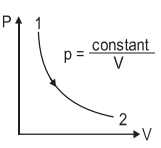
Consider p-V diagram for an ideal gas shown in figure.
Image
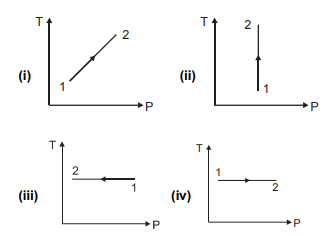
Out of the following diagrams, which figure represents the T-P diagram ?
Image
  • A
    (iv)
  • B
    (ii)
  • (iii)
  • D
    (i)
Answer
Correct option: C.
(iii)
C
View full question & answer
MCQ 424 Marks
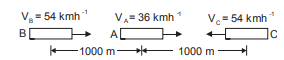
On a two-lane raod, car A is travelling with a speed of 36 kmh-1. Two cars B and C approach car A in opposite directions with a speed of 54 kmh-1 each At a certain instant, when the distance AB is equal to AC, both being 1 km, B decides to overtake A before C does. What minimum acceleration of car B is required to avoid an accident?
  • A
    2 ms-2
  • B
    5 ms-2
  • C
    1 ms-2
  • D
    10 ms-2
View full question & answer
MCQ 434 Marks
A parallel beam of light of wavelenght 500 nm falls on a narrow slit and the resulting diffraction pattern is observed on a screen 1 m away. It is observed that the first minimun is at a distance of 2.5 mm from the centre of the screen. Find the width of the slit.
  • A
    2 mm
  • B
    1mm
  • 0.2 mm
  • D
    0.1 mm
Answer
Correct option: C.
0.2 mm
(C) 0.2 mm
$\lambda=500 nm$
=500 × 109 m D =1 m, n =1, x =2.5 mm
$=2.5 \times 10^{-3} m$
$x=\frac{n D \lambda}{d}$
$d=\frac{n D \lambda}{x}=\frac{1 \times 1 \times 500 \times 10^{-9}}{2.5 \times 10^{-3}}$
$=2 \times 10^{-4} m \Rightarrow d=0.2 mm$
View full question & answer
MCQ 454 Marks
The refractive index of the material of a prism is $\sqrt{2}$ and the angle of the prism is $30^{\circ}$. One of the two refracting surfaces of the prism is made a mirror inwards, by silver coating. A beam of monochromatic light entering the prism from the other face will retrace its path (after reflection from the silvered surface) if angle of incidence on the prism is :
  • A
    zero
  • B
    $60^{\circ}$
  • C
    $30^{\circ}$
  • $45^{\circ}$
Answer
Correct option: D.
$45^{\circ}$
(D) $45^{\circ}$
$(\mu)_{\text {Prism }}=\sqrt{2}$
Prism angle $( A )=30^{\circ}$
Retracing path take place
when ray fall normaly to silvered surface
$\Rightarrow i_2=0 \quad r_2=0 \quad r_1=A=30^{\circ}$
$\left(\frac{\sin i}{\sin r}=\frac{\mu_2}{\mu_1}\right)_{\text {at first face }}$
$\frac{\sin i_1}{\sin r _1}=\frac{\sqrt{2}}{1} \Rightarrow \sin i _1=\sqrt{2} \times \sin 30^{\circ}$
$\sin i_t=\frac{1}{\sqrt{2}} \Rightarrow i_1=45^{\circ}$
View full question & answer