Question
Light of wavelength $5000\,\,\mathop A\limits^o $ falling on a sensitive surface. If the surface has received $10^{-7}\,J$ of energy, then the number of photons falling on the surface will be

Answer

Energy of one photon $=\frac{\mathrm{hc}}{\lambda}=4 \times 10^{-19}=\mathrm{E}$

$(n)$ $(\mathrm{E})=$ Energy $=10^{-7}$

$(n)$ $\left(4 \times 10^{-19}\right)=10^{-7}$

$\mathrm{n}=2.5 \times 10^{11}$

Need a full question paper?

Generate a complete, print-ready paper with questions like this in minutes — across 16+ boards, with answer keys.
Start Generating Free

Similar questions

An electron is moving along the positive $X$$-$axis. You want to apply a magnetic field for a short time so that the electron may reverse its direction and move parallel to the negative $X$$-$axis. This can be done by applying the magnetic field along
A capacitance of $2\ μF$ is required in an electrical circuit across a potential difference of $1.0\ kV$. A large number of $1\ μF$ capacitors are available which can withstand a potential difference of not more than $300\ V$. The minimum number of capacitors required to achieve this is
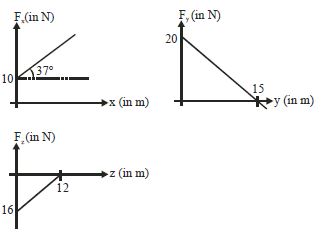
The components of a force acting on a particle are varying according to the graphs shown. To reach at point $B\, (8, 20, 0)$ from point $A\,(0, 5, 12)$ the particle moves on paths parallel to $x-$ axis then $y-$ axis and then $z-$ axis, then work done by this force is ............ $\mathrm{J}$
A planet of mass is moving around a star of mass $M$ and radius $R$ in a circular orbit of radius $r$. The star abruptly shrinks to half its radius without any loss of mass. What change will be there in the orbit of the planet?
During illness an $80\, kg$ man ran a fever of $102.2^o F$ instead of normal body temperature of $98.6^o F$. Assuming that human body is mostly water, how much heat is required to raise his temperature by that amount  .......... $kcal$ 
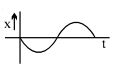
If position time graph of a particle is sine curve as shown, what will be its velocity-time graph.
The kinetic energy needed to project a body of mass $m$ from the earth surface (radius $R$) to infinity is
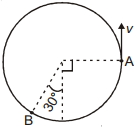
A particle of mass $m$ moves with constant speed $v$ on a circular path of radius $r$ as shown in figure. The average force on it during its motion from $A$ to $B$ is
A heavy nucleus at rest breaks into two fragments which fly off with velocities in the ratio $8 : 1$. The ratio of radii of the fragments is
A charge moving with velocity $v$ in $X$-direction is subjected to a field of magnetic induction in the negative $X$-direction. As a result, the charge will