MCQ
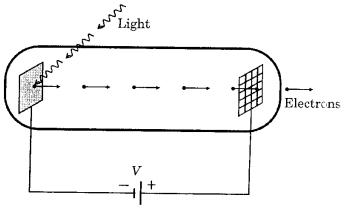
Light of wavelength $\lambda_{\text {ph }}$ falls on a cathode plate inside a vacuum tc:be as shown in the figure. The work function of the cathode surface is $\phi$ and the anode is a wire mesh of conducting material kept at a distance $d$ from the cathode. A potential difference $V$ is maintained between the electrodes. If the minimum de Broglie wavelength of th: electrons passing through the anode is $\lambda_c$, which of the following statement($s$) is(are) true?
  • A
    $\lambda_e$ decreases with increase in $\phi$ and $\lambda_{\text {ph }}$
  • B
    $\lambda_c$ is approximately halved, if $d$ is doubled
  •  For large potential difference $(V \gg \phi / e), \lambda_e$ is approximately halved if $V$ is made four times
  • D
    $\lambda_e$ increases at the same rate as $\lambda_{\text {ph }}$ for $\lambda_{\text {ph }} < h c / \phi$
Answer

Correct option: C.
 For large potential difference $(V \gg \phi / e), \lambda_e$ is approximately halved if $V$ is made four times
c
The correct option is A For large potential difference $\left(V \gg \frac{\phi}{e}\right), \lambda_e$ is approximately halved if V is made four times According to the conservation of energy principle,

$\frac{h c}{\lambda_{P h}}-\phi+e V=\frac{p_{\max }^2}{2 m}$

Now, the de-Broglie wavelength is given by,

$\lambda_e=\frac{h}{p_{\max }} \Rightarrow p_{\max }^2=\frac{h^2}{\lambda_e^2}$

$\therefore \frac{h c}{\lambda_{ Ph }}-\phi+e V=\frac{h^2}{2 m \lambda_e^2}$

When $V >> \frac{\phi}{e}$

$\Rightarrow \phi \ll e V \text { and } \frac{h c}{\lambda_{p h}}+e V=\frac{h^2}{2 m \lambda_e^2}$

$\Rightarrow \lambda_e \propto \frac{1}{\sqrt{V}}$

So, when $V$ is made four times, $\lambda_e$ is halved.

Hence, $(A)$ is the correct answer.

Need a full question paper?

Generate a complete, print-ready paper with questions like this in minutes — across 16+ boards, with answer keys.

Start Generating Free

Similar questions

In the spectrum of light of a luminous heavenly body the wavelength of a spectral line is measured to be $4747 Å$ while actual wavelength of the line is $4700 Å$. The relative velocity of the heavenly body with respect to earth will be (velocity of light is $3 \times {10^8}m/s$)
A beam of light has two wavelengths of $4972\,\mathop A\limits^o $ and $6216\,\mathop A\limits^o $ with a total intensity of $3 .6 \times  10^{- 3}\,\,Wm^{-2}$ equally distributed among the two wavelengths. The beam falls normally on an area of $1\,cm^2$ of a clean metallic surface of work function $ 2.3\,eV.$ Assume that there is no loss of light by reflection and that each capable photon ejects one electron. The number of photoelectrons liberated in $2\,s$ is approximately
A body is thrown vertically upwards. If air resistance is to be taken into account, then the time during which the body rises is
From a supply of identical capacitors rated $8\  \mu F$, $250\  V$, the minimum number of capacitors required to form a composite $16$ $\mu F$, $1000$ $V$ is :
Hard $X-$ rays for the study of fractures in bones should have a minimum wavelength of $10^{11}\, m$. The accelerating voltage for electrons in $X-$ ray machine should be
The magnifying power of a telescope can be increased by
The volume of a sphere is $1.76\ cm^3$. The volume of $25$ such spheres taking into account the significant figure is
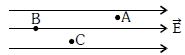
$A, B$ and $C$ are three points in a uniform electric field. The electric potential is
$300$ Joule of work is done in sliding up a $2 \,kg$ block on an inclined plane to a height of $10\, metres$. Taking value of acceleration due to gravity $‘g’ $ to be $10 \,m/s^2$, work done against friction is ........ $J$
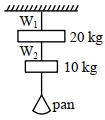
Wires ${W}_{1}$ and ${W}_{2}$ are made of same material having the breaking stress of $1.25 \times 10^{9} \,{N} / {m}^{2}$ ${W}_{1}$ and ${W}_{2}$ have cross-sectional area of $8 \times 10^{-7}\, {m}^{2}$ and $4 \times 10^{-7}\, {m}^{2}$, respectively. Masses of $20 \,{kg}$ and $10\, {kg}$ hang from them as shown in the figure. The maximum mass that can be placed in the pan without breaking the wires is $.....{kg}$ (Use $\left.{g}=10\, {m} / {s}^{2}\right)$