From a supply of identical capacitors rated $8\ \mu F$, $250\ V$, the minimum number of capacitors required to form a composite $16$ $\mu F$, $1000$ $V$ is :
Medium


Download our appand get started for free
Experience the future of education. Simply download our apps or reach out to us for more information. Let's shape the future of learning together!No signup needed.*
Similar Questions
- 1A charge $3$ coulomb experiences a force $3000$ $N$ when placed in a uniform electric field. The potential difference between two points separated by a distance of $1$ $cm$ along the field lines is.....$V$View Solution
- 2View SolutionAdielectric slab is inserted between the plates of an isolated charged capacitor. Which of the following quantities will remain the same?
- 3Between the plates of a parallel plate condenser there is $1\,mm$ thick paper of dielectric constant $4$. It is charged at $100\;volt$. The electric field in $volt/metre$ between the plates of the capacitor isView Solution
- 4Two small spheres each carrying a charge $q$ are placed $r$ metre apart. If one of the spheres is taken around the other one in a circular path of radius $r$, the work done will be equal toView Solution
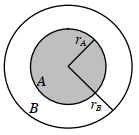
- 5In the figure, the inner (shaded) region $A$ represents a sphere of radius $r_A=1$, within which the electrostatic charge density varies with the radial distance $r$ from the center as $\rho_A=k r$, where $k$ is positive. In the spherical shell $B$ of outer radius $r_B$, the electrostatic charge density varies as $\rho_{\bar{B}}=\frac{2 k}{r}$. Assume that dimensions are taken care of. All physical quantities are in their $SI$ units.View Solution
Which of the following statement($s$) is(are) correct?
- 6The plates of a parallel plate capacitor with no dielectric are connected to a voltage source. Now a dielectric of dielectric constant $K $ is inserted to fill the whole space between the plates with voltage source remaining connected to the capacitor.View Solution
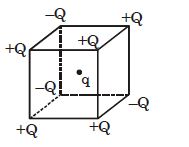
- 7Nine point charges are placed on a cube as shown in the figure. The charge $q$ is placed at the body centre whereas all other charges are at the vertices. The electrostatic potential energy of the system will beView Solution
- 8Condenser $A$ has a capacity of $15\,\mu F$ when it is filled with a medium of dielectric constant $15$. Another condenser $B$ has a capacity of $1\,\mu F$ with air between the plates. Both are charged separately by a battery of $100\;V$. After charging, both are connected in parallel without the battery and the dielectric medium being removed. The common potential now is.....$V$View Solution
- 9Two identical particles of mass m carry a charge $Q$ each. Initially one is at rest on a smooth horizontal plane and the other is projected along the plane directly towards first particle from a large distance with speed $v.$ The closest distance of approach beView Solution
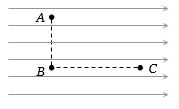
- 10Figure shows three points $A$, $B$ and $C$ in a region of uniform electric field $\overrightarrow E $. The line $AB$ is perpendicular and $BC$ is parallel to the field lines. Then which of the following holds good. Where ${V_A} > {V_B}$ and ${V_C}$ represent the electric potential at points $A$, $B$ and $C$ respectivelyView Solution