MCQ
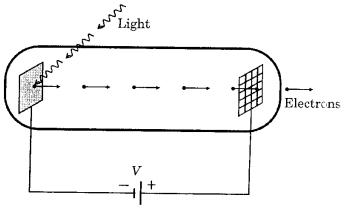
Light of wavelength $\lambda_{\text {ph }}$ falls on a cathode plate inside a vacuum tc:be as shown in the figure. The work function of the cathode surface is $\phi$ and the anode is a wire mesh of conducting material kept at a distance $d$ from the cathode. A potential difference $V$ is maintained between the electrodes. If the minimum de Broglie wavelength of th: electrons passing through the anode is $\lambda_c$, which of the following statement($s$) is(are) true?
  • A
    $\lambda_e$ decreases with increase in $\phi$ and $\lambda_{\text {ph }}$
  • B
    $\lambda_c$ is approximately halved, if $d$ is doubled
  •  For large potential difference $(V \gg \phi / e), \lambda_e$ is approximately halved if $V$ is made four times
  • D
    $\lambda_e$ increases at the same rate as $\lambda_{\text {ph }}$ for $\lambda_{\text {ph }} < h c / \phi$
Answer

Correct option: C.
 For large potential difference $(V \gg \phi / e), \lambda_e$ is approximately halved if $V$ is made four times
c
The correct option is A For large potential difference $\left(V \gg \frac{\phi}{e}\right), \lambda_e$ is approximately halved if V is made four times According to the conservation of energy principle,

$\frac{h c}{\lambda_{P h}}-\phi+e V=\frac{p_{\max }^2}{2 m}$

Now, the de-Broglie wavelength is given by,

$\lambda_e=\frac{h}{p_{\max }} \Rightarrow p_{\max }^2=\frac{h^2}{\lambda_e^2}$

$\therefore \frac{h c}{\lambda_{ Ph }}-\phi+e V=\frac{h^2}{2 m \lambda_e^2}$

When $V >> \frac{\phi}{e}$

$\Rightarrow \phi \ll e V \text { and } \frac{h c}{\lambda_{p h}}+e V=\frac{h^2}{2 m \lambda_e^2}$

$\Rightarrow \lambda_e \propto \frac{1}{\sqrt{V}}$

So, when $V$ is made four times, $\lambda_e$ is halved.

Hence, $(A)$ is the correct answer.

Need a full question paper?

Generate a complete, print-ready paper with questions like this in minutes — across 16+ boards, with answer keys.

Start Generating Free

Similar questions

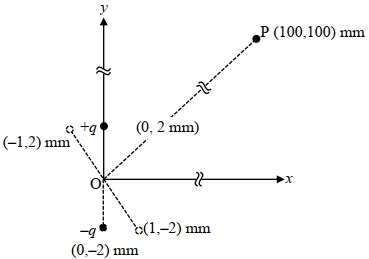
An electric dipole is formed by two charges $+q$ and $-q$ located in xy-plane at $(0,2) \mathrm{mm}$ and $(0,-2) \mathrm{mm}$, respectively, as shown in the figure. The electric potential at point $\mathrm{P}(100,100) \mathrm{mm}$ due to the dipole is $V_0$. The charges $+q$ and $-q$ are then moved to the points $(-1,2) \mathrm{mm}$ and $(1,-2) \mathrm{mm}$, respectively. What is the value of electric potential at $P$ due to the new dipole?
A galvanometer having a resistance $G$ and current $I_g$ flowing in it, produces full scale defection. If $S_1$ is the value of shunt which converts it into an ammeter of range $0-I$ and $S_2$ is the value of shunt for range $0-8I$ . Then the ratio $\frac {S_1}{S_2}$ will be
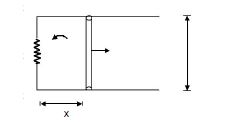
Two long parallel horizontal rails, a distance $l$ apart and each has a resistance $\lambda$ per  unit length are joined at one end by a resistance $R$. A perfectly conducting rod $MN$ of mass  $m$ is free to slide along the rails without friction. There is a uniform magnetic field of  induction $B$ normal to the plane of paper and directed into the paper. A variable force $F$ is applied to the rod $MN$ such that, as the rod moves, a constant current $i$ flows through $P$. The applied force $F$ as function of distance $x$ of the rod from $R$ is


In an experiment of meter bridge, a null point is obtained at the centre of the bridge wire. When a resistance of 10 ohm is connected in one gap, the value of resistance in other gap is
The electric field associated with an $e.m.$ wave in vacuum is given by $\vec E = \hat i\,40\,\cos \,\left( {kz - 6 \times {{10}^8}\,t} \right)$. where $E$, $z$ and $t$ are in $volt/m$, meter and seconds respectively. The value of wave factor $k$ is ....... $m^{-1}$.
Two concentric coils each of radius equal to $2\pi \,{\rm{ }}cm$ are placed at right angles to each other. $3$ $ampere$ and $4$ $ampere$ are the currents flowing in each coil respectively. The magnetic induction in $Weber/{m^2}$ at the centre of the coils will be $({\mu _0} = 4\pi \times {10^{ - 7}}\,Wb/A.m)$
Given below are two statement: one is labelled as Assertion $A$ and the other is labelled as Reason $R$.

Assertion $A:$ If an electric dipole of dipole moment $30 \times 10^{-5}\,Cm$ is enclosed by a closed surface, the net flux coming out of the surface will be zero.

Reason $R$ : Electric dipole consists of two equal and opposite charges.

In the light of above, statements, choose the correct answer from the options given below:

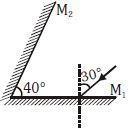
Two long plane mirrors $M_1$ and $M_2$ are kept inclined to each other. The angle between reflecting surfaces is $40^o$. The maximum number of reflections , the ray will undergo is
When light is incident on surface, photo electrons are emitted. For photoelectrons
In $YDSE$ how many maxima can be obtained on the screen if wavelength of light used is $200\,nm$ and $d = 700\, nm:$