MCQ
Line spectra are due to
  • A
    Hot solids
  • Atoms in gaseous state
  • C
    Molecules in gaseous state
  • D
    Liquid at low temperature

Answer

Correct option: B.
Atoms in gaseous state
b
Atoms in gaseous state tend to absorb waves of certain wavelength when electromagnetic waves are passed through them. When this light is projected on a photographic film, there are some dark lines caused due to the atoms absorbing waves. This discontinuous spectrum is called line spectrum.

Need a full question paper?

Generate a complete, print-ready paper with questions like this in minutes — across 16+ boards, with answer keys.
Start Generating Free

Similar questions

The radius of the smallest electron orbit in hydrogen-like ion is $(0.51\times10^{-10}/4)$ $metre$ ; then it is
The type of waves that can be propagated through solid is
In a radioactive decay process, the activity is defined as $A=-\frac{\mathrm{d} N}{\mathrm{~d} t}$, where $N(t)$ is the number of radioactive nuclei at time $t$. Two radioactive sources, $S_1$ and $S_2$ have same activity at time $t=0$. At a later time, the activities of $S_1$ and $S_2$ are $A_1$ and $A_2$, respectively. When $S_1$ and $S_2$ have just completed their $3^{\text {rd }}$ and $7^{\text {th }}$ half-lives, respectively, the ratio $A_1 / A_2$ is. . . . . . .
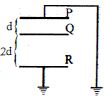
See the diagram . Area of each plate is $2.0\ m^2$ and $d = 2 \times 10^{-3}\ m$. A charge of $8.85 \times 10^{-8}\ C$ is given to $Q$. Then the potential of $Q$ becomes......$V$
A air bubble of radius $1\,cm$ in water has an upward acceleration $9.8\, cm\, s ^{-2}$. The density of water is $1\, gm\, cm ^{-3}$ and water offers negligible drag force on the bubble. The mass of the bubble is$.......gm$

$\left( g =980 \,cm / s ^{2}\right)$

A simple pendulum oscillates in air with time period $T$ and amplitude $A$. As the time passes
A submarine $(A)$ travelling at $18\, km/hr$ is being chased along the line of its velocity by another submarine $(B)$ travelling at $27\, km/hr$. $B$ sends a sonar signal of $500\, Hz$ to detect $A$ and receives a reflected sound of frequency $v$. The value of $v$ is close to ... $Hz$ (Speed of sound in water $= 1500\, ms^{-1}$)
Through a semiconductor, an electric current is due to drift of
According to Newton, the viscous force acting between liquid layers of area $A$ and velocity gradient $\Delta v/\Delta z$ is given by $F = - \eta A\frac{{\Delta v}}{{\Delta z}}$ where $\eta $ is constant called coefficient of viscosity. The dimension of $\eta $ are
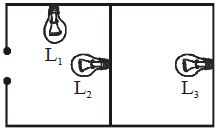
Figure shows three similar lamps $L_1, L_2$ and $L_3$ connected across a power supply. If the lamp $L_3$ fuses, how will the light emitted by $L_1$ and $L_2$ change ?