Figure shows three similar lamps $L_1, L_2$ and $L_3$ connected across a power supply. If the lamp $L_3$ fuses, how will the light emitted by $L_1$ and $L_2$ change ?
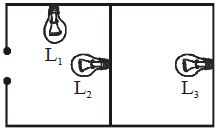
Medium


Download our appand get started for free
Experience the future of education. Simply download our apps or reach out to us for more information. Let's shape the future of learning together!No signup needed.*
Similar Questions
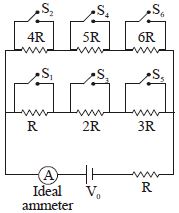
- 1Say switches $S_1, S_2$ and so on upto $S_6$ are closed, one after other in order (first $S_1$, then $S_2$) at regular intervals of $1$ minute starting from $t = 0$. The graph of current versus time is best represented asView Solution
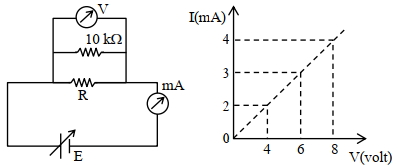
- 2To determine the resistance ($R$) of a wire, a circuit is designed below, The $V-I$ characteristic curve for this circuit is plotted for the voltmeter and the ammeter readings as shown in figure. The value of $\mathrm{R}$ is . . . . . . .$\Omega$View Solution
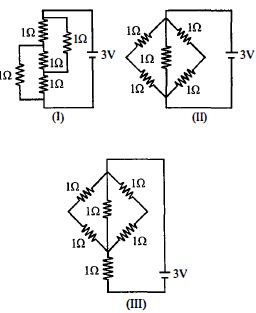
- 3The figure shows three circuits $I, II$ and $III$ which are connected to a $3\,V$ battery. If the powers dissipated by the configurations $I, II$ and $III$ are $P_1 , P_2$ and $P_3$ respectively, thenView Solution
- 4A piece of wire of resistance $4\, ohms$ is bent through $180^o$ at its mid point and the two halves are twisted together, then the resistance is ............ $ohms$View Solution
- 5View SolutionA steel wire has a resistance twice that of an aluminium wire. Both of them are connected with a constant voltage supply. More heat will be dissipated in
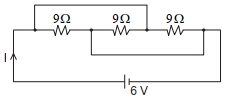
- 6The current $I$ flowing through the given circuit will be $.....A$.View Solution
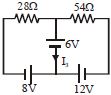
- 7Consider the circuit shown in the figure. The current $I_3$ is equal toView Solution
- 8A battery of $e.m.f.$ $3\, volt$ and internal resistance $1.0\, ohm$ is connected in series with copper voltameter. The current flowing in the circuit is $1.5\, amperes$. The resistance of voltameter will be ........... $ohm$View Solution
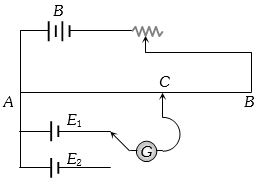
- 9The circuit shown here is used to compare the $e.m.f.$ of two cells ${E_1}$ and ${E_2}({E_1} > {E_2})$. The null point is at $C$ when the galvanometer is connected to ${E_1}$. When the galvanometer is connected to ${E_2}$, the null point will beView Solution
- 10A current of $1\, mA$ is flowing through a copper wire. How many electrons will pass a given point in one secondView Solution