MCQ
Liquids have no Poisson's ratio, because
  • It has no definite shape
  • B
    It has greater volume
  • C
    It has lesser density than solid
  • D
    None of the above

Answer

Correct option: A.
It has no definite shape
a
(a)

Need a full question paper?

Generate a complete, print-ready paper with questions like this in minutes — across 16+ boards, with answer keys.
Start Generating Free

Similar questions

A wooden object floats in water kept in a beaker. The object is near a side of the beaker. Let $P_1, P_2, P_3$ be the pressures at the three points $\mathrm{A}, \mathrm{B}$ and $C$ of bottom as shown in the figure.
A black body is at a temperature of $500 \;K$, it emits energy at a rate which is proportional to
Two vectors of magnitude $3$ & $4$ have resultant which make angle $\alpha$ & $\beta$ respectively with them $\{given\, \alpha + \beta \neq 90^o\}$
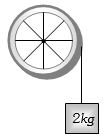
A block of mass $2\,kg$ hangs from the rim of a wheel of radius $0.5\,m$. On releasing from rest the block falls through $5\,m$ height in $2\,s$. The moment of inertia of the wheel will be ...... $kg - {m^2}$
The potential energy of a body is given by, $U =A - B{x^2}$(Where x is the displacement). The magnitude of force acting on the particle is
Vapour is injected at a uniform rate in a closed veseel which was initially evacuated. The pressure in the vessel:
At any instant of time $t$, the displacement of any particle is given by $2 t-1$ ($SI$ unit) under the influence of force of $5 \mathrm{~N}$. The value of instantaneous power is (in SI unit):
Equation of motion of a body is $\frac{d v}{d t}=-4 v+8$, where $v$ is the velocity in $m / s$ and $t$ is the time in second. Initial velocity of the particle was zero. Then,
If the distance covered by an object is directly proportional to time, then we can say that the object :
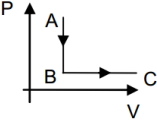
If one mole of an ideal gas goes through the process $A \rightarrow B$ and $B \rightarrow C .$ Given that $T _{ A }=400\, K ,$ and $T _{ C }=400 \,K .$ If $\frac{ P _{ B }}{ P _{ A }}=\frac{1}{5},$ then find the heat supplied to the gas (in $J$)