Question
List five characteristics by which compounds can be distinguished from mixtures.

Answer

 
MIXTURES
 
COMPOUNDS
i
A mixture can be separated into constituents by the physical processes.
i
A compound cannot be separatwd into its constituents by the physical processes.
ii
A mixture shows the properties its contituents.
ii
The properties of a compound are entirely different from those of its constituents. 
iii
Energy is usually neither given out nor absorbed in the preparation of a mixture.
iii
Energy is usually given or absorbed during the preparation of a compound.
iv
The composition of a mixture is variable.
iv
The composition of a compound is fixed.
v
A mixture does not have a fixed melting point, boiling point, etc. 
v
A compound has a fixed melting boiling point etc.

Need a full question paper?

Generate a complete, print-ready paper with questions like this in minutes — across 16+ boards, with answer keys.
Start Generating Free

Similar questions

Write the modes by which insects affect the crop yield.
Explain the transformation of energy in the following cases:
  1. A ball thrown upwards.
  2. A stone dropped from the roof of a building.
Discuss the conservation of momentum in each of the following cases:
  1. A rocket taking off from ground.
  2. Flying of a jet aeroplane.

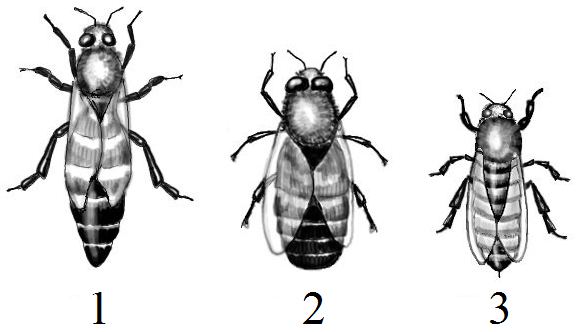
Look at Figures 1, 2 and 3 given alongside and answer the following questions.
  1. What do these figures show all together?
  2. Which one is queen bee?
  3. Which one of them is the haploid, fertile male? What is it called?
  4. What is the status of the insect shown in the figure: individual/ social?
A liquid compound X of molecular mass 18u can be obtained from a number of natural sources. All the animals and plants need liquid X for their survival. When an electric current is passed through 200 grams of pure liquid X under suitable conditions, then 178 grams of gas Y and 22 grams of gas Z are produced. Gas Y is produced at the positive electrode whereas gas Z is obtained at the negative electrode. Moreover, gas Y supports combustion whereas gas Z burns itself causing explosions.
  1. Name (i) liquid X (ii) gas Y, and (iii) gas Z
  2. What is the ratio to the mass of element Z to the mass of element Y in the liquid X?
  3. Which law of chemical combination is illustrated by this example?
  4. Name two sources of liquid X.
  5. Gate an important use of Y in our life.
What weight of oxygen gas will contain the same number of molecules as $56g$ of nitrogen gas$?$
$(O = 16u; N = 14u)$
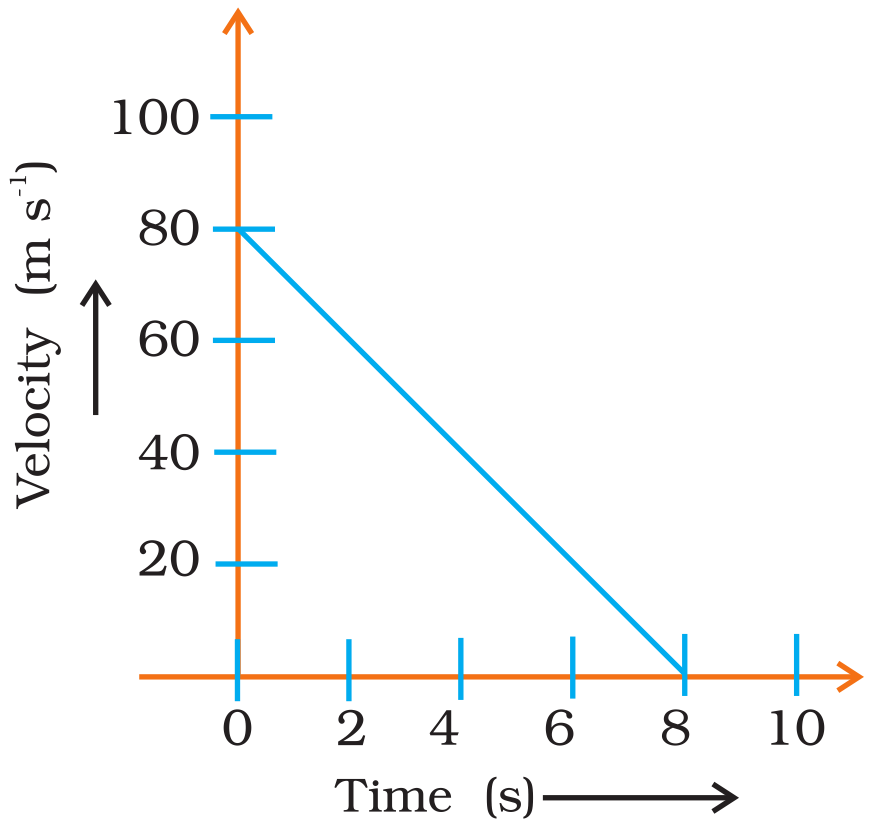
Velocity versus time graph of a ball of mass $50g$ rolling on a concrete floor is shown in Fig. Calculate the acceleration and frictional force of the floor on the ball.
How will you separate camphor, common salt and iron nails from their mixture?
Obtain a relation for the distance travelled by an object moving with a uniform acceleration in the interval between 4th and 5th second.
A ball $X$ of mass $1\ kg$ travelling at $2\ m/s$ has a head-on collision with an identical ball $Y$ at rest. $X$ stops and $Y$ moves off. Calculate the velocity of $Y$ after the collision.