Question
List the differences between a progressive and a stationary wave.

Answer

S. No.
Progressive Wave
Stationary Wave
1.
All particles have same phase and amplitude.
Amplitude varies with position.
2.
Speed of motion is same.
Speed varies with position.
3.
Energy is transported.
Energy is not transported.
4.
Same change in pressure and density is with every point.
Pressure and density varies with point.

Need a full question paper?

Generate a complete, print-ready paper with questions like this in minutes — across 16+ boards, with answer keys.
Start Generating Free

Similar questions

Show graphically how gravitational field strength varies with distance from the centre of earth, outwards. Give the relation also.
A human body excretes (removes by waste discharge, sweating, etc.) certain materials by a law similar to radioactivity. If technetium is injected in some form in a human body, the body excretes half the amount in 24 hours. A patient is given an injection containing $^{99}Tc$. This isotope is radioactive with a half-life of 6 hours. The activity from the body just after the injection is $6\mu\text{Ci}.$ How much time will elapse before the activity falls to $3\mu\text{Ci}?$
Derive an expression for the work done in an isothermal process.
Suppose an attractive nuclear force acts between two protons which may be written as $\text{F}=\text{Ce}^{-\text{kr}}/\text{r}^2.$
  1. Write down the dimensional formulae and appropriate $SI$ units of $C$ and $k.$
  2. Suppose that $k = 1\ \text{fermi}^{-1}$ and that the repulsive electric force between the protons is just balanced by the attractive nuclear force when the separation is $5$ fermi. Find the value of $C.$
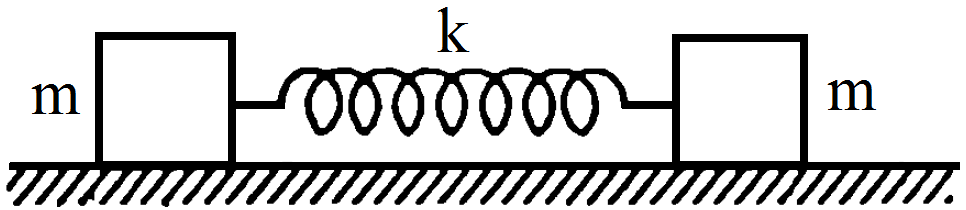
Consider the situation shown in figure Show that if the blocks are displaced slightly in opposite directions and released, they will execute simple harmonic motion. Calculate the time period.
Light in certain cases may be considered as a stream of particles called photons. Each photon has a linear momentum $\frac{\text{h}}{\lambda}$ where h is the Planck's constant and $\lambda$ is the wavelength of the light. A beam of light of wavelength $\lambda$ is incident on a plane mirror at an angle of incidence $\theta.$ Calculate the change in the linear momentum of a photon as the beam is reflected by the mirror.
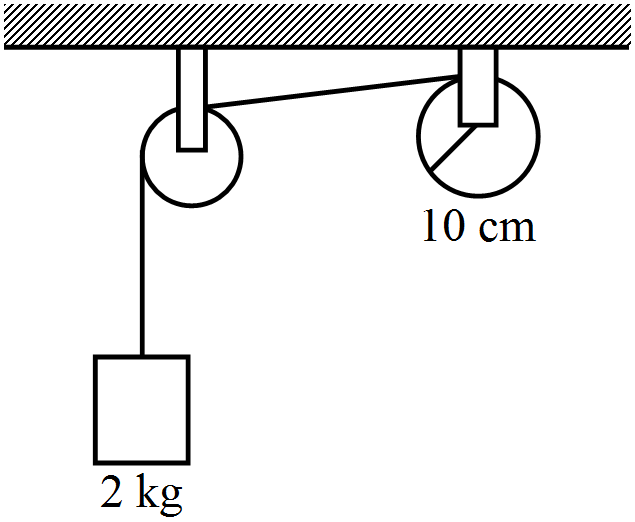
A string is wrapped on a wheel of moment of inertia $0.20kg-m^2$ and radius 10cm and goes through a light pulley to support a block of mass $2.0kg$ as shown in figure. Find the acceleration of the block.
A body of mass m is placed on the floor of a lift. Find its apparent weight when the lift is:
  1. Moving upward with uniform acceleration.
  2. Moving downward with uniform acceleration.
  3. Moving upward with constant speed.
To maintain a rotor at a uniform angular speed of $200rad s^{-1}$, an engine needs to transmit a torque of $180Nm$. What is the power required by the engine? (Note: uniform angular velocity in the absence of friction implies zero torque. In practice, applied torque is needed to counter frictional torque). Assume that the engine is 100% efficient.
An ideal gas is taken through a cyclic thermodynamic process through four steps. The amount of heat involved in these steps are $Q_1=5960 \mathrm{~J}, Q_2=-5585 \mathrm{~J} . Q_3=-2980 \mathrm{~J}$ and $Q_4=3645$ respectively. The corresponding quantities of work involved are $W_1=200 \mathrm{~J}, \mathrm{~W}_2=-825 \mathrm{~J}, \mathrm{~W}_3=-1100 \mathrm{~J}$ and $\mathrm{W}_4$ respectively. Find the value of $\mathrm{W}_4$. What is the efficiency of the cycle?