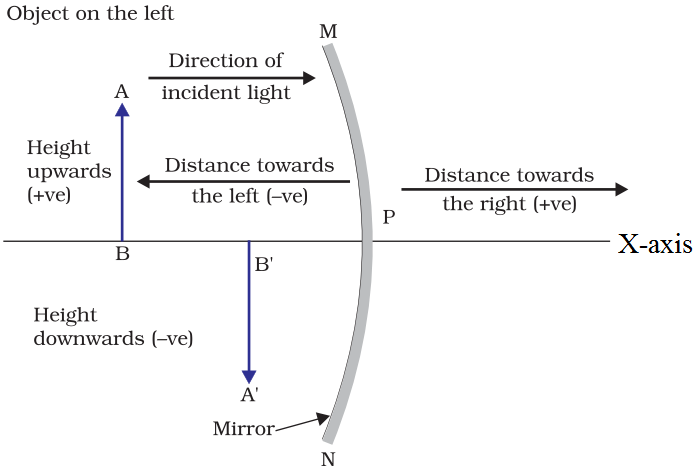
New Cartesian Sign Conventions for reflection of light by spherical mirrors are given
below: - The object is always placed to the left of the mirror. This implies that the light from the object falls on the mirror from the left-hand side.
- All distances parallel to the principal axis are measured from the pole of the mirror.
- All the distances measured to the right of the origin (along + x-axis) are taken as positive while those measured to the left of the origin (along - x-axis) are taken as negative.
- Distances measured perpendicular to and above the principal axis (along + y-axis) are taken as positive.
- Distances measured perpendicular to and below the principal axis (along - y-axis) are taken as negative.
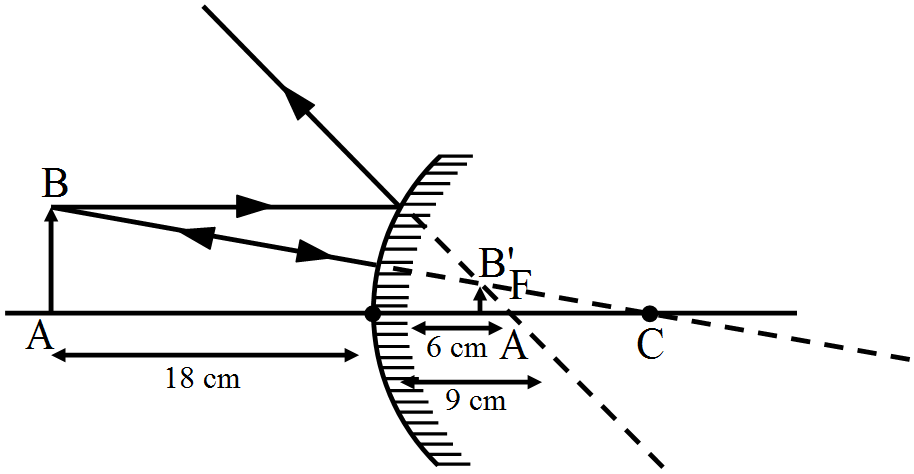
$\text{m}=\frac{1}{3}$
$\Rightarrow\text{u}=-18\text{cm}$
$\Rightarrow\text{f}=?$
$\Rightarrow\text{v}=?$
$\Rightarrow\text{m}=-\frac{\text{v}}{\text{u}}=\frac{1}{3}$
$\Rightarrow\text{v}=-\frac{\text{u}}{3}=-\frac{(-18)}{3}=-6\text{cm.}$
Now, according to mirror formula.
$\frac{1}{\text{v}}+\frac{1}{\text{u}}=\frac{1}{\text{f}}$
$\Rightarrow\frac{1}{6}+\frac{1}{(-18)}=\frac{1}{\text{f}}$
$\Rightarrow\frac{1}{\text{f}}=\frac{3-1}{18}$
$\Rightarrow\frac{1}{\text{f}}=\frac{2}{18}$
$\text{f}=9\text{cm}$
Since, the focal length is positive so, it is a convex mirror. Ray diagram: