Question
Logarithmic differentiation is a powerful technique to differentiate functions of the form $\text{f}(\text{x})=[\text{u}(\text{x})]^{\text{v}(\text{x})},$ where both u(x) and v(x) are differentiable functions and f and u need to be positive functions.

Let function $\text{y}=\text{f}(\text{x})=(\text{u}(\text{x}))^{\text{v}(\text{x})},$ then $\text{y}'=\text{y}\Big[\frac{\text{v}(\text{x})}{\text{u}(\text{x})}\text{u}'(\text{x})+\text{v}'(\text{x})\cdot\log[\text{u}(\text{x})]\Big]$

On the basis of above information, answer the following questions.

  1. Differentiate xx w.r.t. x.
  1. $\text{x}^\text{x}(1+\log\text{x})$

  2. $\text{x}^\text{x}(1-\log\text{x})$

  3. $-\text{x}^\text{x}(1+\log\text{x})$

  4. $\text{x}^\text{x}\log\text{x}$

  1. Differentiate xx + a+ xa + aa w.r.t. x.
  1. $(1+\log\text{x})+(\text{a}^\text{x}\log\text{a}+\text{ax}^{\text{a}-1})$

  2. $\text{x}^\text{x}(1+\log\text{x})+\log\text{a}+\text{ax}^{\text{a}-1}$

  3. $\text{x}^\text{x}(1+\log\text{x})+\text{x}^\text{a}\log\text{x}+\text{ax}^{\text{a}-1}$

  4. $\text{x}^\text{x}(1+\log\text{x})+\text{a}^\text{x}\log\text{a}+\text{ax}^{\text{a}-1}$

  1. If $\text{x}=\text{e}^\frac{\text{x}}{\text{y}},$ then find $\frac{\text{dy}}{\text{dx}}.$

  1. $-\frac{(\text{x}+\text{y})}{\text{x}\log\text{x}}$

  2. $-\frac{(\text{x}-\text{y})}{\text{x}\log\text{x}}$

  3. $\frac{(\text{x}+\text{y})}{\text{x}\log\text{x}}$

  4. $\frac{\text{x}-\text{y}}{\text{x}\log\text{x}}$

  1. If y = (2 - x)3(3 + 2x)5, then find $\frac{\text{dy}}{\text{dx}}.$

  1. $(2-\text{x})^3(3+2\text{x})^5\Big[\frac{15}{3+2\text{x}}-\frac{8}{2-\text{x}}\Big]$

  2. $(2-\text{x})^3(3+2\text{x})^5\Big[\frac{15}{3+2\text{x}}+\frac{3}{2-\text{x}}\Big]$

  3. $(2-\text{x})^3(3+2\text{x})^5\Big[\frac{10}{3+2\text{x}}-\frac{3}{2-\text{x}}\Big]$

  4. $(2-\text{x})^3(3+2\text{x})^5\cdot\Big[\frac{10}{3+2\text{x}}+\frac{3}{2-\text{x}}\Big]$

  1. If $\text{y}=\text{x}^\text{x}\cdot\text{e}^{(2\text{x}+5)},$ then find $\frac{\text{dy}}{\text{dx}}.$

  1. $\text{x}^\text{x}\text{e}^{2\text{x}+5}$

  2. $\text{x}^\text{x}\text{e}^{2\text{x}+5}(3-\log\text{x})$

  3. $\text{x}^\text{x}\text{e}^{2\text{x}+5}(1-\log\text{x})$

  4. $\text{x}^\text{x}\text{e}^{2\text{x}+5}\cdot(3+\log\text{x})$
Answer

  1. (a) $\text{x}^\text{x}(1+\log\text{x})$

Solution:

Let $\text{y}=\text{x}^\text{x}\Rightarrow\log\text{y}=\text{x}\log\text{x}$

$\Rightarrow\frac{1}{\text{y}}\frac{\text{dy}}{\text{dx}}=\frac{\text{d}}{\text{dx}}(\text{x}\log\text{x})$

$\Rightarrow\frac{\text{dy}}{\text{dx}}=\text{x}^\text{x}[1\times\log\text{x}+\text{x}\times\frac{1}{\text{x}}]$

$=\text{x}^\text{x}[1+\log\text{x}]$

  1. (d) $\text{x}^\text{x}(1+\log\text{x})+\text{a}^\text{x}\log\text{a}+\text{ax}^{\text{a}-1}$

  1. (d) $\frac{\text{x}-\text{y}}{\text{x}\log\text{x}}$

Solution:

Given $\text{x}=\text{e}^\frac{\text{x}}{\text{y}}\Rightarrow\log\text{x}=\frac{\text{x}}{\text{y}}\log\text{e}\Rightarrow\text{y}\log\text{x}=\text{x}$

$\Rightarrow\text{y}\frac{1}{\text{x}}+(\log\text{x})\frac{\text{dy}}{\text{dx}}=1$

$\Rightarrow\frac{\text{dy}}{\text{dx}}=\Big(1-\frac{\text{y}}{\text{x}}\Big)\frac{1}{\log\text{x}}\Rightarrow\frac{1}{\text{x}\log\text{x}}(\text{x}-\text{y})$

  1. (c) $(2-\text{x})^3(3+2\text{x})^5\Big[\frac{10}{3+2\text{x}}-\frac{3}{2-\text{x}}\Big]$

Solution:

$\text{y}=(2-\text{x})^3(3+2\text{x})^5$

$\Rightarrow\log\text{y}=\log(2-\text{x})^3+\log(3+2\text{x})^5$

$=3\log(2-\text{x})+5\log(3+2\text{x})$

$\Rightarrow\frac{1}{\text{y}}\frac{\text{dy}}{\text{dx}}=\frac{3\times(-1)}{2-\text{x}}+\frac{5}{3+2\text{x}}\times(2)$

$\Rightarrow\frac{\text{dy}}{\text{dx}}=(2-\text{x})^3(3+2\text{x})^5\Big[\frac{10}{3+2\text{x}}-\frac{3}{2-\text{x}}\Big]$

  1. (d) $\text{x}^\text{x}\text{e}^{2\text{x}+5}\cdot(3+\log\text{x})$
Solution:

$\text{y}=\text{x}^\text{x}\cdot\text{e}^{(2\text{x}+5)}$

$\Rightarrow\log\text{y}=\text{x}\log\text{x}+(2\text{x}+5)$

$\Rightarrow\frac{1}{\text{y}}\cdot\frac{\text{dy}}{\text{dx}}=\Big(\text{x}\cdot\frac{1}{\text{x}}+\log\text{x}\Big)+2$

$\Rightarrow\frac{\text{dy}}{\text{dx}}=\text{x}^\text{x}\cdot\text{e}^{2\text{x}+5}\cdot(3+\log\text{x})$
Need a full question paper?

Generate a complete, print-ready paper with questions like this in minutes — across 16+ boards, with answer keys.

Start Generating Free

Similar questions

Read the following passage and answer the questions given below. 

Image

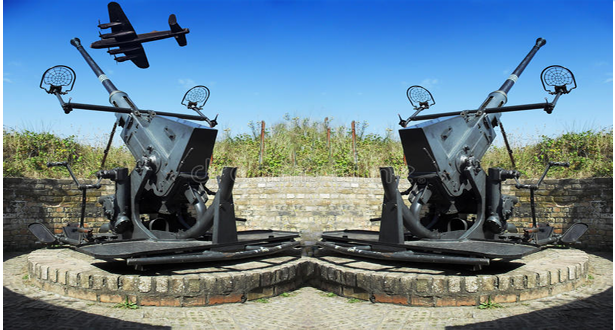
There are two antiaircraft guns, named as A and B. The probabilities that the shell fired from them hits an airplane are 0.3 and 0.2 respectively. Both of them fired one shell at an airplane at the same time.
(i) What is the probability that the shell fired from exactly one of them hit the plane?
(ii) If it is known that the shell fired from exactly one of them hit the plane, then what is the probability that it was fired from B?

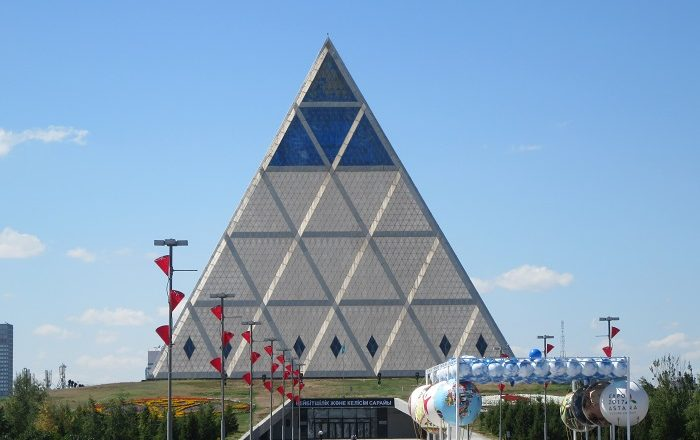
Each triangular face of the Pyramid of Peace in Kazakhstan is made up of 25 smaller equilateral triangles as shown in the figure.

Using the above information and concept of determinants, answer the following questions.
  1. If the vertices ofoneof the smaller equilateral triangle are (0, 0), $(3,\sqrt{3})$ and $(3,-\sqrt{3}),$ then the area of such triangle is:
  1. $\sqrt{3}\text{ sq}.\text{units}$
  2. $2\sqrt{3}\text{ sq}.\text{units}$
  3. $3\sqrt{3}\text{ sq}.\text{units}$
  4. None of these.
  1. The area of a face of the Pyramid is:
  1. $25\sqrt{3}\text{ sq}.\text{units}$
  2. $50\sqrt{3}\text{ sq}.\text{units}$
  3. $75\sqrt{3}\text{ sq}.\text{units}$
  4. $35\sqrt{3}\text{ sq}.\text{units}$
  1. The length of a altitude of a smaller equilateral triangle is:
  1. 2 units
  2. 3 units
  3. $\sqrt{3}\text{ units}$
  4. 4 units
  1. If (2, 4), (2, 6) are two vertices of a smaller equilateral triangle, then the third vertex will lie on the line represented by:
  1. $\text{x}+\text{y}=5$
  2. $\text{x}=1+\sqrt3$
  3. $\text{x}=2+\sqrt3$
  4. $2\text{x}+\text{y}=5$
  1. Let A(a, 0), B(0, b) and C(1, 1) be three points. If $\frac{1}{\text{a}}+\frac{1}{\text{b}}=1,$ then the three points are:
  1. Vertices of an equilateral triangle.
  2. Vertices of a right angled triangle.
  3. Collinear.
  4. Vertices of an isosceles triangle.
In a play zone, Aastha is playing crane game. It has 12 blue balls, 8 red balls, 10 yellow balls and 5 green balls. If Aastha draws two balls one after the other without replacement, then answer the following questions.

  1. What is the probability that the first ball is blue and the second ball is green?
  1. $\frac{5}{119}$

  2. $\frac{12}{119}$

  3. $\frac{6}{119}$

  4. $\frac{15}{119}$

  1. What is the probability that the first ball is yellow and the second ball is red?
  1. $\frac{16}{119}$

  2. $\frac{8}{119}$

  3. $\frac{24}{119}$

  4. None of these.

  1. What is the probability that both the balls are red?
  1. $\frac{4}{85}$

  2. $\frac{24}{595}$

  3. $\frac{12}{119}$

  4. $\frac{64}{119}$

  1. What is the probability that the first ball is green and the second ball is not yellow?
  1. $\frac{10}{119}$

  2. $\frac{6}{85}$

  3. $\frac{12}{119}$

  4. None of these.

  1. What is the probability that both the balls are not blue?
  1. $\frac{6}{595}$
  2. $\frac{12}{85}$

  3. $\frac{15}{17}$

  4. $\frac{253}{595}$
Consider 2 families A and B. Suppose there are 4 men,4 women and 4 children in family A and 2 men, 2 women and 2 children in family B. The recommend daily amount of calories is 2400 for a man, 1900 for a woman, 1800 for a children and 45 grams of proteins for a man, 55 grams for a woman and 33 grams for children.

Based on the above information, answer the following questions.

  1. The requirement of calories and proteins for each person in matrix form can be represented as:
  1. $\begin{matrix}& \ \ \ \ \ \ \ \ \ \ \ \ \ \text{Calorise}&\text{Proteins}\end{matrix}\\\begin{matrix}\text{Man}\\\text{Woman}\\\text{Children}\end{matrix}\begin{bmatrix} \ \ 2400 \ \ \ & 45\\1900 & 55\\1800& \ 33&\end{bmatrix}$
  2. $\begin{matrix}& \ \ \ \ \ \ \ \ \ \ \ \ \ \text{Calorise}&\text{Proteins}\end{matrix}\\\begin{matrix}\text{Man}\\\text{Woman}\\\text{Children}\end{matrix}\begin{bmatrix} \ \ 1900 \ \ \ & 55\\2400 & 45\\1800& \ 33&\end{bmatrix}$
  3. $\begin{matrix}& \ \ \ \ \ \ \ \ \ \ \ \ \ \text{Calorise}&\text{Proteins}\end{matrix}\\\begin{matrix}\text{Man}\\\text{Woman}\\\text{Children}\end{matrix}\begin{bmatrix} \ \ 1800 \ \ \ & 33\\1900 & 55\\2400& \ 45&\end{bmatrix}$
  4. $\begin{matrix}& \ \ \ \ \ \ \ \ \ \ \ \ \ \text{Calorise}&\text{Proteins}\end{matrix}\\\begin{matrix}\text{Man}\\\text{Woman}\\\text{Children}\end{matrix}\begin{bmatrix} \ \ 2400 \ \ \ & 33\\1900 & 55\\1800& \ 45&\end{bmatrix}$
  1. Requirement of calories of family A is:
  1. 24000
  2. 24400
  3. 15000
  4. 15800
  1. Requirement of proteins for family B is:
  1. 560 grams
  2. 332 grams
  3. 266 grams
  4. 300 grams
  1. If A and Bare two matrices such that AB = B and BA = A, then A2 + B2 equals.
  1. 2AB
  2. 2BA
  3. A + B
  4. AB
  1. If $\text{A}=(\text{a}_\text{ij})_{\text{m}\times\text{n}},\ \ \text{B}=(\text{b}_\text{ij})_{\text{n}\times\text{p}}$ and $\text{C}=(\text{c}_\text{ij})_{\text{p}\times\text{q}}$ then the product (BC) A is possible only when.
  1. m = q
  2. n = q
  3. p = q
  4. m = p
If $\text{A}=[\text{a}_\text{ij}]_{\text{m}\times\text{n}}$ and $\text{B}=[\text{b}_\text{ij}]_{\text{m}\times\text{n}}$ are two matrices, then A ± B is of order m × n and is defined as:
$(\text{A}\pm\text{B})_\text{ij}=\text{a}_\text{ij}\pm\text{b}_\text{ij},$ where i = 1, 2, ............. , m and j = 1, 2, .......... , n
If $\text{A}=[\text{a}_\text{ij}]_{\text{m}\times\text{n}}$ and $\text{B}=[\text{b}_\text{ij}]_{\text{n}\times\text{p}}$ are two matrices, then AB is of order m × p and is defined as:
$(\text{A}\text{B})_\text{ik}=\sum\limits_\text{r=1}^\text{n}\text{a}_\text{ir}\text{b}_\text{rk}=\text{a}_\text{i1}\text{b}_\text{1k}+\text{a}_\text{i2}\text{b}_\text{2k}+.....+\text{a}_\text{in}\text{b}_\text{nk}$
Consider $\text{A}=\begin{bmatrix}2&-1\\3&4\end{bmatrix},\ \text{B}=\begin{bmatrix}5&2\\7&4\end{bmatrix},\ \text{B}=\begin{bmatrix}2&5\\3&8\end{bmatrix} \text{And}\ \text{D}=\begin{bmatrix}\text{a}&\text{b}\\\text{c}&\text{d}\end{bmatrix}$
Using the concept of matrices answer the following questions.
  1. Find the product AB.
  1. $\begin{bmatrix}3&0\\43&22\end{bmatrix}$
  2. $\begin{bmatrix}0&3\\22&43\end{bmatrix}$
  3. $\begin{bmatrix}43&22\\0&3\end{bmatrix}$
  4. $\begin{bmatrix}22&43\\3&0\end{bmatrix}$
  1. If A and Bare any other two matrices such that AB exists, then
  1. BA does not exist.
  2. BA will be equal to AB.
  3. BA may or may not exist.
  4. None of these.
  1. Find the values of a and c in the matrix D such than CD - AB = 0.
  1. a = 77, c = -191
  2. a = -191, c = 77
  3. a = 191, c = 77
  4. a = 91, c = 70
  1. Find the values of band din the matrix D such that CD - AB = 0.
  1. b = 44, d = -110
  2. b = 110, d = 44
  3. b = -110, d = 44
  4. b = -44, d = 110
  1. Find B + D.
  1. $\begin{bmatrix}80&200\\115&105\end{bmatrix}$
  2. $\begin{bmatrix}84&48\\180&181\end{bmatrix}$
  3. $\begin{bmatrix}186&108\\-84&-48\end{bmatrix}$
  4. $\begin{bmatrix}-186&-108\\84&48\end{bmatrix}$
Linear programming is a method for finding the optimal values (maximum or minimum) of quantities subject to the constraints when relationship is expressed as linear equations or inequations.

Based on the above information, answer the following questions.
  1. The optimal value of the objective function is attained at the points:
  1. On X-axis.
  2. On Y-axis.
  3. Which are comer points of the feasible region.
  4. None of these.
  1. The graph of the inequality 3x + 4y < 12 is:
  1. Half plane that contains the origin.
  2. Half plane that neither contains the origin nor the points of the line 3x + 4y = 12.
  3. Whole XOY-plane excluding the points on line 3x + 4y = 12.
  4. None of these.
  1. The feasible region for an LPP is shown in the figure. Let Z = 2x + 5y be the objective function. Maximum of Z occurs at:

  1. (7, 0)
  2. (6, 3)
  3. (0, 6)
  4. (4, 5)
  1. The corner points of the feasible region determined by the system of linear constraints are (0, 10), (5, 5), (15, 15), (0, 20). Let Z = px + qy, where p, q > 0. Condition on p and q so that the maximum of Z occurs at both the points ( 15, 15) and (0, 20) is:
  1. p = q
  2. p = 2q
  3. q = 2p
  4. q = 3p
  1. The comer points of the feasible region determined by the system of linear constraints are (0, 0), (0, 40), (20, 40), (60, 20), (60, 0). The objective function is Z = 4x + 3y.

Compare the quantity in Column A and Column B

Column A
Column B
Maximum of Z
325
  1. The quantity in column A is greater.
  2. The quantity in column Bis greater.
  3. The two quantities are equal.
  4. The relationship cannot be determined on the basis of the information supplied.
On a holiday, a father gave a puzzle from a newspaper to his son Ravi and his daughter Priya. The probability of solving this specific puzzle independently by Ravi and Priya are $\frac{1}{4}$ and $\frac{1}{5}$ respectively.


Based on the above information, answer the following questions.
  1. The chance that both Ravi and Priya solved the puzzle, is:
  1. 10%
  2. 5%
  3. 20%
  4. 25%
  1. Probability that puzzle is solved by Ravi but not by Priya, is:
  1. $\frac{1}{2}$

  2. $\frac{1}{5}$

  3. $\frac{3}{5}$

  4. $\frac{1}{3}$

  1. Find the probability that puzzle is solved.
  1. $\frac{1}{2}$

  2. $\frac{1}{5}$

  3. $\frac{2}{5}$

  4. $\frac{5}{6}$

  1. Probability that exactly one of them solved the puzzle, is:
  1. $\frac{1}{30}$

  2. $\frac{1}{20}$

  3. $\frac{7}{20}$

  4. $\frac{3}{20}$

  1. Probability that none of them solved the puzzle, is:
  1. $\frac{1}{5}$

  2. $\frac{3}{5}$

  3. $\frac{2}{5}$

  4. None of these

Read the following passage and answer the questions given below. 

Image

The temperature of a person during an intestinal illness is given by $f(x)=-0.1 x^2+m x+98.6,0 \leq x \leq 12, \mathrm{~m}$ being a constant, where $\mathrm{f}(\mathrm{x})$ is the temperature in ${ }^{\circ} \mathrm{F}$ at $x$ days.

(i) Is the function differentiable in the interval $(0,12)$ ? Justify your answer.

(ii) If 6 is the critical point of the function, then find the value of the constant $\mathrm{m}$.

(iii) Find the intervals in which the function is strictly increasing/strictly decreasing.
OR
(iii) Find the points of local maximum/local minimum, if any, in the interval (0, 12) as well as the points of absolute maximum/absolute minimum in the interval [0, 12]. Also, find the corresponding local maximum/local minimum and the absolute maximum/absolute minimum values of the function. 

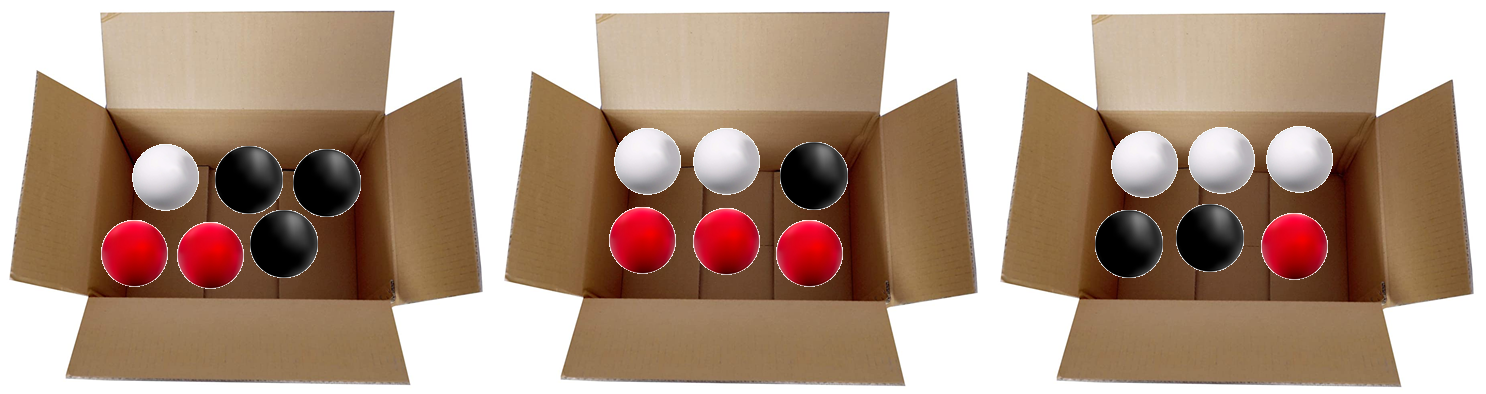
Box I contains 1 white, 3 black and 2 red balls. Box II contains 2 white, 1 black and 3 red balls. Box III contains 3 white, 2 black and 1 red balls. One box is chosen at random and two balls are drawn with replacement.

If E1, E2, E3 be the events that the balls drawn from box I, box II and box III respectively and E be the event that balls drawn are one white and one red, then answer the following questions.

  1. Probability of occurrence of event E given that the balls drawn are from box I, is:
  1. $\frac{1}{9}$

  2. $\frac{2}{6}$

  3. $\frac{3}{5}$

  4. $\frac{1}{7}$
  1. Probability of occurrence of event E, given that the balls drawn are from box II, is:
  1. $\frac{1}{3}$

  2. $\frac{1}{4}$

  3. $\frac{3}{4}$

  4. $\frac{3}{5}$
  1. Probability of occurrence of event E, given that balls drawn are from box III, is:
  1. $\frac{1}{12}$

  2. $\frac{3}{11}$

  3. $\frac{1}{6}$

  4. $\frac{4}{11}$

  1. The value of $\displaystyle{\sum^3_{\text{i}=1}}\text{P(E}|\text{E}_\text{i})$ is equal to.
  1. $\frac{5}{18}$

  2. $\frac{1}{2}$

  3. $\frac{1}{18}$

  4. $\frac{11}{18}$

  1. The probability that the balls drawn are from box II, given that event E has already occurred, is:
  1. $\frac{1}{11}$

  2. $\frac{6}{11}$

  3. $\frac{5}{11}$

  4. None of these

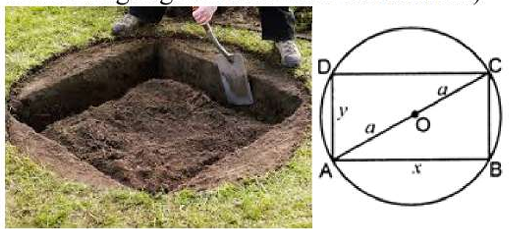
A gardener wants to construct a rectangular bed of garden in a circular patch of land. He takes the maximum perimeter of the rectangular region as possible. (Refer to the images given below for calculations) 

Image

(i) Find the perimeter of rectangle in terms of any one side and radius of circle.

(ii) Find critical points to maximize the perimeter of rectangle?

(iii) Check for maximum or minimum value of perimeter at critical point.

OR

If a rectangle of the maximum perimeter which can be inscribed in a circle of radius $10 \mathrm{~cm}$ is square, then the perimeter of region.