Question
Read the following passage and answer the questions given below. 
Image

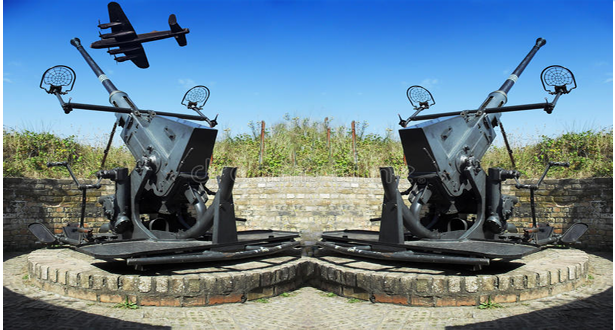
There are two antiaircraft guns, named as A and B. The probabilities that the shell fired from them hits an airplane are 0.3 and 0.2 respectively. Both of them fired one shell at an airplane at the same time.
(i) What is the probability that the shell fired from exactly one of them hit the plane?
(ii) If it is known that the shell fired from exactly one of them hit the plane, then what is the probability that it was fired from B?

Answer

Get the step-by-step solution for this question inside the Vidyadip app.

Get the answer in the app

Need a full question paper?

Generate a complete, print-ready paper with questions like this in minutes — across 16+ boards, with answer keys.

Start Generating Free

Similar questions

To promote the making of toilets for women, an organisation tried to generate awareness through (i) house call (ii) emails and (iii) announcements. The cost for each mode per attempt is given below:

  1. ₹ 50
  2. ₹ 20
  3. ₹ 40
The number of attempts made in the villages X, Y and Z are given below:
  (i) (ii) (iii)
X 400 300 100
Y 300 250 75
Z 500 400 150
Also, the chance of making of toilets corresponding to one attempt of given modes is:
  1. 2%
  2. 4%
  3. 20%
Based on the above information, answer the following questions.

  1. The cost incurred by the organisation on village X is:
  1. ₹ 10000
  2. ₹ 15000
  3. ₹ 30000
  4. ₹ 20000
  1. The cost incurred by the organisation on village Y is:
  1. ₹ 25000
  2. ₹ 18000
  3. ₹ 23000
  4. ₹ 28000
  1. The cost incurred by the organisation on village Z is:
  1. ₹ 19000
  2. ₹ 39000
  3. ₹ 45000
  4. ₹ 50000
  1. The total number of toilets that can be expected after the promotion in village X, is:
  1. 20
  2. 30
  3. 40
  4. 50
  1. The total number of toilets that can be expected after the promotion in village Z, is
  1. 56
  2. 26
  3. 36
  4. 46
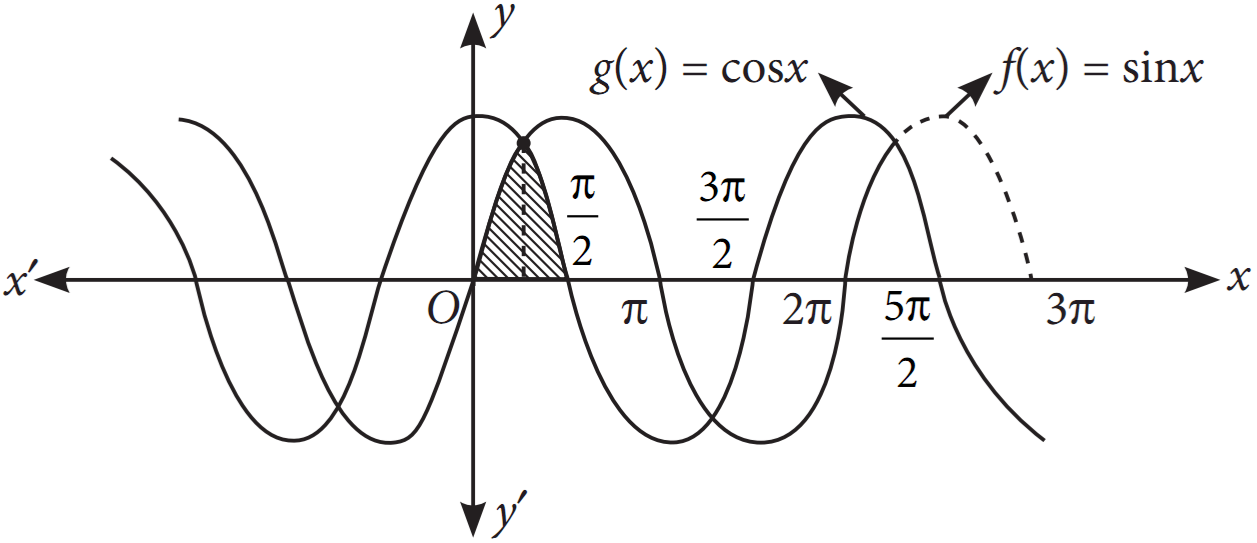
Graphs of two function $\text{f}(\text{x})=\text{sin}\text{ x}$ and $\text{(g)}\text{x}=\text{cos}\text{ x}$ is given below:

Based on the above information, answer the following questions.
  1. In $(0, \pi)$, the curves $\text{f}(\text{x})=\text{sin}\text{ x}$ and $\text{g}\text{ (x)}=\text{cos}\text{ x}$ at $\text{x}=$ 
    1. $\frac{\pi}{2}$
    2. $\frac{\pi}{3}$
    3. $\frac{\pi}{4}$
    4. ${\pi}$
  2. Value of $\int\limits_{0}^{\frac{\pi}{4}}\text{sin}\text{ x}\text{ dx}$ is.
    1. $1-\frac{1}{\sqrt{2}}$
    2. $1+\frac{1}{\sqrt{2}}$
    3. $2-\frac{1}{\sqrt{2}}$
    4. $2+\frac{1}{\sqrt{2}}$
  1. Value of $\int\limits_\frac{\pi}{4}^{\frac{\pi}{2}}\text{cos}\text{ x}\text{ dx}$ is.
    1. $1+\frac{1}{\sqrt{2}}$
    2. $1-\frac{1}{\sqrt{2}}$
    3. $2-\sqrt{2}$
    4. $2+\sqrt{2}$
  2. Value of $\int\limits_{0}^{\pi}\text{sin}\text{ x}\text{ dx}$ is.
  1. 0
  2. 1
  3. 2
  4. -2
  1. Value of $\int\limits_{0}^\frac{\pi}{2}\text{sin}\text{ x}\text{ dx}$ is.
  1. 0
  2. 1
  3. 3
  4. 4
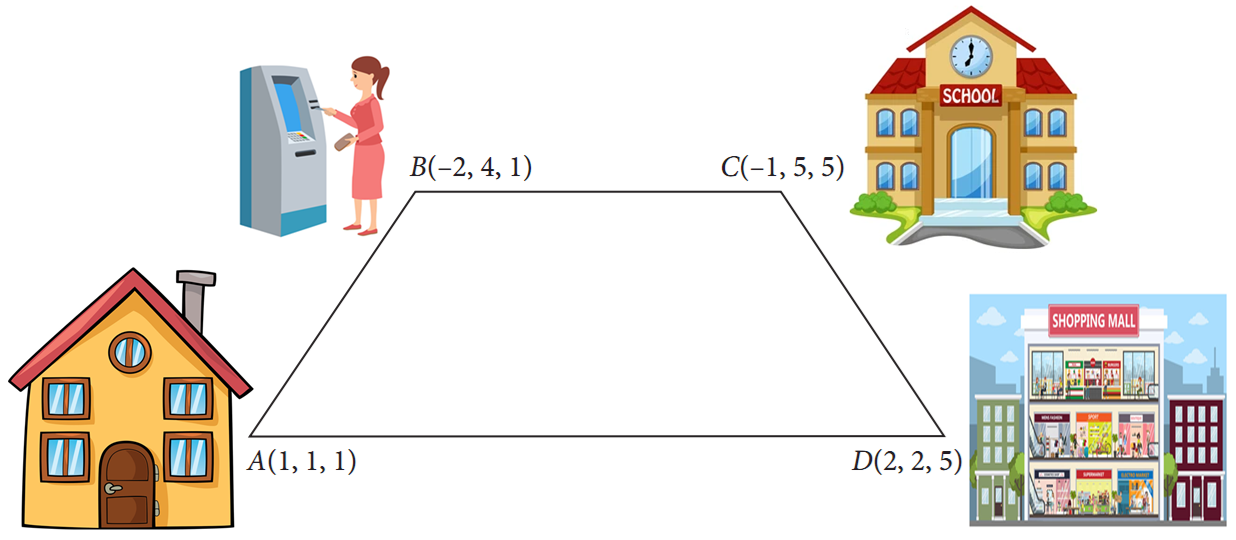
Ritika starts walking from his house to shopping mall. Instead of going to the mall directly, she first goes to a ATM, from there to her daughter's school and then reaches the mall. ln the diagram, A, B, C, and D represent the coordinates of House, ATM, School and Mall respectively.

Based on the above information, answer the following questions.
  1. Distance between House (A) and ATM (B) is:
  1. $3\text{ units}$
  2. $3\sqrt{2}\text{ units}$
  3. $\sqrt{2}\text{ units}$
  4. $4\sqrt{2}\text{ units}$
  1. Distance between ATM (B) and School (C) is:
  1. $\sqrt{2}\text{ units}$
  2. $2\sqrt{2}\text{ units}$
  3. $3\sqrt{2}\text{ units}$
  4. $4\sqrt{2}\text{ units}$
  1. Distance between School (C) and Shopping mall (D) is:
  1. $3\sqrt{2}\text{ units}$
  2. $5\sqrt{2}\text{ units}$
  3. $7\sqrt{2}\text{ units}$
  4. $10\sqrt{2}\text{ units}$
  1. What is the total distance travelled by Ritika:
  1. $4\sqrt{2}\text{ units}$
  2. $6\sqrt{2}\text{ units}$
  3. $8\sqrt{2}\text{ units}$
  4. $9\sqrt{2}\text{ units}$
  1. What is the extra distance travelled by Ritika in reaching the shopping mall?
  1. $3\sqrt{2}\text{ units}$
  2. $5\sqrt{2}\text{ units}$
  3. $6\sqrt{2}\text{ units}$
  4. $7\sqrt{2}\text{ units}$
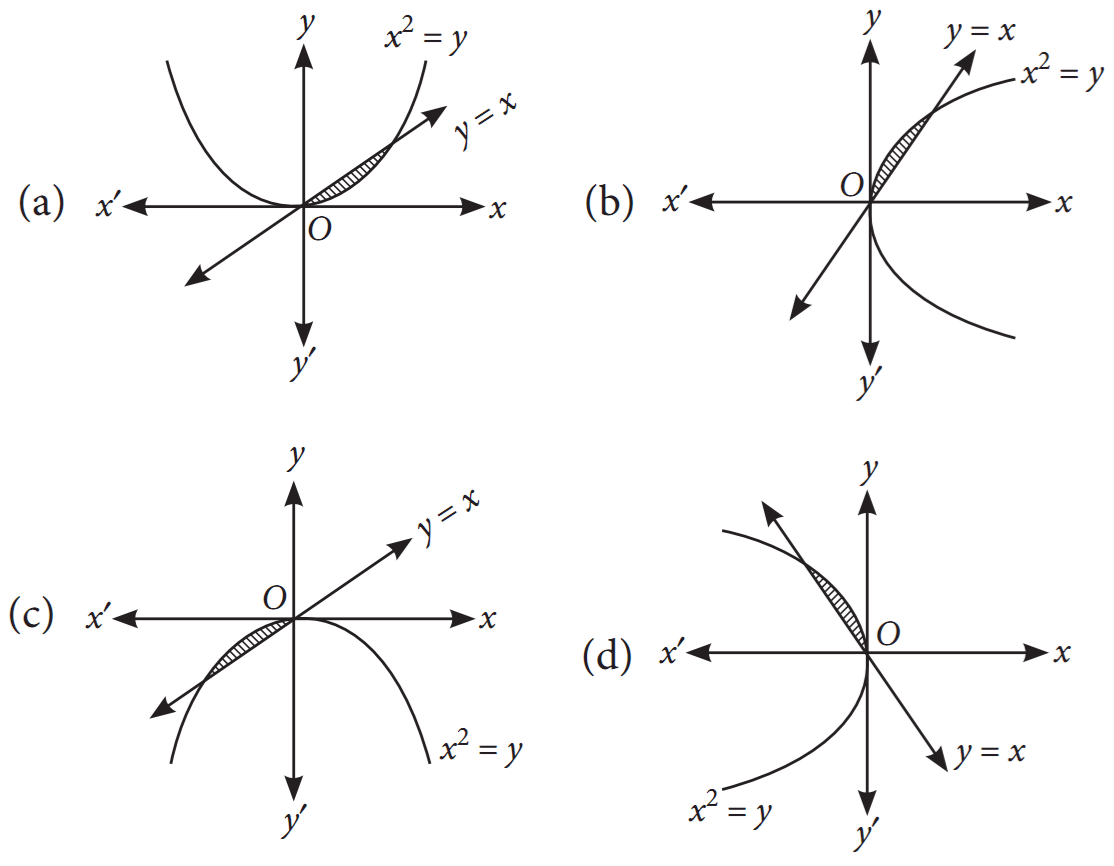
Consider the following equations of curves x2 = y and y = x.

On the basis of above information, answer the following questions.

  1. The point(s) of intersection of both the curves is (are).
  1. (0, 0)(2, 2)
  2. (0, 0)(1, 1)
  3. (0, 0)(-1, -1)
  4. (0, 0)(-2, -2)
  1. Area bounded by the curves is represented by which of the following graph?

  1. The value of the integral $\int\limits_{1}^{0}\text{x}\ \text{dx}$ is.
  1. $\frac{1}{4}$

  2. $\frac{1}{3}$

  3. $\frac{1}{2}$

  4. $1$

  1. The value of the integral $\int\limits_{0}^{1}\text{x}^2\ \text{dx}$ is.
  1. $\frac{1}{4}$

  2. $\frac{1}{3}$

  3. $\frac{1}{2}$

  4. $1$

  1. The value of area bounded by the curves x2 = y and x = y is.
  1. $\frac{1}{6}\text{ sq}.\text{unit}$

  2. $\frac{1}{3}\text{ sq}.\text{unit}$

  3. $\frac{1}{2}\text{ sq}.\text{unit}$

  4. ${1}\text{ sq}.\text{unit}$

The Government declare that farmers can get ₹ 300 per quintal for their onions on 1st July and after that, the price will be dropped by ₹ 3 per quintal per extra day. Shyams father has 80 quintal of onions in the field on 1st July, and he estimates that crop is increasing at the rate of 1 quintal per day.

Based on the above information, answer the following questions.
  1. If x is the number of days after 1st July, then price and quantity of onion respectively can be expressed as.
  1. ₹(300 - 3x), (80 + x) quintals
  2. ₹(300 - 3x), (80 - x) quintals
  3. ₹(300 + x), 80 quintals
  4. None of these
  1. Revenue R as a function of x can be represented as.
  1. R(x) = 3x2 - 60x - 24000
  2. R(x) = 3x2 + 60x - 24000
  3. R(x) = 3x2 + 40x - 16000
  4. R(x) = 3x2 - 60x - 14000
  1. Find the number of days after 1st July, when Shyam's father attain maximum revenue.
  1. 10
  2. 20
  3. 12
  4. 22
  1. On which day should Shyam's father harvest the onions to maximise his revenue?
  1. 11th July
  2. 20th July
  3. 12th July
  4. 22nd July
  1. Maximum revenue is equal to.
  1. ₹ 20,000
  2. ₹ 24,000
  3. ₹ 24,300
  4. ₹ 24,700
Three shopkeepers A, B and C go to a store to buy stationary. A purchase 12 dozen notebooks, 5 dozen pens and 6 dozen pencils. B purchases 10 dozen notebooks, 6 dozen pens and 7 dozen pencils. C purchases 11 dozen notebooks, 13 dozen pens and 8 dozen pencils. A notebook costs ₹ 40, a pen costs ₹ 12 and a pencil costs ₹ 3.

Based on the above information, answer the following questions.
  1. The number of items purchased by shopkeepers A, B and C represented in matrix form as:
  1. $\begin{matrix}\text{Notebooks}&\text{Pens}&\text{Pencils}\end{matrix}\\\begin{bmatrix}144&\ \ \ \ \ \ \ \ 60&\ \ \ \ \ 72\\120&\ \ \ \ \ \ \ \ \ 720&\ \ \ \ \ 84\\132&\ \ \ \ \ \ \ \ \ 156&\ \ \ \ \ 96\end{bmatrix}\begin{matrix}\text{A}\\\text{B}\\\text{C}\end{matrix}$
  2. $\begin{matrix}\text{Notebooks}&\text{Pens}&\text{Pencils}\end{matrix}\\\begin{bmatrix}144&\ \ \ \ \ \ \ \ 72&\ \ \ \ \ 60\\120&\ \ \ \ \ \ \ \ \ 84&\ \ \ \ \ 72\\132&\ \ \ \ \ \ \ \ \ 156&\ \ \ \ \ 96\end{bmatrix}\begin{matrix}\text{A}\\\text{B}\\\text{C}\end{matrix}$
  3. $\begin{matrix}\text{Notebooks}&\text{Pens}&\text{Pencils}\end{matrix}\\\begin{bmatrix}144&\ \ \ \ \ \ \ \ 72&\ \ \ \ \ 72\\120&\ \ \ \ \ \ \ \ \ 156&\ \ \ \ \ 84\\132&\ \ \ \ \ \ \ \ \ 84&\ \ \ \ \ 96\end{bmatrix}\begin{matrix}\text{A}\\\text{B}\\\text{C}\end{matrix}$
  4. $\begin{matrix}\text{Notebooks}&\text{Pens}&\text{Pencils}\end{matrix}\\\begin{bmatrix}144&\ \ \ \ \ \ \ \ 60&\ \ \ \ \ 60\\120&\ \ \ \ \ \ \ \ \ 84&\ \ \ \ \ 72\\132&\ \ \ \ \ \ \ \ \ 156&\ \ \ \ \ 96\end{bmatrix}\begin{matrix}\text{A}\\\text{B}\\\text{C}\end{matrix}$
  1. If Y represents the matrix formed by the cost of each item, then XY equals.
  1. $\begin{bmatrix}5741\\6780 \\8040\end{bmatrix}$
  2. $\begin{bmatrix}6696\\5916 \\7440\end{bmatrix}$
  3. $\begin{bmatrix}5916\\6696 \\7440\end{bmatrix}$
  4. $\begin{bmatrix}6740\\5740 \\8140\end{bmatrix}$
  1. Bill of A is equal to:
  1. ₹ 6740
  2. ₹ 8140
  3. ₹ 5740
  4. ₹ 6696
  1. If A2 = A, then (A + 1)- 7A =
  1. A
  2. A - I
  3. I
  4. A + I
  1. If A and B are 3 × 3 matrices such that A2 - B2 = (A - B) (A+ B), then
  1. Either A or B is zero matrix.
  2. Either A or B is unit matrix.
  3. A = B
  4. AB = BA
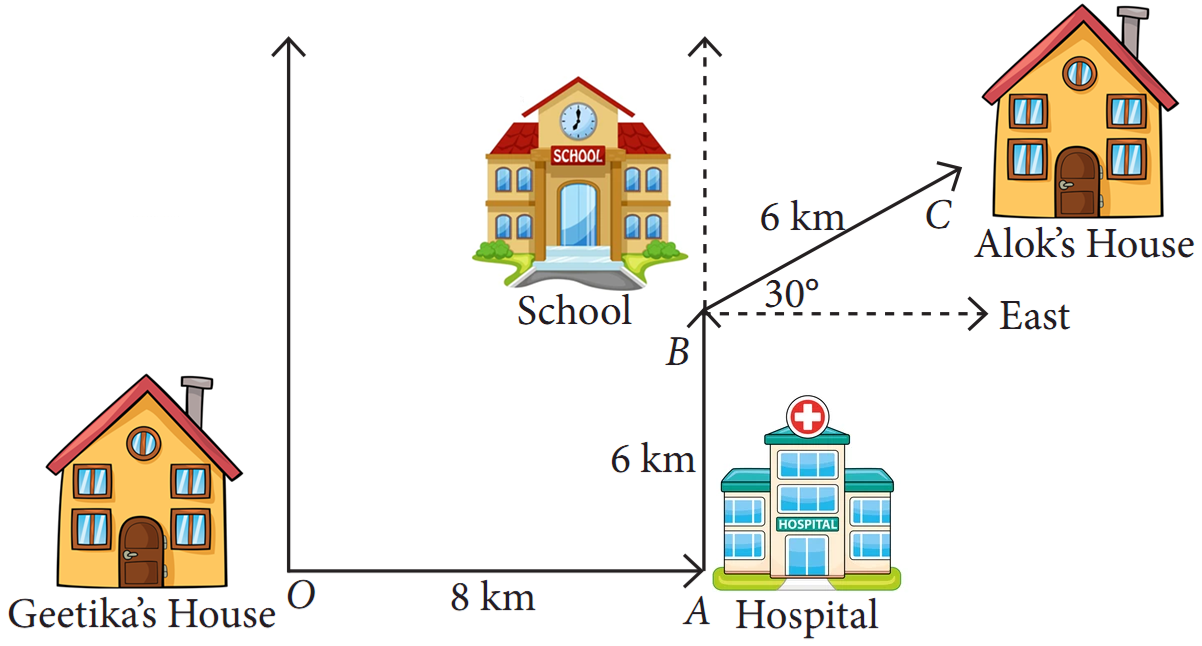
Geetika's house is situated at Shalimar Bagh at point O, for going to Alok's house she first travels 8km by bus in the East. Here at point A, a hospital is situated. From Hospital, Geetika takes an auto and goes 6km in the North, here at point B school is situated. From school, she travels by bus to reach Alok's house which is at 30º East, 6km from point B.

Based on the above information, answer the following questions.
  1. What is the vector distance between Geetika's house and school?
  1. $8\hat{\text{i}}-6\hat{\text{j}}$
  2. $8\hat{\text{i}}+6\hat{\text{j}}$
  3. $8\hat{\text{i}}$
  4. $6\hat{\text{j}}$
  1. How much distance Geetika travels to reach school?
  1. 14km
  2. 15km
  3. 16km
  4. 17km
  1. What is the vector distance from school to Alok's house?
  1. $\sqrt{3}\hat{\text{i}}+\hat{\text{j}}$
  2. $3\sqrt{3}\hat{\text{i}}+3\hat{\text{j}}$
  3. $6\hat{\text{i}}$
  4. $6\hat{\text{j}}$
  1. What is the vector distance from Geetika's house to Alok's house?
  1. $(8+3\sqrt{3})\hat{\text{i}}+9\hat{\text{j}}$
  2. $4\hat{\text{i}}+6\hat{\text{j}}$
  3. $15\hat{\text{i}}$
  4. $16\hat{\text{j}}$
  1. What is the total distance travelled by Geetika from her house to Alok's house?
  1. 19km
  2. 20km
  3. 21km
  4. 22km
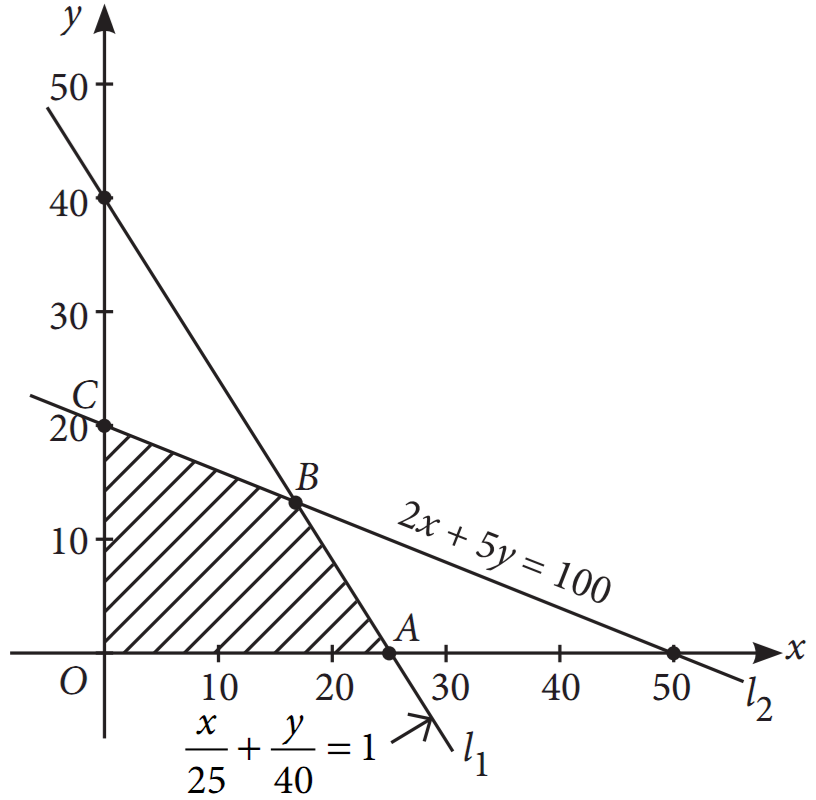
Deepa rides her car at 25 km/ hr. She has to spend ₹ 2 per km on diesel and if she rides it at a faster speed of 40 km/ hr, the diesel cost increases to ₹ 5 per km. She has ₹ 100 to spend on diesel. Let she travels x kms with speed 25 km/ hr and y kms with speed 40 km/ hr. The feasible region for the LPP is shown below:

Based on the above information, answer the following questions.

  1. What is the point of intersection of line l1 and l2?
  1. $\Big(\frac{40}{3},\frac{50}{3}\Big)$

  2. $\Big(\frac{50}{3},\frac{40}{3}\Big)$

  3. $\Big(\frac{-50}{3},\frac{40}{3}\Big)$

  4. $\Big(\frac{-50}{3},\frac{-40}{3}\Big)$

  1. The comer points of the feasible region shown in above graph are:
  1. $(0,25),(20,0),\Big(\frac{40}{3},\frac{50}{3}\Big)$

  2. $(0, 0), (25, 0), (0, 20) $

  3. $(0,0),\Big(\frac{40}{3},\frac{50}{3}\Big),(0,20)$

  4. $(0,0),(25,0),\Big(\frac{50}{3},\frac{40}{3}\Big),(0,20)$

  1. If Z = x + y be the objective function and max Z = 30. The maximum value occurs at point:
  1. $\Big(\frac{50}{3},\frac{40}{3}\Big)$
  2. (0, 0)
  3. (25, 0)
  4. (0, 20)
  1. If Z = 6x - 9y be the objective function, then maximum value of Z is:
  1. -20
  2. 150
  3. 180
  4. 20
  1. If Z = 6x + 3y be the objective function, then what is the minimum value of Z?
  1. 120
  2. 130
  3. 0
  4. 150
Three friends Ravi, Raju and Rohit were doing buying and selling of stationery items in a market. The price of per dozen of pen, notebooks and toys are Rupees $\mathrm{x}, \mathrm{y}$ and $\mathrm{z}$ respectively.

Ravi purchases 4 dozen of notebooks and sells 2 dozen of pens and 5 dozen of toys. Raju purchases 2 dozen of toy and sells 3 dozen of pens and 1 dozen of notebooks. Rohit purchases one dozen of pens and sells 3 dozen of notebooks and one dozen of toys.

In the process, Ravi, Raju and Rohit earn ₹1500, ₹100 and ₹ 400 respectively.

Image

(i) Write the above information in terms of matrix Algebra.

(ii) What is the total price of one dozen of pens and one dozen of notebooks?

(iii) What is the sale amount of Ravi?

OR

What is the amount of purchases and sales made by all three friends?

x and y are the sides of two squares such that y = x - x2. Find the rate of change of the area of second square with respect to the area of first square.