Question
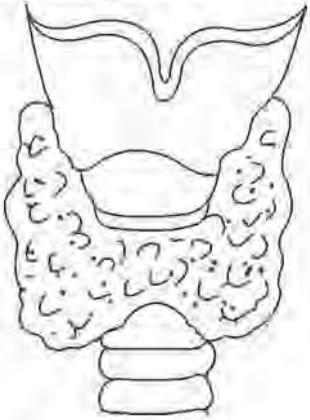
✓
Answer
(i) Thyroid gland
(ii) Thyroxine regulates basal metabolism of the body.
(iii) Iodine
(ii) Thyroxine regulates basal metabolism of the body.
(iii) Iodine
Need a full question paper?
Generate a complete, print-ready paper with questions like this in minutes — across 16+ boards, with answer keys.
Explore more
Similar questions
State Mendel’s law of Independent Assortment.
Differentiate Between Transpiration and Guttation.
The diagram represents the ‘closed system’ or ‘double circulation’ of blood in mammals.
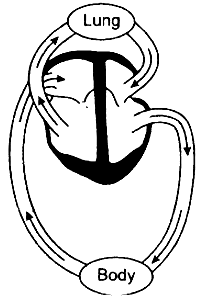
Justify the above statement.
State two structural and two functional differences between the arteries and veins.
State the changes in the composition of blood as it passes through the following organs:
$(a)$ Lungs $(b)$ Gut $(c)$ Liver $(d)$ Kidneys.
→Justify the above statement.
State two structural and two functional differences between the arteries and veins.
State the changes in the composition of blood as it passes through the following organs:
$(a)$ Lungs $(b)$ Gut $(c)$ Liver $(d)$ Kidneys.
Given below is a diagrammatic representation of a defect of the human eye:
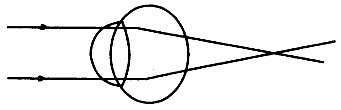
(i) Identify the defect.
(ii) Mention two reasons for the above defect.
(iii) State how the defect can be rectified.
(iv) Name the part of the eye responsible for maintaining the shape of the eyeball.
(i) Identify the defect.
(ii) Mention two reasons for the above defect.
(iii) State how the defect can be rectified.
(iv) Name the part of the eye responsible for maintaining the shape of the eyeball.
How is mitosis important?
Give Reasons for the following:
Transplanting of seedlings to a flowerbed in the evening is better than doing so in the morning.
Transplanting of seedlings to a flowerbed in the evening is better than doing so in the morning.
Draw a labeled diagram of sperm.
The diagram below represents a structure found in a leaf.
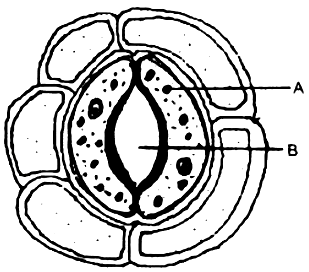
Study the same and answer the questions that follow:
(i) Name the pis labeled A and B.
(ii) What is the biological term for the above structure?
(iii) What is the function of the part labeled A?
(iv) Mention two structural features of A, which help in the function mentioned in (iii) above.
(v) Where is this structure likely to be found in a leaf?
(vi) The above structure helps in the process of transpiration. Explain the term transpiration.
(vii) How many other cells are found surrounding this structure as seen in the diagram?
Study the same and answer the questions that follow:
(i) Name the pis labeled A and B.
(ii) What is the biological term for the above structure?
(iii) What is the function of the part labeled A?
(iv) Mention two structural features of A, which help in the function mentioned in (iii) above.
(v) Where is this structure likely to be found in a leaf?
(vi) The above structure helps in the process of transpiration. Explain the term transpiration.
(vii) How many other cells are found surrounding this structure as seen in the diagram?
Differentiate between the following:
Pulmonary artery and pulmonary vein
Pulmonary artery and pulmonary vein
The apparatus arranged here signifies an important process.
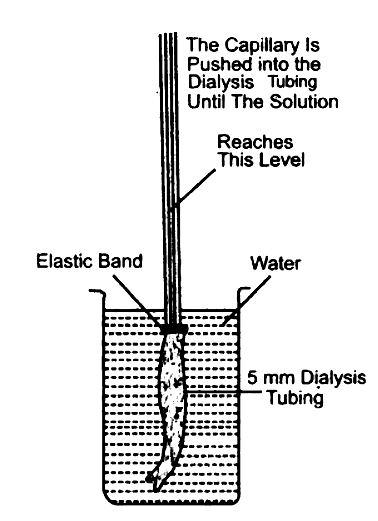
(i) Name the process.
(ii) Where does this process occur in plants?
(iii) What solution is placed inside the dialysis tubing?
(iv) What happens to the level of the solution in the capillary tube?
(v) Define the process mentioned in Q. (i) above.
(i) Name the process.
(ii) Where does this process occur in plants?
(iii) What solution is placed inside the dialysis tubing?
(iv) What happens to the level of the solution in the capillary tube?
(v) Define the process mentioned in Q. (i) above.