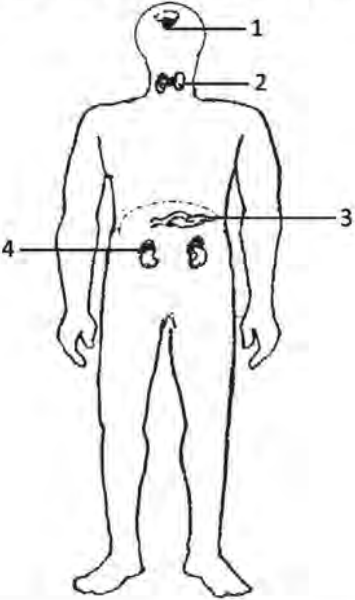
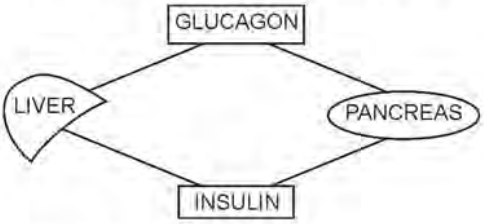
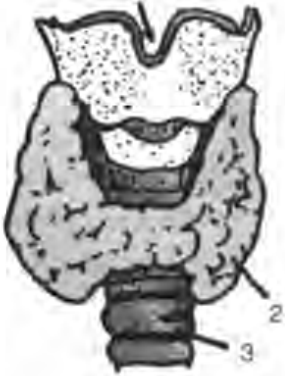
Question 13 Marks
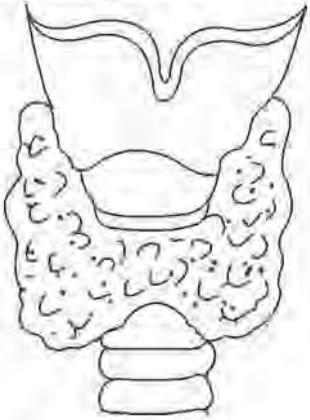
Answer
View full question & answer→(i) Thyroid gland
(ii) Thyroxine regulates basal metabolism of the body.
(iii) Iodine
(ii) Thyroxine regulates basal metabolism of the body.
(iii) Iodine
8 questions · timed · auto-graded
| Diabetes insipidus | Diabetes mellitus |
| This is due to under-secretion of anti-diuretic hormone. | This is due to failure of secretion of insulin. |
| It is marked by loss of excess water in urine. | It is marked by loss of excess glucose in urine. |
| Osmotic balance of the body is disturbed. | Total metabolism of the body is disturbed. |
| Body's healing power is not affected. | Body's healing capacity is impaired. |
| Hormone | Enzyme |
| They are produced by endocrine glands. | They are produced by exocrine glands. |
| Chemically they may be proteins, steroids or their derivatives. | All enzymes are proteins. |
| They are secreted at one site and act at another. | They act at their site of secretion or pass through ducts to their site of action. |
| Hormone-regulated processes are not reversible. | Enzyme-mediated reactions are reversible. |
| "They are effective in low concentration. Their under-secretion or over-secretion affects body metabolism and growth." | They act in low concentration. An increase or decrease in their concentration affects the rate of the process." |
| They act either slowly or rapidly. | They act quickly. |
| Endocrine Glands | Exocrine Glands |
| These are ductless glands. | They may or may not have ducts. |
| They pour secretion directly into the blood. | The secretion is poured directly at the site of action or reaches the target. |
| They secrete hormones. | They secrete enzymes. |
| They control long-term activities of target organs, e.g., thyroid glands. | They control short-term activity, e.g., gastric gland. |
| Nervous Control | Hormonal Control |
| The information is sent in the form of electric signals. | The information is sent in the form of chemical signals. |
| The signals travel through nerve fibres to specific target cells like muscle fibres and glands. | The signals travel through bloodstream to cells in different organs. |
| The nervous system causes muscles to contract or relax, glands to secrete more or less. But it cannot bring about growth. | Endocrine system brings about changes in metabolic activities of all body tissues. It affects growth. |
| Action is immediate (within few milliseconds). | Action is slow (can take hours or days to produce response). |
| Effect lasts for a short time. | Effect is more lasting and permanent. |