Longitudinal stress of $1\,kg/m{m^2}$ is applied on a wire. The percentage increase in length is $(Y = {10^{11}}\,N/{m^2})$
Medium


Download our appand get started for free
Experience the future of education. Simply download our apps or reach out to us for more information. Let's shape the future of learning together!No signup needed.*
Similar Questions
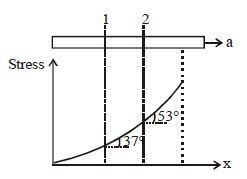
- 1Rod of constant cross-section moves towards right with constant acceleration. Graph of stress and distance from left end is given as in figure. If density of material of rod at cross section $1$ is $9$ $\frac{{gm}}{{c{m^3}}}$ . Find density at cross section $2$.View Solution
.......... $\mathrm{gm} / \mathrm{cm}^{3}$
- 2An aluminium rod with Young's modulus $Y =7.0$ $\times 10^{10} N / m ^2$ undergoes elastic strain of $0.04 \%$. The energy per unit volume stored in the rod in SI unit is:View Solution
- 3A uniform wire (Young's modulus $2 \times 10^{11}\, Nm^{-2}$ ) is subjected to longitudinal tensile stress of $5 \times 10^7\,Nm^{-2}$ . If the over all volume change in the wire is $0.02\%,$ the fractional decrease in the radius of the wire is close toView Solution
- 4What must be the lengths of steel and copper rods at $0^o C$ for the difference in their lengths to be $10\,cm$ at any common temperature? $(\alpha_{steel}=1.2 \times {10^{-5}} \;^o C^{-1})$ and $(\alpha_{copper} = 1.8 \times 10^{-5} \;^o C^{-1})$View Solution
- 5A wire of length $L$ and radius $r$ is rigidly fixed at one end. On stretching the other end of the wire with a force $F$, the increase in its length is $l$. If another wire of same material but of length $2L$ and radius $2r$ is stretched with a force of $2F$, the increase in its length will beView Solution
- 6View SolutionThe value of Young's modulus for a perfectly rigid body is ...........
- 7A meter scale of mass $m$ , Young modulus $Y$ and cross section area $A$ is hanged vertically from ceiling at zero mark. Then separation between $30\ cm$ and $70\ cm$ mark will be :-( $\frac{{mg}}{{AY}}$ is dimensionless)View Solution
- 8A wire of diameter $1mm$ breaks under a tension of $1000\, N.$ Another wire, of same material as that of the first one, but of diameter $2\, mm$ breaks under a tension of ...... $N$View Solution
- 9Compressibility per unit atm. pressure of water is $'\sigma '$ and if due to pressure $P$ there is decrement in volume $V$, find change is volumeView Solution
- 10View SolutionA stretched rubber has