MCQ
Lorentz force is:
  • A
    Electrostatic force acting on a charged particle.
  • B
    Magnetic force acting on a moving charged particle.
  • The vector sum of electrostatic and magnetic force acting on a moving charged particle.
  • D
    The vector sum of gravitational and magnetic force acting on a moving charged particle

Answer

Correct option: C.
The vector sum of electrostatic and magnetic force acting on a moving charged particle.

Need a full question paper?

Generate a complete, print-ready paper with questions like this in minutes — across 16+ boards, with answer keys.

Start Generating Free

Similar questions

The simplest type of $AC$ voltage or current is the one which.
The ratio of de-Broglie wavelength of a a-particle to that of a proton being subjected to the same magnetic field so that the radii of their path are equal to each other assuming the field induction vector $\vec B$ is perpendicular to the velocity vectors of the a-particle and the proton is 
The circular boundary of the concave mirror subtends a cone of half angle $\theta$ at its centre of curvature. The minimum value of $\theta$ for which ray incident on this mirror parallel to the principle axis suffers reflection more than one is......$^o$
The output voltage (taken across the resistance) of a $L-C-R$ series resonant circuit falls to half its peak value at a frequency of $200 \,Hz$ and again reaches the same value at $800 \,Hz$. The bandwidth of this circuit is ............. $\,Hz$
Electric potential can be calculated in a:
If intensity of each wave in the observed interference pattern in Young's double slit experiment is $I_0$. then for some point $P$ where the phase difference is $\phi $ , intensity $I$ will be
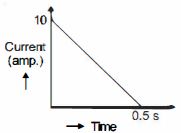
In a coil of resistance $100\ \Omega$ , a current is induced by changing the magnetic flux through it as shown in the figure. The magnitude of change in flux through the coil is......$Wb$
In Young's double slit experiment, the two slits act as coherent sources of equal amplitudeAand wavelength $\lambda$ . In another experiment with the same setup the two slits are sources of equal amplitudeAand wavelength $\lambda$ but are incoherent. The ratio of the intensity of light at the midpoint of the screen in the first case to that in the second case is
The upper limit temperature of a super conductor is:
Two sources give interference pattern which is observed on a screen, $D$ distance apart from the sources. The fringe width is $2w$. If the distance $D$ is now doubled, the fringe width will