MCQ
${M^{ + 3}}$ ion loses $3{e^ - }$. Its oxidation number will be
  • A
    $0$
  • B
    $+3$
  • $+6$
  • D
    $-3$

Answer

Correct option: C.
$+6$
(c) $2$ $×$ No. of ${e^ - }$ losses = Oxi. no.

$2 \times 3{e^ - } = + 6$.

Need a full question paper?

Generate a complete, print-ready paper with questions like this in minutes — across 16+ boards, with answer keys.
Start Generating Free

Similar questions

The heat of neutralization of a strong acid and a strong alkali is $57.0 \,kJ\, mol^{-1}.$ The heat released when $0.5$ mole of $HNO_3$ solution is mixed with $0.2\,mole$ of $KOH$ is....$kJ$
Ionisation energy in group $I-A$ varies in the decreasing order as
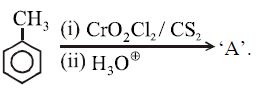
Product $A$ in the reaction will be
For an aqueous solution, the characteristic species of acid is
Which of the following pair has elements containing same number of electrons in the outermost orbit
Highest $pH =14$  is given by
Answer the following by appropriately matching the lists based on the information given in the paragraph Consider the Bohr's model of a one-electron atom where the electron moves around the nucleus. In the following $List-I$ contains some quantities for the $n^{t /}$ orbit of the atom and $List-II$ contains options showing how they depend on $n$.

Which of the following options has the correct combination considering $List-I$ and $List-II$?

$List-I$ $List-II$
$(I)$ Radius of the $n^{\text {th }}$ orbit $(P)$ $\propto n ^{-2}$
$(II)$ Angular momentum of the electron in the $n^{\text {th }}$ orbit $(Q)$ $\propto n ^{-1}$
$(III)$ Kinetic energy of the electron in the $n^{\text {th }}$ orbit $(R)$ $\propto n ^0$
$(IV)$ Potential energy of the electron in the $n^{\text {th }}$ orbit $(S)$ $\propto n ^1$
  $(T)$ $\propto n ^2$
  $(U)$ $\propto n ^{1 / 2}$

($1$) Which of the following options has the correct combination considering $List-I$ and $List-II$?

$(1) (II), (R)$ $(2) (I), (P)$ $(3) (I), (T)$ $(4) (II), (Q)$

($2$) Which of the following options has the correct combination considering $List-I$ and $List-II$?

$(1) (III), (S)$ $(2) (IV), (Q)$ $(3) (IV),(U)$ $(4) (III), (P)$

Give the answer or quetion ($1$) and ($2$)

An element $(A)$ occurs in the short period having electronic configuration $ns^2\,np^1$. The formula of its oxide will be
The value of $\Delta S$ for freezing of $10\,g$ of $H_2O(l)$ (enthalpy of fusion is $80 \, cal/g$) at $0\,^oC$ and $1\, atm$ pressure is.......$J/K$
Zinc sulphate contains $22.65\%$ of zinc and $43.9\%$ of water of crystallization. If the law of constant proportions is true, then the weight of zinc required to produce $20\, g$ of the crystals will be ............. $\mathrm{g}$