MCQ
Maatch Liat $I$ List $II$

Chose the correct answer from the options given below
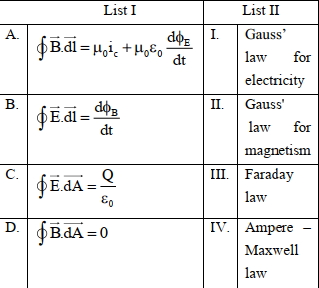
  • A
    $ A-IV, B-I, C-III, D-II$
  • B
    $ A-II, B-III, C-I, D-IV$
  • $ A-IV, B-III, C-I, D-II$
  • D
     $A-I, B-II, C-III, D-IV$

Answer

Correct option: C.
$ A-IV, B-III, C-I, D-II$
c
Ampere - Maxwell law

$\rightarrow \oint \overrightarrow{\mathrm{B}} \cdot \overrightarrow{\mathrm{dl}}=\mu_0 i_c+\mu_0 \varepsilon_0 \frac{\mathrm{d} \phi_{\mathrm{E}}}{\mathrm{dt}}$

Faraday law $\rightarrow \oint \overrightarrow{\mathrm{E}} \cdot \overrightarrow{\mathrm{dl}}=\frac{\mathrm{d} \phi_{\mathrm{B}}}{\mathrm{dt}}$

Gauss' law for electricity $\rightarrow \oint \vec{E} \cdot \overrightarrow{d A}=\frac{Q}{\varepsilon_0}$

Gauss ' law for magnetism $\rightarrow \oint \vec{B} \cdot \overrightarrow{d A}=0$

Need a full question paper?

Generate a complete, print-ready paper with questions like this in minutes — across 16+ boards, with answer keys.

Start Generating Free

Similar questions

Two similar wires under the same load yield elongation of $0.1$ $mm$ and $0.05$ $mm$ respectively. If the area of cross- section of the first wire is $4m{m^2},$ then the area of cross section of the second wire is..... $mm^2$
A ring is rolling on an inclined plane. The ratio of the linear and rotational kinetic energies will be
Two beams of light having intensities $I$ and $4I$ interfere to produce a fringe pattern on a screen. The phase difference between the beams is $\frac{\pi }{2}$ at point $A$ and $\pi$ at point $B$. Then the difference between the resultant intensities at $A$ and $B$ is
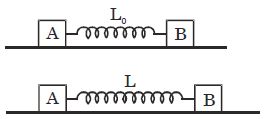
$A$ and $B$ are two identical blocks made of a conducting material. These are placed on a horizontal frictionless table and connected by a light conducting spring of force constant $‘K’$. Unstretched length of the spring is $L_0$. Charge $Q/2$ is given  to each block. Consequently, the spring stretches to an equilibrium length $L$. Value of $Q$ is
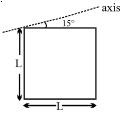
A square plate of mass $M$ and edge $L$ is shown in figure. The moment of inertia of the plate about the axis in the plane of plate passing through one of its vertex making an angle $15^o$ from horizontal is. 
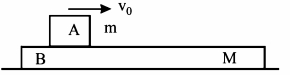
The masses of blocks A and B are $m$ and $M$ respectively. Between $A$ and $B$, there is a constant frictional force $F$ and $B$ can slide on a smooth horizontal surface. A is set in motion with velocity while $B$ is at rest. What is the distance moved by A relative to $B$ before they move with the same velocity?
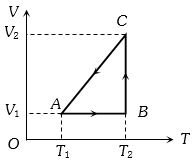
A cyclic process for $1\, mole$ of an ideal gas is shown in figure in the $V-T,$ diagram. The work done in $AB, BC$ and $CA$ respectively
Four blocks are connected as shown in the fig. on a horizontal frictionless surface of $m_1 = m_2 = m_3 = m_4$ then $T_3/T_4$ will be
As the temperature of water increases, its viscosity
In Young's experiment, monochromatic light is used to illuminate the two slits $A$ and $B.$ interference fringes are observed on a screen placed infront of the slits. Now if a thin  glass plate is placed normally in the path of the beam coming from the slit $A$, then