Question
Magnetic lines of force due to a bar magnet do not intersect because

Answer

Magnetic lines of force due to a bar magnet do not intersect because a point always has a single net magnetic field.

Need a full question paper?

Generate a complete, print-ready paper with questions like this in minutes — across 16+ boards, with answer keys.
Start Generating Free

Similar questions

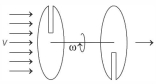
Two parallel discs are connected by a rigid rod of length $L=0.5 \,m$ centrally. Each disc has a slit oppositely placed as shown in the figure. A beam of neutral atoms are incident on one of the discs axially at different velocities $v$, while the system is rotated at angular speed of $600 \,rev / second$, so that atoms only with a specific velocity emerge at the other end. Calculate the two largest speeds (in metre/second) of the atoms that will emerge at the other end.
A current $i$ is flowing in a conductor of length $l$. When it is bent in the form of a circular  loop then its magnetic moment will be-
$A$ uniform copper wire carries a current $i$ amperes and has $p$ carriers per meter$^3$. The length of the wire is $\lambda$ meters and its cross-section area is $s$ meter $^2$. If the charge on a carrier is $q$ coulombs, the drift velocity in $ms^{-1}$ is given by
According to Joule's law of heating, heat produced $H = {I^2}\,Rt$, where I is current, $R$ is resistance and $t$ is time. If the errors in the measurement of $I, R$ and t are $3\%, 4\% $ and $6\% $ respectively then error in the measurement of $H$ is
Which of the following is deflected by electric field
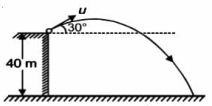
Figure shows a projectile thrown with speed $u=20 \,m / s$ at an angle $30^{\circ}$ with horizontal from the top of a building $40 \,m$ high. Then the horizontal range of projectile is ........... $m$
This question has statement $1$ and statement $2$ . Of the four choices given after the statements, choose the one that best describes the two statements. 
Statement $- 1$: A point particle of mass m moving with speed $u$ collides with stationary point particle of mass $M$. If the maximum energy loss possible is given as $f$ $\left( {\frac{1}{2}m{v^2}} \right)$ then $ f = \left( {\frac{m}{{M + m}}} \right)$ 

Statement $-2$: Maximum energy loss occurs when the particles get stuck together as a result of the collision.

A wire of mass $m$ and length $l$ is bent in the form of a circular ring, the moment of inertia of the ring about its axis is
A charged particle having drift velocity of $7.5 \times 10^{-4}\, ms ^{-1}$ is an electric field of $3 \times 10^{-10}\, Vm ^{-1}$ has a mobility in $m ^{2} V ^{-1} s ^{-1}$ of 
Assertion $(A):$ A spherical equipotential surface is not possible for a point charge.

Reason $(R):$ A spherical equipotential surface is possible inside a spherical capacitor.