A charged particle having drift velocity of $7.5 \times 10^{-4}\, ms ^{-1}$ is an electric field of $3 \times 10^{-10}\, Vm ^{-1}$ has a mobility in $m ^{2} V ^{-1} s ^{-1}$ of
NEET 2020, Easy


Download our appand get started for free
Experience the future of education. Simply download our apps or reach out to us for more information. Let's shape the future of learning together!No signup needed.*
Similar Questions
- 1Two electric bulbs marked $25\ W - 220\ V$ and $100\ W - 220\ V$ are connected in series to a $440\ V$ supply. Which of the bulbs will fuse?View Solution
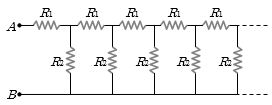
- 2An infinite sequence of resistance is shown in the figure. The resultant resistance between $A$ and $B$ will be, when ${R_1} = 1\,ohm$ and ${R_2} = 2\,ohm$ ............. $\Omega$View Solution
- 3View SolutionIt is easier to start a car engine on a hot day than on a cold day. This is because the internal resistance of the car battery
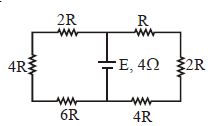
- 4A battery of internal resistance $4\,\Omega $ is connected to the network of the resistance as shown in Fig. If the maximum power can be delivered to the network, the magnitude of $R$ in $\Omega $ should beView Solution
- 5Two wires each of radius of cross section $r$ but of different materials are connected together end to end (in series). If the densities of charge carriers in the two wires are in the ratio $1 : 4$, the drift velocity of electrons in the two wires will be in the ratio:View Solution
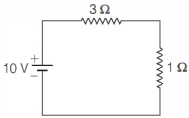
- 6In the following circuit, $1 \,\Omega$ resistor dissipates power $P$. If the resistor is replaced by $9 \,\Omega$, the power dissipated in it isView Solution
- 7The current flowing through $R _2$ is:View Solution
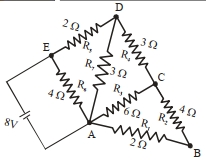
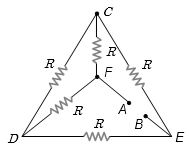
- 8Five equal resistances each of resistance $R$ are connected as shown in the figure. A battery of $V\, volts$ is connected between $A$ and $B$. The current flowing in $AFCEB$ will beView Solution
- 9A source of $e.m.f.$ $E = 15\,V$ and having negligible internal resistance is connected to a variable resistance so that the current in the circuit increases with time as $i = 1.2 t + 3$. Then, the total charge that will flow in first five second will be ............... $C$View Solution
- 10The current flowing through a conductor connected across a source is $2\,A$ and $1.2\,A$ at $0^{\circ}\,C$ and $100^{\circ}\,C$ respectively. The current flowing through the conductor at $50^{\circ}\,C$ will be $......\times 10^2\,mA$.View Solution