MCQ
Many elements have non-integral atomic masses because :
- AThey have isotopes
- BTheir isotopes have non-integral masses
- CTheir isotopes have different masses
- ✓The constituents neutrons, protons and electrons combine to give fractional masses
Eg. $Cl ; z =17$ and $A =35$ and $37$. They are present in the ratio $3: 1$.
$\therefore \frac{3 \times 35+1 \times 37}{4}=35.5( A )$
Generate a complete, print-ready paper with questions like this in minutes — across 16+ boards, with answer keys.
| List $I$ | List $II$ |
| $1E_1\,\,1E_2\,\,1E_3$ | |
| $(A)$ $1510$ $-$ $-$ | $(1)$ $H$ |
| $(B)$ $495$ $6500$ $10200$ | $(2)$ $Li$ |
| $(C)$ $840$ $1630$ $13100$ | $(3)$ $Be$ |
| $(D)$ $600$ $2050$ $3100$ | $(4)$ $B$ |
( $1E$ in $KJ\,mol^{-1}$ )

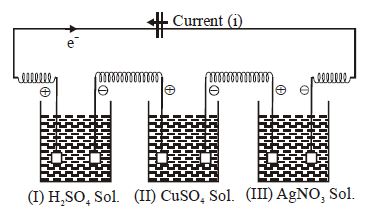
A current was passed for $10$ hours. $10.8\ g\ Ag$ was deposited at cathode in $(III)$ electrolytic cell during electrolysis if current efficiency is $50\%.$
What is magnitude of the current in ampere ?