Need a full question paper?

Generate a complete, print-ready paper with questions like this in minutes — across 16+ boards, with answer keys.

Start Generating Free

Similar questions

Molecule having non-polar as well as polar bonds but the molecule as a whole is polar
$Fe ^{3+}$ is reduced to $Fe ^{2+}$ by using

$(A)$ $H _2 O _2$ in presence of $NaOH$

$(B)$ $Na _2 O _2$ in water

$(C)$ $H _2 O _2$ in presence of $H _2 SO _4$

$(D)$ $Na _2 O _2$ in presence of $H _2 SO _4$

The correct $IUPAC$ name of $\left[\mathrm{PtBr}_2\left(\mathrm{PMe}_3\right)_2\right]$ is:
Given below are two statements: one is labelled as Assertion $(A)$ and the other is labelled as Reason $(R)$.

Assertion $(A)$ : Haloalkanes react with $\mathrm{KCN}$ to form alkyl cyanides as a main product while with $\mathrm{AgCN}$ form isocyanide as the main product.

Reason $(R)$ : $\mathrm{KCN}$ and $\mathrm{AgCN}$ both are highly ionic compounds.

In the light of the above statement, choose the most appropriate answer from the options given below:

According to $MO$ theory the bond orders for $O _2{ }^{2-}$, $CO$ and $NO ^{+}$respectively, are
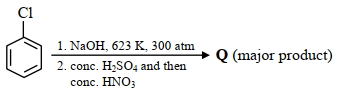
The weight percentage of hydrogen in $Q$, formed in the following reaction sequence, is. . . . 

[Given : Atomic mass of $H =1, C =12, N =14, O =16, S =32, Cl =35$ ]
Acid strength of oxy acids of chlorine follows the order
$0.02\,mole$ of $[Co(NH_3)_5Br]Cl_2$ and $0.02\,mole$ of $[Co(NH_3)_5Cl]SO_4$ are present in $200 \,cc$ of a solution $X$. The number of moles of the precipitates $Y$ and $Z$ that are formed when the solution $X$ is treated with excess silver nitrate and excess barium chloride are respectively
Conductivity of $0.001\  M$ aq.solution of $Na_2SO_4$ is found to be $2.6 × 10^{-3}\  S\, cm^{-1}$ at $25\,^oC$. If limiting molar conductance of $Na^+$ is $50\  S\, cm^2 \,mol^{-1}$, then limiting molar conductance of $SO_4^{2-}$ will be .............. ${\rm{S}}\,{\rm{c}}{{\rm{m}}^2}{\rm{mo}}{{\rm{l}}^{ - 1}}$ (neglect conductivity of water).
How many $EDTA$ molecules are required to make an octahedral complex with a $Ca^{2+}$ ion?