Question 14 Marks
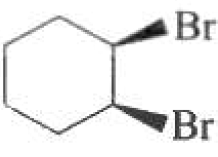
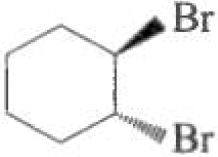
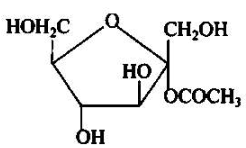
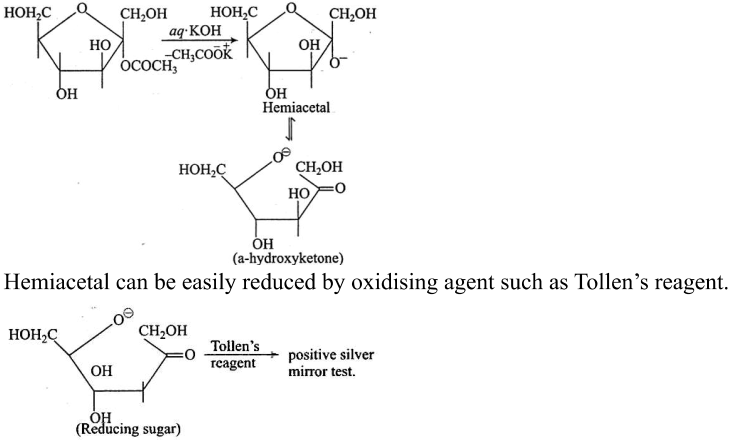
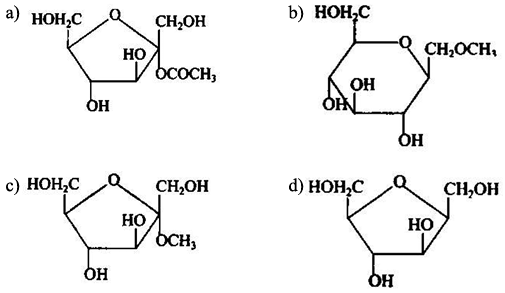
Which of the following compounds will behave as a reducing sugar in an aqueous KOH solution?
Question 24 Marks
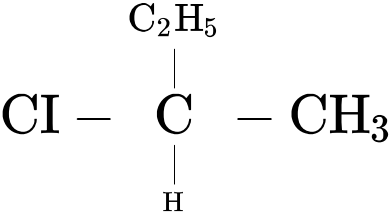
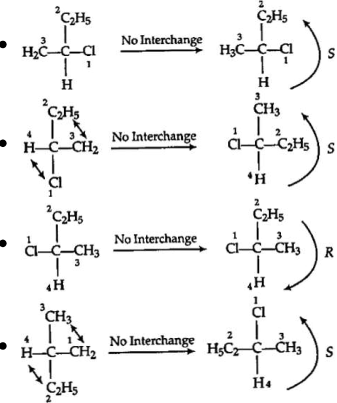
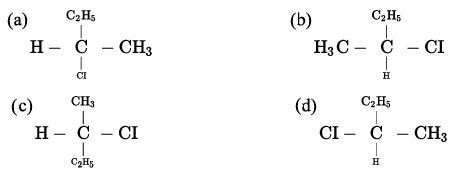
$CH _3- CHCI - CH _2- CH _3$ has a chiral centre which one of the following represents its R - configuration?
View full question & answer→MCQ 34 Marks
When iodine reacts with sodium thiosulphate, the oxidation state of sulphur changes from +4 to __________ .
- A
- B
- C
$+\frac{3}{2}$
- D
$+\frac{5}{2}$
AnswerD. $+\frac{5}{2}$
Explanation:
$I_2+2 \stackrel{+4}{S_2} O_{3(a q)}^{2-} \rightarrow \stackrel{+\frac{5}{S^2}}{S_4} O_{6(a q)}^{2-}+2 I_{(a q)}^{-}$
S has fractional oxidation state in the product.
View full question & answer→MCQ 44 Marks
Which techniques is based on the difference in the solubilities of the compound and the impurities in a suitable solvent?
AnswerA. Crystallisation
Explanation:
Crystallisation process is based on the difference in the solubilities of the compound and the impurities in a suitable solvent.
The impure compound is dissolved in a solvent in which it is sparingly soluble at room temperature but appreciably soluble at higher temperature.
View full question & answer→MCQ 54 Marks
- A
$A \longrightarrow CH _3 COOH , B\longrightarrow CH _3 COONa$
- B
$A \longrightarrow NH _4 OH , B \longrightarrow NH _4 Cl$
- C
$A \longrightarrow NH _4 OH , B \longrightarrow NaCl$
- D
$A \longrightarrow KCl , B \longrightarrow NH _4 OH$
View full question & answer→MCQ 64 Marks
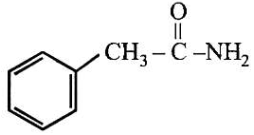
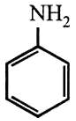
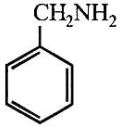
Which of the following compounds can be prepared in good yield by Gabriel phthalimide synthesis?
- A
$CH _3- CH _2- NHCH _3$
- B
- C
- D
View full question & answer→MCQ 74 Marks
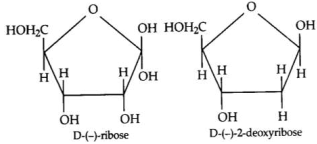
RNA and DNA are chiral molecules, their chirality is due to:
- A
- B
chiral phosphate ester units
- C
- D
View full question & answer→MCQ 84 Marks
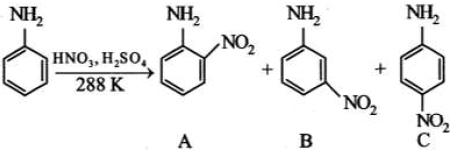
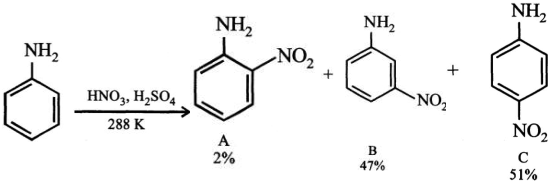
Consider the given reaction, percentage yield of:
- A
A $>$ C $>$ B
- B
C $>$ A $>$ B
- C
C $>$ B $>$ A
- D
B $>$ C $>$ A
View full question & answer→MCQ 94 Marks

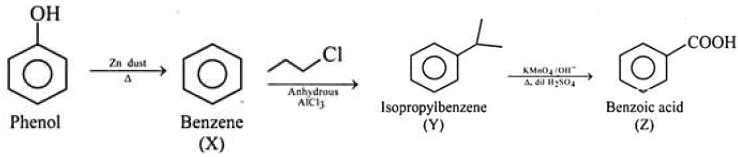
Predict Y and Z.
- A
Y = -Propylbenzene, Z = 2 Propylbenzaldehyde
- B
Y = Isopropylbenzene, Z = Benzoic acid
- C
Y = Isopropylbenzene, Z = Phenol
- D
Y = Propylphenol, Z = Benzophenone
View full question & answer→MCQ 104 Marks
AnswerB. pent-3-en-2-ol
Explanation:
pent-3-en-2-ol
View full question & answer→MCQ 114 Marks
Propene on hydroboration oxidation produces:
- A
$CH _3 CH _2 CH _2 O$
- B
$CH _3 CH _2 CHO$
- C
$CH _3 CHOHCH _2 OH$
- D
$CH _3 CHOHCH _3$
AnswerA. $CH _3 CH _2 CH _2 O$
Explanation:
Anti-Markovnikov addition of $H _2 O$ on alkene.
View full question & answer→MCQ 124 Marks
The following statements are TRUE about crystal field theory except:
AnswerD.It considers s , p and d orbitals of the central metal.
Explanation:
In crystal field theory, only d orbitals of the central metal are considered. There is no explanation for s and p orbitals.
View full question & answer→MCQ 134 Marks
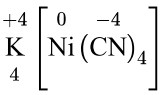
In the coordination compound $K _4\left[ Ni ( CN )_4\right]$, the oxidation state of nickel is:
View full question & answer→MCQ 144 Marks
When neutral or faintly alkaline $KMnO _4$ is treated with potassium iodide, iodide ion is converted into $X . X$ is __________
- A
$IO _3^{-}$
- B
$IO ^{-}$
- C
$I _2$
- D
$IO _4^{-}$
AnswerA. $IO _3^{-}$
Explanation:
In neutral or faintly alkaline $KMnO _4$ solution, iodide ion is converted into iodate.
$2 MnO_4^{-}+H_2 O+I^{-} \rightarrow 2 MnO_2+2 OH^{-}+IO_3^{-}$
View full question & answer→MCQ 154 Marks
When conc. $H _2 SO _4$ was treated with $K _4\left[ Fe ( CN )_6\right]$, CO gas was evolved. By mistake, somebody used dilute $H _2 SO _4$ instead of conc. $H _2 SO _4$ then the gas evolved was:
View full question & answer→MCQ 164 Marks
If outermost E.C. of Ce is $4 f ^1 5 d^1 6 s^2$, then select the incorrectly matched outermost E.C. of its various ions in ground state:
- A
$Ce ^{2+} \longrightarrow 4 f ^1 5 d^1$
- B
$Ce ^{3+} \longrightarrow 4 f ^1$
- C
$Ce ^{4+} \longrightarrow 4 f ^0$
- D
$Ce ^{2+} \longrightarrow 4 f ^2$
AnswerA. $Ce ^{2+} \longrightarrow 4 f ^1 5 d^1$
Explanation:
$Ce ^{2+} \longrightarrow 4 f ^2$
View full question & answer→MCQ 174 Marks
For a first order reaction, $A \rightarrow P , t _{\frac{1}{2}}$ (half-life) is 10 days. The time required for $\frac{1}{4}^{\text {th }}$ conversion of $A$ (in days) is: (In $2=0.693$, In $3=1.1$ ).
AnswerD. 4.1
Explanation:
The half life $t _{\frac{1}{2}}=10$ days The decay constant,
$K=\frac{0.693}{t_{\frac{1}{2}}}=\frac{0.693}{10 \text { days }}=0.0693 \text { days }^{-1}$
The time required for one fourth conversion
$\begin{array}{l}
t=\frac{2.303}{k} \log _{10} \frac{a}{a-x} \\
=\frac{2.303}{0.0693 day ^{-1}}\log _{10} \frac{1}{1-\left(\frac{1}{4}\right)}=4.1 \text { days }
\end{array}$
View full question & answer→MCQ 184 Marks
For a first order reaction $A \longrightarrow$ Product, the initial concentration of A is 0.1 M and after 40 minute it becomes 0.025 M . Calculate the rate of reaction at reactant concentration of 0.01 M .
- A
$3.47 \times 10^{-5} M min ^{-1}$
- B
$1.735 \times 10^{-6} M min ^{-1}$
- C
$3.47 \times 10^{-4} M min ^{-1}$
- D
$1.735 \times 10^{-4} M min ^{-1}$
AnswerC. $3.47 \times 10^{-4} M min ^{-1}$
Explanation:
$\begin{array}{l} K =\frac{2.303}{40} \log \frac{0.1}{0.025} \\ \therefore K=0.03466 min^{-1} \\ \text { rate }= K \times 0.01=0.03466 \times 0.01=3.47 \times 10^{-4} M min ^{-1}\end{array}$
View full question & answer→MCQ 194 Marks
Which of the following statements is incorrect for salt bridge?
- A
It maintains electrical neutrality of two half-cell solution.
- B
It prevents mixing of the electrolytic solutions.
- C
It completes the electrical circuit.
- D
It prevents the flow of current between the two half-cells.
AnswerD. It prevents the flow of current between the two half-cells
View full question & answer→MCQ 204 Marks
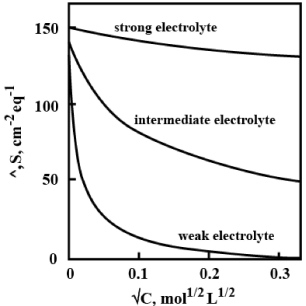
$AgNO _3$ (aq.) was added to an aqueous KCl solution gradually and the conductivity of the solution was measured. The plot of conductance $(\Lambda)$ versus the volume of $AgNO _3$ is:
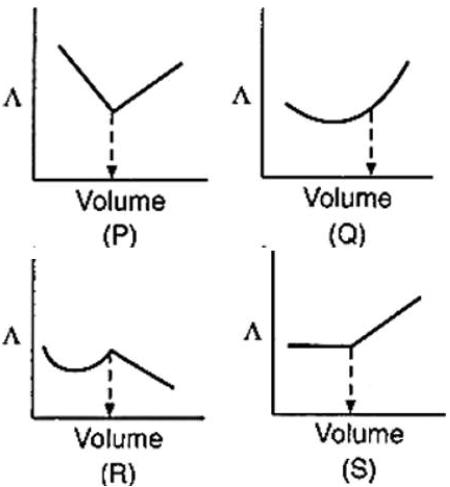
AnswerD. (S)
Explanation:
Initial conductance $(\Lambda)$ of solution was due to $K _{(a q)}^{+}$and $Cl _{(a q)}^{-}$. On addition of $AgNO _3$, the reaction occurs as
$AgNO_3(aq)+KCl(aq) \rightarrow AgCl \downarrow+KNO_3$
Showing $AgNO _3$ as limiting reagent upto complete precipitation. The conductance up to precipitation shows horizontal linearly due to $K _{(a q)}^{+}$and (left $Cl ^{-}$formed $NO _3$ ) anions as ionic mobility of $NO _3$ and CP are almost same. After complete precipitation, further addition of $AgNO _3$, the conductance is observed due to $K ^{+}, NO _3$ ions and added $Ag ^{+}, NO _3$ ions thus a sudden increase is noticed.
View full question & answer→MCQ 214 Marks
At $pH =1.2$ and 1 bar pressure, potential of hydrogen electrode at 298 K is __________ [Given : $\log 1.2=0.079$ ]
AnswerC. $-0.0708 V$
Explanation:
For the given hydrogen electrode,
Pressure of $H _2=1$ bar and $pH =1.2$
Pressure of $H _2$ is 1 bar (or 1 atm ) and $\left[ H ^{+}\right] \neq 1 M$
$\begin{array}{l}
E_{\frac{H^{+}}{H_2}}=\frac{0.059}{2} \log _{10}\left[H^{+}\right]^2 \\
=0.059 \times \log _{10}\left[H^{+}\right] \\
=0.059 \times[-pH] \\
E_{H}=0.059 \times(-pH)=0.059 \times(-1.2)=-0.0708 V
\end{array}$
View full question & answer→MCQ 224 Marks
The freezing point of a 0.05 molal solution of a non-electrolyte in water is: $\left( K _{ f }=1.86\right.$ $K _{\text {molality }}{ }^{-1}$ )
- A
$-0.093^{\circ} C$
- B
$-1.86^{\circ} C$
- C
$-0.93^{\circ} C$
- D
$0.093^{\circ} C$
AnswerA. $-0.093^{\circ} C$
Explanation:
$\begin{array}{l}\Delta T _{ f }=1.86 \times 0.05=0.093 \\ \therefore T_{ f }=0-0.093=-0.093^{\circ} C \end{array}$
View full question & answer→MCQ 234 Marks
An unknown substance X contains $66.66$ $\%$ carbon, $3.73$ $\%$ hydrogen and $29.62 \%$ oxygen. Molar mass of X is the same as its empirical molar mass. If 3.15 grams of the unknown substance is dissolved in 25 grams of benzene, what is the freezing point of the resulting solution?
Normal freezing point of benzene is $5.50^{\circ} C$ and the molal freezing-point depression constant, $K _{ f }$, for benzene is 5.12 K $kg mol ^{-1}$.
- A
$-8.2{ }^{\circ} C$
- B
$-11.9^{\circ} C$
- C
$-2.9^{\circ} C$
- D
$-6.5^{\circ} C$
AnswerD. $-6.5^{\circ} C$
Explanation:
| Element | $\%$ Composition | Moles |
| C | 66.66 | $66.66 g \times \frac{1 mol}{12 g}=5.5 mol$ |
| H | 3.73 | $3.73 g \times \frac{1 mol}{1.008 g}=3.7 mol$ |
| O | 29.62 | $29.62 g \times \frac{1 mol}{16 g}=1.85 mol$ |
$\begin{array}{l} C _{\frac{5.5}{1.85}} H _{\frac{3.75}{1.85}} O _{\frac{1.85}{1.85}} \\ \therefore \text { Empirical formula }= C _3 H _2 O \\ \text { Molar mass }=54 g / mol \\ \text { Now, } T _{ f } \text { (solution) }= T _{ f (\text { solvent })}^0-\Delta T _{ f } \\ \Delta T _{ f }= m \cdot K _{ f }=\frac{3.15}{54 \times 0.025} \times 5.12 \\ \Delta T_{ f }=11.95^{\circ} C \\ \therefore T _{ f (\text { solution })}=5.5-11.95=-6.45 \approx-6.5^{\circ} C \end{array}$ View full question & answer→MCQ 244 Marks
An unripe mango placed in a concentrated salt solution to prepare pickle, shrivels because:
- A
it gains water due to endo osmosis
- B
it gains water due to reverse osmosis
- C
it loses water due to exo osmosis
- D
it loses water due to reverse osmosis
AnswerC. it Loses water due to exo osmosis
Explanation:
When unripe mango is dipped in saturated solution then it loses water due to exosmosis.
View full question & answer→MCQ 254 Marks
An aqueous solution of a non-volatile solute show vapour pressure of 90.9 mm . If vapour pressure of pure water is 100 mm at the same temperature and $K_f$ for water is 1.86 K molality $^{-1}$, what will be depression in f.pt. of solution?
View full question & answer→MCQ 264 Marks
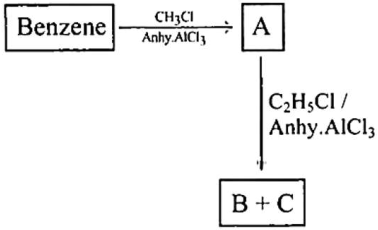
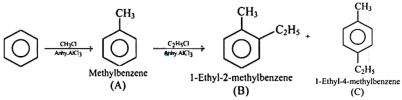
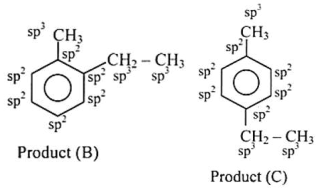
- A
Product B - Ratio $2: 3$, Product C - Ratio $3:2$
- B
Product B - Ratio $1:2$, Product C - Ratio $1:2$
- C
Product B - Ratio $2:1$, Product C - Ratio $2:3$
- D
Product B - Ratio $2:1$, Product C - Ratio $2:1$
View full question & answer→MCQ 274 Marks
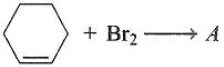
A will have configuration
MCQ 284 Marks
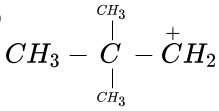
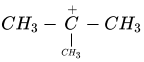
Which of the following ion is most stable?
AnswerA.
View full question & answer→MCQ 294 Marks
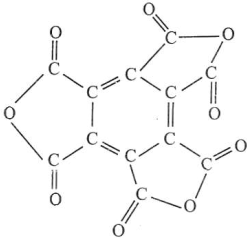
Graphite $\xrightarrow[(\text { oxidation })]{\text { Strong oxdising,agent }} X($ acid $) \xrightarrow[\text { Dehydration }]{\Delta} Y, Y$ is:
- A
$C _3 O _2$
- B
$CO _2$
- C
- D
$C _{12} O _9$
View full question & answer→MCQ 304 Marks
Bucky ball or Buckminster fullerene is:
MCQ 314 Marks
Which of the following reactions is an example of a redox reaction?
i. $XeF _4+ O _2 F_2 \rightarrow XeF _6+ O _2$
ii. $XeF _2+ PF _5 \rightarrow[ XeF ]^{+} PF _6^{-}$
iii. $XeF _6+ H _2 O \rightarrow XeOF _4+2 HF$
iv. $XeF _6+2 H _2 O \rightarrow XeO _2 F_2+4 HF$
AnswerC. only i
Explanation:
$\begin{array}{l} XeF _4+ O _2 F_2 \rightarrow XeF _6+ O _2 \\ Xe ^{4+} \rightarrow Xe ^{6+}+2 e \\ 2 e +\left( O ^{+1}\right)_2 \rightarrow O_2^0\end{array}$
View full question & answer→MCQ 324 Marks
The mass of phosphoric acid $\left( H _3 PO _4\right)$ required to prepare 550 mL of 0.40 N solution
i. assuming complete neutralisation of acid
ii. assuming reduction to $HPO _3^{2-}$ are respectively:
- A
$10.8 g, 10.8 g$
- B
$7.19 g, 7.19 g$
- C
$10.8 g, 7.19 g$
- D
$7.19 g, 10.8 g$
AnswerD. $7.19 g, 10.8 g$
View full question & answer→MCQ 334 Marks
Which of the following is not an example of redox reaction?
i. $CuO + H _2 \rightarrow Cu + H _2 O$
ii. $Fe _2 O _3+3 CO \rightarrow 2 Fe +3 CO _2$
iii. $2 K+ F _2 \rightarrow 2 KF$
iv. $BaCl _2+ H _2 SO _4 \rightarrow BaSO _4+2 HCI$
AnswerB. iv and i
Explanation:
Neither there is an oxidant nor reductant or none of the species shows the change in oxidation no.
View full question & answer→MCQ 344 Marks
The total number of different kind of buffers obtained during the titration of $H _3 PO _4$ with NaOH are:
AnswerD. 3
Explanation:
$NaH _2 PO _4+ H _3 PO _4 ; NaH _2 PO _4+ Na _2 HPO _4 ; Na _2 HPO _4+ Na _3 PO _4$
View full question & answer→MCQ 354 Marks
For the reaction $H_2(g)+I_2(g) \rightarrow 2 H I(g)$ the change in enthalpy $(\Delta H)$ will be
- A
- B
$=\Delta E$
- C
$>\Delta E$
- D
$<\Delta E$
AnswerB. $=\Delta E$
Explanation:
$\begin{array}{l}
H_{2(g)}+I_{2(g)} \rightarrow 2 H I_{(2 g)} \\
\Delta n=N o .
\end{array}$
of gaseous product - no. of gaseous reactant
$\begin{array}{l}
=2-(1+1)=0 \\
A s \Delta H=\Delta E+\Delta n R T
\end{array}$
$\begin{array}{l}
\Rightarrow \Delta H=\Delta E+0 \times R T \\
\Rightarrow \Delta H=\Delta E
\end{array}$
View full question & answer→MCQ 364 Marks
A mixture contains $n _1$ moles of monoatomic gas and $n _2$ moles of diatomic gas. If $\gamma=$ 1.50 for mixture, the ratio of $n_1: n_2$ is:
- A
$2: 1$
- B
$1: 1$
- C
$1: 2$
- D
$2: 3$
View full question & answer→MCQ 374 Marks
The bond order in $NO ^{+}$molecule is __________ .
AnswerC. 3
Explanation:
Electronic configuration of $NO ^{+}$molecule is
$\begin{array}{l}
NO^{+}: K K(\sigma 2 s)^2\left(\sigma^* 2 s\right)^2\left(\sigma 2 p_2\right)^2\left(\pi 2 p_x\right)^2 \\
\equiv\left(\pi 2 p_\nu\right)^2\left(\pi^* 2 p_x\right)^0
\end{array}$
KK represents closed K shell structure $(\sigma 1 s)^2\left(\sigma^* 1 s\right)^2$
Bond order of $NO ^{+}$molecule $=\frac{N_b-N_a}{2}=\frac{8-2}{2}=3$
View full question & answer→MCQ 384 Marks
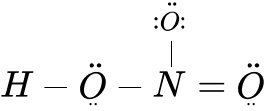
What is the formal charge on the nitrogen atom in $HNO _3$ ?
View full question & answer→MCQ 394 Marks
Which of the following compounds readily decomposes on heating to give ionic compound with higher value of lattice energy as compare to corresponding reactant?
i. $Li _2 CO _3$
ii. $LiBF _4$
iii. $BeSO _4$
iv. $Na _2 O _2$
v. $BeCO _3$
AnswerA. All of these
Explanation :
$Li _2 CO _3 \xrightarrow{\Delta} Li _2 O + CO _2$
$LiBF _4 \xrightarrow{\Delta} LiF + BF _3$
$BeSO _4 \xrightarrow{\Delta} BeO + SO _2+\frac{1}{2} O _2$
$Na _2 O _2 \xrightarrow{\Delta} Na _2 O +\frac{1}{2} O _2$
$BeCO _3 \xrightarrow{\Delta} BeO + CO _2$
In all of these above reactions, the lattice energy of the product is higher as compared to the reactant.
View full question & answer→MCQ 404 Marks
Which of following is not correctly matched?
A. d-block element: electronic configuration is $n s^{0-2}(n-1) d^{1-10}$
B. p-block element: electronic configuration is $ns ^{1-2} np ^{1-6}$
C. s-block elemen: electronic configuration is $ns { }^{1-2}$
D. Ce: f-block's first member.
AnswerB. B
Explanation:
p-block element: electronic configuration is $n s^{1-2} n p^{1-6}$
View full question & answer→MCQ 414 Marks
If the wave number of light is $5 \times 10^6 m^{-1}$, then the frequency associated with this light is __________ .
AnswerB. $1.5 \times 10^{15} sec ^{-1}$
Explanation:
$\begin{array}{l} v = c \bar{v} \\ =3 \times 10^8 ms^{-1} \times 5 \times 10^6 m^{-1} \\ v =1.5 \times 10^{15} sec ^{-1}\end{array}$
View full question & answer→MCQ 424 Marks
A certain orbital has no angular nodes and two radial nodes. The orbital is
AnswerB. 3s
Explanation:
| Orbit | Angular nodes $\ell$ | Radial nodes$(n-\ell-1)$ |
| 2p | $\ell=1$ | 2-1-1=0 |
| 3p | $\ell=1$ | 3-1-1=1 |
| 3s | $\ell=0$ | 3-0-1=2 |
| 2s | $\ell=0$ | 2-0-1=1 |
3s orbital has no angular nodes and two radial nodes. View full question & answer→MCQ 434 Marks
The uncertainty in the momentum of an electron is $10^{-5} kg ms ^{-1}$. The uncertainty in it position will be:
- A
$1.05 \times 10^{-26} m$
- B
$5.25 \times 10^{-28} m$
- C
$1.05 \times 10^{-28} m$
- D
$5.27 \times 10^{-30} m$
AnswerD. $5.27 \times 10^{-30} m$
Explanation:
Use $\Delta x \cdot \Delta p=\frac{h}{4 \pi}$
View full question & answer→MCQ 444 Marks
For the redox reaction,
$MnO_4^{-}+C_2 O_4^{2-}+H^{+} \longrightarrow Mn^{2+}+CO_2+H_2 O$
The correct coefficients of the reactants for the balanced reaction are
- A
$MnO _4^{-}=5, C _2 O _4^{2-}=16, H ^{+}=2$
- B
$MnO _4^{-}=16, C _2 O _4^{2-}=5, H ^{+}=2$
- C
$MnO _4^{-}=2, C _2 O _4^{2-}=5, H ^{+}=16$
- D
$MnO _4^{-}=2, C _2 O _4^{2-}=16, H ^{+}=5$
AnswerC. $MnO _4^{-}=2, C _2 O _4^{2-}=5, H ^{+}=16$
Explanation:
The balanced redox reaction is
$2 MnO_4^{-}+5 C_2 O_4^{2-}+16 H^{+} \longrightarrow 2 Mn^{2+}+10 CO_2+16 H_2 O$
Hence, the coefficients of reactants in balanced reaction are 2,5 and 16 respectively.
View full question & answer→MCQ 454 Marks
Using the given data, calculate the average atomic mass of argon.
| Isotope | Atomic mass (amu) | Relative abundance (%) |
| 36 Ar | 35.97 | 0.337 |
| 38 Ar | 37.96 | 0.063 |
| 40 Ar | 39.96 | 99.6 |
AnswerA. 39.94 amu
Explanation:
$\begin{array}{l}\text { Average atomic mass }=\frac{\text { Sum of (Isotopic mass } \times \text { its } \% \text { abundance ) }}{100} \\ =\frac{(35.97 \times 0.337)+(37.96 \times 0.063)+(39.96 \times 99.6)}{100} \\ =39.94 amu \end{array}$
View full question & answer→