Mark the wrong statement
Easy
Download our app for free and get started
For SHM, the force of the particle is given by,
$F =- kx$
$\Rightarrow ma =- kx$
$\Rightarrow a =\frac{- k }{ m } x$
We also have,
$a=-\omega^2 x$
From this, we can say $\omega^2=\frac{k}{ m }$
or, $\omega^2=\sqrt{\frac{ k }{ m }}$, which is a constant.
Now, time period is given by, $T =\frac{2 \pi}{\omega}$ which will also be a constant. Hence,
option $A$ is right.
All motion which have same period may not be SHM. $A$ good example is that
of when a particle is moving in a circle. This case has same time period but is
not an example of SHM. Hence, the wrong answer is $B$.
The total energy of SHM is given by, $KE =\frac{1}{2} kA ^2$. So, we can see that the total
energy is directly proportional to the square of amplitude. Hence, option $C$ is
also correct.
The phase constant is given by $y=A \sin \omega t+\phi$ where $\phi$ is the phase constant.
Clearly we can see that the phase constant depends directly upon the initial
condition of the particle. Hence, option $D$ is also correct.

Download our appand get started for free
Experience the future of education. Simply download our apps or reach out to us for more information. Let's shape the future of learning together!No signup needed.*
Similar Questions
- 1Amplitude of a wave is represented by $A = \frac{c}{{a + b - c}}$ Then resonance will occur whenView Solution
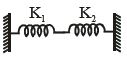
- 2View SolutionThe effective spring constant of two spring system as shown in figure will be
- 3The mass of a particle is $1\,\,kg$ and it is moving along $x-$ axis. The period of its small oscillation is $\frac {\pi }{2}$ . Its potential energy may beView Solution
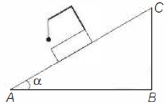
- 4A simple pendulum is attached to a block which slides without friction down an inclined plane $A B C$ having an angle of inclination $\alpha$ as shown below. While the block is sliding down the pendulum oscillates in such a way that at its mean position the direction of the string isView Solution
- 5The displacement of a particle varies according to the relation $x = 3 \ sin\ 100t + 8\ cos^2\ 50t$ . Which of the following is incorrect about this motionView Solution
- 6Two springs have spring constants ${K_A}$ and ${K_B}$ and ${K_A} > {K_B}$. The work required to stretch them by same extension will beView Solution
- 7A wooden cube (density of wood $'d'$ ) of side $'l'$ floats in a liquid of density $'\rho '$ with its upper and lower surfaces horizontal. If the cube is pushed slightly down and released, it performs simple harmonic motion of period $'T'$. Then, $'T'$ is equal toView Solution
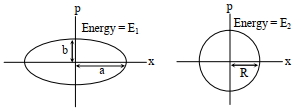
- 8Two independent harmonic oscillators of equal mass are oscillating about the origin with angular frequencies $\omega_1$ and $\omega_2$ and have total energies $E_1$ and $E_2$, respectively. The variations of their momenta $p$ with positions $x$ are shown in the figures. If $\frac{a}{b}= n ^2$ and $\frac{ a }{ R }= n$, then the correct equation$(s)$ is(are) $Image$View Solution
$(A)$ $E_1 \omega_1=E_2 \omega_2$ $(B)$ $\frac{\omega_2}{\omega_1}=n^2$ $(C)$ $\omega_1 \omega_2= n ^2$ $(D)$ $\frac{E_1}{\omega_1}=\frac{E_2}{\omega_2}$
- 9View SolutionThe period of a simple pendulum is doubled, when
- 10A $3\ kg$ sphere dropped through air has a terminal speed of $25\ m/s$. (Assume that the drag force is $-bv$.) Now suppose the sphere is attached to a spring of force constant $k = 300\ N/m$, and that it oscillates with an initial amplitude of $20\ cm$. What is the angular frequencu of its damped $SHM$? ..... $rad/s$View Solution