MCQ
Mark the wrong statement
  • A
    All S.H.M.’s have fixed time period
  • All motion having same time period are S.H.M.
  • C
    In S.H.M. total energy is proportional to square of amplitude
  • D
    Phase constant of S.H.M. depends upon initial conditions

Answer

Correct option: B.
All motion having same time period are S.H.M.
b
For SHM, the force of the particle is given by,

$F =- kx$

$\Rightarrow ma =- kx$

$\Rightarrow a =\frac{- k }{ m } x$

We also have,

$a=-\omega^2 x$

From this, we can say $\omega^2=\frac{k}{ m }$

or, $\omega^2=\sqrt{\frac{ k }{ m }}$, which is a constant.

Now, time period is given by, $T =\frac{2 \pi}{\omega}$ which will also be a constant. Hence,

option $A$ is right.

All motion which have same period may not be SHM. $A$ good example is that

of when a particle is moving in a circle. This case has same time period but is

not an example of SHM. Hence, the wrong answer is $B$.

The total energy of SHM is given by, $KE =\frac{1}{2} kA ^2$. So, we can see that the total

energy is directly proportional to the square of amplitude. Hence, option $C$ is

also correct.

The phase constant is given by $y=A \sin \omega t+\phi$ where $\phi$ is the phase constant.

Clearly we can see that the phase constant depends directly upon the initial

condition of the particle. Hence, option $D$ is also correct.

Need a full question paper?

Generate a complete, print-ready paper with questions like this in minutes — across 16+ boards, with answer keys.
Start Generating Free

Similar questions

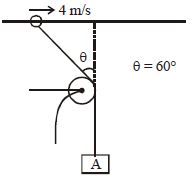
For the given fig. find the speed of block $A$ when $\theta  = {60^o}$
At which of the following temperatures the value of surface tension of water is minimum?
Which one of the following statements is true?
Starting from the origin at time $t=0,$ with initial velocity $5 \hat{ j }\, ms ^{-1},$ a particle moves in the $x-y$ plane with a constant acceleration of $(10 \hat{ i }+4 \hat{ j })\, ms ^{-2}$. At time $t$, its coordinates are $\left(20\, m , y _{0}\, m \right) .$ The values of $t$ and $y _{0},$ are respectively
A vector $\vec A $ is rotated by a small angle $\Delta \theta$ radian $( \Delta \theta << 1)$ to get a new vector $\vec B$ In that case $\left| {\vec B - \vec A} \right|$ is
Compressibility per unit atm. pressure of water is $'\sigma '$ and if due to pressure $P$ there is decrement in volume $V$, find change is volume
Two plates $A$ and $B$ have thermal conductivities $84\,Wm ^{-1}\,K ^{-1}$ and $126\,Wm ^{-1}\,K ^{-1}$ respectively. They have same surface area and same thickness. They are placed in contact along their surfaces. If the temperatures of the outer surfaces of $A$ and $B$ are kept at $100^{\circ}\,C$ and $0{ }^{\circ}\,C$ respectively, then the temperature of the surface of contact in steady state is $..........\,{ }^{\circ} C$.
A child weighing $25$ kg slides down a rope hanging from the branch of a tall tree. If the force of friction acting against him is $2\, N$,  ........ $m/s^2$ is the acceleration of the child (Take $g = 9.8\,m/{s^2})$
An object moves at a constant speed along a circular path in a horizontal plane with centre at the origin. When the object is at $x =+2\,m$, its velocity is $-4 \hat{ j }\, m / s$. The object's velocity $(v)$ and acceleration $(a)$ at $x =-2\,m$ will be
The direction of the angular velocity vector along