Question
Market for a good is in equilibrium. There is decrease in supply for this good. Explain the chain of effects of this change. Use diagram.
OR
Explain the chain effects of decrease in supply of a good on its price, supply and demand.
Answer

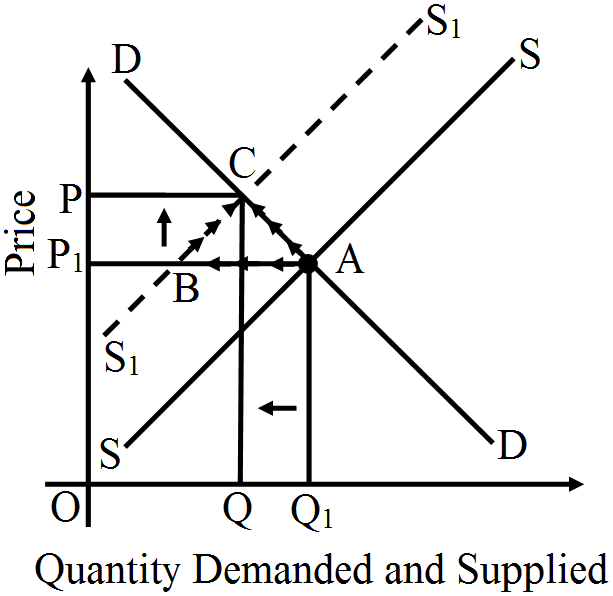
As given in the examination problem that market for a good is in equilibrium. So, we assume that initial price is OP as shown in the given figure.

In the given figure price is on vertical axis and quantity demanded and supplied is on horizontal axis. But due to decrease in supply the supply curve shifts leftward from SS to $S_1S_1$. With new supply curve $S_1S_1,$ there is excess demand at initial price OP because at price OP, supply is PB and demand is PA, so there is excess demand of AB at price OP. Due to this excess demand competition among the consumer will rise the price. Due to this rise in price there is upward movement along the supply curve (Expansion in supply) from B to C and similarly, there is upward movement along the demand curve (Contraction in demand) from A to C. So, finally, equilibrium price rises from OP to $OP_1$ and equilibrium quantity falls from $OQ$ to $OQ_1.$
Conclusion: Due to decrease in supply,
  1. Equilibrium price rises from OP to $OP_1$.
  2. Equilibrium quantity falls from OQ to $OQ_1.$

Need a full question paper?

Generate a complete, print-ready paper with questions like this in minutes — across 16+ boards, with answer keys.

Start Generating Free

Similar questions

Differentiate between Law of Demand and Price Elasticity of Demand.
Explain the relationship between AC and MC with the help of a diagram.
From the following information about a firm, find the firms equilibrium output in terms of marginal cost and marginal revenue. Give reasons. Also find profit at this output.
Output
(Units)
Total Revenue
(₹)
Total Cost
(₹)
1 7 8
2 14 15
3 21 21
4 28 28
5 35 36
If equilibrium price of a good is greater than its market price, explain all the changes that will take will place in the market. Use diagram.
How does technological progress affect the supply curve of a firm?
Explain the relationship between:
  1. Prices of other goods and demand for the given good.
  2. Income of the buyers and demand for a good.
Define price floor. Explain the implications of price floor.
A consumer consumes only two goods $X$ and $Y$ whose prices are Rs. $4$ and Rs. $5$ per unit respectively. If the consumer chooses a combination of the two goods with marginal utility of $X$ equal to $5$ and that of $Y$ equal to $4$, is the consumer in equilibrium? Give reasons. What will a rational consumer do in this situation? Use utility analysis.
Explain the meaning and conditions of producer's equilibrium using marginal cost and marginal revenue approach. Use diagram.
OR
What is meant by producer's equilibrium? Explain the conditions of producer's equilibrium using MR and MC approach. Use diagram.
From the following schedule find out the level of output at which the producer is in equilibrium. Calculate profit. Give reasons for your answer.
Output(Units)
1
2
3
4
5
6
7
Price (Rs.)
24
24
24
24
24
24
24
Total Cost (Rs.)
26
50
72
92
115
139
165