MCQ
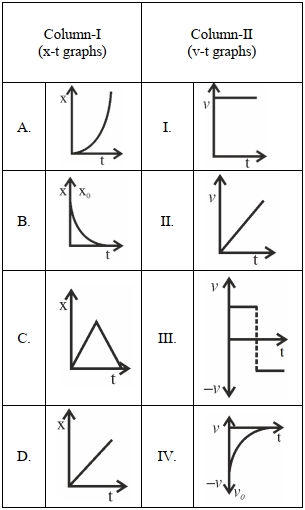
Match Column$-I$ with Column$-II :$

Choose the correct answer from the options given below:
  • $(A)-(II), (B)-(IV), (C)-(III), (D)-(I)$
  • B
    $(A)-( I), (B)-(II), (C)-(III), (D)-(IV)$
  • C
    $(A)-( II), (B)-(III), (C)-(IV), (D)-(I)$
  • D
    $(A)-(I), (B)-(III), (C)-(IV), (D)-(II)$
Answer

Correct option: A.
$(A)-(II), (B)-(IV), (C)-(III), (D)-(I)$
a
$\frac{d x}{d t}=\text { slope } \geq 0 \text { always increasing }$

$\text { (A - II) }$

$\frac{d x}{d t} < 0 \text {; and at } t \rightarrow \infty \frac{ dx }{ dt } \rightarrow 0$

$( B - IV )$

$\frac{ dx }{ dt } > 0 \text { for first half } \frac{ dx }{ dt } < 0 \text { for second half. }$

$\text { (C - III) }$

$\frac{ dx }{ dt }=\text { constant }$

$\text { (D - I) }$

Need a full question paper?

Generate a complete, print-ready paper with questions like this in minutes — across 16+ boards, with answer keys.

Start Generating Free

Similar questions

On a frictionless horizontal plane, a bob of mass $m=0.1 kg$ is attached to a spring with natural length $l_0=0.1 m$. The spring constant is $k_1=0.009 Nm ^{-1}$ when the length of the spring $I > l_0$ and is $k_2=0.016 Nm ^{-1}$ when $ I < l_0$. Initially the bob is released from $l=0.15 m$. Assume that Hooke's law remains valid throughout the motion. If the time period of the full oscillation is $T=(n \pi) s$, then the integer closest to $n$ is. . . . .
In the co$-$efficient of friction between the floor and the body $B$ is $0.1$ . The co$-$efficient of friction between the bodies $B$ and $A$ is $0.2 .$ A force $F$ is applied as shown on $B$. The mass of $A$ is $m / 2$ and of $B$ is $m$. Which of the following statements are true?
Which one of the following statements is true
An object is thrown along a direction inclined at an angle of ${45^o}$ with the horizontal direction. The horizontal range of the particle is equal to
In the given figure a ring of mass $m$ is kept on a horizontal surface while a body of equal mass $'m'$ attached through a string, which is wounded on the ring. When the system is released the ring rolls without slipping. Consider the following statements and choose the  correct option.

$(i)$ acceleration of the centre of mass of ring is $\frac{g}{3}$

$(ii)$ acceleration of the hanging particle is  $\frac{2g}{3}$

$(iii)$ frictional force (on the ring) acts along forward direction

$(iv)$ frictional force (on the ring) acts along backward direction

With reference to figure of a cube of edge $a$ and mass $m$, state whether the following
($O$ is the centre of the cube.) option is correct

$(a)$ The moment of inertia of cube about $z-$ axis is $I_z$ = $I_x + I_y$

$(b)$ The moment of inertia of cube about $A-$ axis is $I_A$=${I_z} + \frac{{m{a^2}}}{2}$

$(c)$ The moment of inertia of cube about $B-$ axis is $I_B$=${I_z} + \frac{{m{a^2}}}{2}$

$(d)$  $I_x$ = $I_z$

$A$ block of mass $m$ moving with a velocity $v_0$ on a smooth horizontal surface strikes and compresses a spring of stiffness $k$ till mass comes to rest as shown in the figure. This phenomenon is observed by two observers:

$A$: standing on the horizontal surface

$B$: standing on the block 

To an observer $B$, when the block is compressing the spring

A circular disc $X$ of radius $R$ is made from an iron plate of thickness $t,$ and another plate $y$ of radius $4R$ is made from an iron plate of thickness $\frac {t}{4}$. The ratio of moment of inertia $\frac {I_y}{I_x}$ is
Match List $I$ with List $II$

LIST$-I$ LIST$-II$
$(A)$  Torque $(I)$    $ML ^{-2} T ^{-2}$
$(B)$   Stress $(II)$   $ML ^2 T ^{-2}$
$(C)$   Pressure of gradient $(III)$   $ML ^{-1} T ^{-1}$
$(D)$   Coefficient of viscosity $(IV)$   $ML ^{-1} T ^{-2}$

Choose the correct answer from the options given below

A vessel of volume $0.02 \,\,m^3$ contains a mixture of hydrogen and helium at $20\,^oC$ and $2$ atmospheric pressure. The mass of mixture is $5\,\, gms$. Find the ratio of mass of hydrogen to that of helium in the mixture.