MCQ
Match List $I$ with List $II$ and select the correct answer using the codes given below the lists :

List $I$ List $II$
$P.$ Boltzmann constant $1.$ $\left[ ML ^2 T ^{-1}\right]$
$Q.$ Coefficient of viscosity $2.$ $\left[ ML ^{-1} T ^{-1}\right]$
$R.$ Planck constant $3.$ $\left[ MLT ^{-3} K ^{-1}\right]$
$S.$ Thermal conductivity $4.$ $\left[ ML ^2 T ^{-2} K ^{-1}\right]$

Codes: $ \quad \quad P \quad Q \quad R \quad S $ 

  • A
    $\quad 3 \quad 1 \quad 2 \quad 4 $
  • B
    $\quad 3 \quad 2 \quad 1 \quad 4 $
  • $\quad 4 \quad 2 \quad 1 \quad 3 $
  • D
    $\quad 4 \quad 1 \quad 2 \quad 3 $

Answer

Correct option: C.
$\quad 4 \quad 2 \quad 1 \quad 3 $
c
$(p)$ $U =\frac{1}{2} kT \quad \Rightarrow \quad ML ^2 T ^{-2}=[ k ] K \quad \Rightarrow \quad[ K ]= ML ^2 T ^{-2} K ^{-1}$

$(q)$ $F =\eta A \frac{ dv }{ dx } \Rightarrow \quad[\eta]=\frac{ MLT ^{-2}}{ L ^2 LT ^{-1} L ^{-1}}= ML ^{-1} T ^{-1}$

$(r)$ $E = h v \quad \Rightarrow \quad ML ^2 T ^2=[ h ] T ^{-1} \Rightarrow \quad[ h ]= ML ^2 T ^{-1}$

$(s)$ $\frac{ dQ }{ dt }=\frac{ kA \Delta \theta}{\ell} \Rightarrow \quad[ k ]=\frac{ ML ^2 T ^{-3} L }{ L ^2 K }= MLT ^{-3} K ^{-1}$

Need a full question paper?

Generate a complete, print-ready paper with questions like this in minutes — across 16+ boards, with answer keys.

Start Generating Free

Similar questions

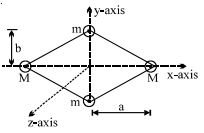
Four point masses are fastened to the corners of $a$ frame of negligible mass lying in the $xy$ plane. Let $w$ be the angular speed of rotation. Then
If on heating liquid through $80°C$, the mass expelled is $(1/100)^{th}$ of mass still remaining, the coefficient of apparent expansion of liquid is
A given ideal gas with $\gamma  = \frac{{{C_p}}}{{{C_v}}} = 1.5$ at a temperature $T$. If the gas is compressed adiabatically to one-fourth of its initial volume, the final temperature will be ..... $T$
An inverted tube barometer is kept on a lift  with a moving downward with a deceleration $\alpha $ . The density of mercury is $\rho$ and acceleration due to gravity is $g$ . If the atmospheric pressure be $P_0$ then
A body starts from the origin and moves along the $X-$axis such that the velocity at any instant is given by $(4{t^3} - 2t)$, where $t$ is in sec and velocity in$m/s$. What is the acceleration of the particle, when it is $2\, m$ from the origin..........$m/{s^2}$
A ball of mass $4\, kg$, moving with a velocity of $10\, ms ^{-1}$, collides with a spring of length $8\, m$ and force constant $100\, Nm ^{-1}$. The length of the compressed spring is $x\, m$. The value of $x$, to the nearest integer, is ........ .
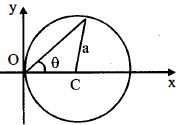
A particle is moving in a circular path of radius $a,$ with a constant velocity $v$ as shown in the figure.The centre of circle is marked by $'C'$. The angular momentum from the origin $O$ can be written as
A stone of mass $0.3\,kg$ attached to a $1.5\,m$ long string is whirled around in a horizontal circle at a speed of $6\,m s ^{-1}$. The tension in the string is $............\,N$
If the tension on a wire is removed at once, then
The fundamental physical quantities that have same dimensions in the dimensional formulae of torque and angular momentum are