MCQ
Match List $I$ with List $II$ and select the correct answer using the codes given below the lists

 $\begin{array}{|l|l|} \hline \,\,List\,\,\,\,I\,\,(Compound) & \,\,List\,\,II\,\,(Oxidation\,\,state\,\,of\,\,N) \\ \hline (A)\,\,N{{O}_{2}} & (1)\,\,\,\,+\,\,5  \\ \hline (B)\,\,HNO  & (2)\,\,-\,\,3  \\ \hline (C)\,\,N{{H}_{3}} & (3)\,\,+\,\,4  \\ \hline (D)\,\,{{N}_{2}}{{O}_{5}} & (4)\,\,+\,\,1  \\ \hline \end{array}$

code :     $A \,\, B \,\,C \,\,D$      

  • A
    $2 \, \,\,3\, \,\,4\,\, \,1$
  • B
    $3 \, \,\,1\, \,\,2\,\, \,4$
  • $3 \, \,\,4\, \,\,2\,\, \,1$
  • D
    $2 \, \,\,3\, \,\,1\,\, \,4$

Answer

Correct option: C.
$3 \, \,\,4\, \,\,2\,\, \,1$
(c) (a) $\mathop N\limits^ * {O_2}$;$x - 4 = 0$;$x = + \,4$

     (b) $H\mathop N\limits^ * O$;$1 + x - 2 = 0$;$x = + 1$

     (c) $\mathop {N{H_3}}\limits^{ * \,\,\,\,\,\,} $; $x + 3 = 0$; $x = - 3$

     (d) ${\mathop {N_2}\limits^ *}{O_5}$; $2x - 10 = 0$;$2x = 10$; $x = \frac{{10}}{2}$; $x = 5.$

Need a full question paper?

Generate a complete, print-ready paper with questions like this in minutes — across 16+ boards, with answer keys.

Start Generating Free

Similar questions

The equilibrium constant for a reaction,

$A + B  \rightleftharpoons  C + D$ is $1 \times 10^{-2}$ at $298\, K$ and is

$2$ at $273\, K$. The chemical process resulting in the formation of $C$ and $D$ is

Which of the following cannot be represented by resonance structures?
Which of the following is better nucleophile
The electronic configuration of three elements $A,B$ and $C$ are given below. The bond between $B$ and $C$ will be

$A : 1s^2\, 2s^2\, 2p^6$
$B : 1s^2\, 2s^2\, 2p^6\, 3s^2\, 3p^3$
$C : 1s^2\, 2s^2\, 2p^6\, 3s^2\, 3p^5$

Which of the following statement is not correct from the view point of molecular orbital theory?
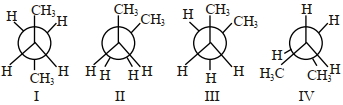
Arrange the following conformational isomers of $n-$butane in order of their increasing potential energy :
What is the work done when $1\, mole$ of a gas expands isothermally and reversibly from $25\, L$ to $250\, L$ at a temperature of $300\, K$?....$J$
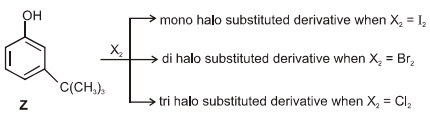
The reactivity of compound $Z$ with different halogens under appropriate conditions is given below :

$Image$

The observed pattern of electrophilic substitution can be explained by

$(A)$ the steric effect of the halogen

$(B)$ the steric effect of the tert-butyl group

$(C)$ the electronic effect of the phenolic group

$(D)$ the electronic effect of the tert-butyl group

If equilibrium constant of

$C{H_3}COOH + {H_2}O \rightleftharpoons C{H_3}CO{O^ - } + {H_3}{O^ + }$ is $1.8 \times 10^{-5}$, equilibrium constant for

$C{H_3}COOH + O{H^ - } \rightleftharpoons C{H_3}CO{O^ - } + {H_2}O$

Oxidation numbers of two $Cl$ atoms in bleaching powder, $CaOC{l_2}$ are