MCQ
Match List$-I$ with List$-II$

  List$-I$   List$-II$
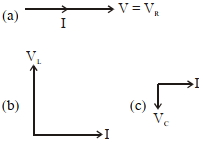
$(a)$ Phase difference between current and voltage in a purely resistive $AC$ circuit $(i)$ $\frac{\pi}{2} ;$ current leads voltage
$(b)$ Phase difference between current and voltage in a pure inductive $AC$ circuit $(ii)$ zero
$(c)$ Phase difference between current and voltage in a pure capacitive $AC$ circuit $(iii)$ $\frac{\pi}{2} ;$ current lags voltage
$(d)$ Phase difference between current and voltage in an $LCR$ series circuit $(iv)$ $\tan ^{-1}\left(\frac{X_{C}-X_{L}}{R}\right)$

Choose the most appropriate answer from the options given below:

  • A
    $(a) -( i ),( b )-( iii ),( c )-( iv ),( d )-( ii )$
  • B
    $(a) -( ii ),( b )-( iv ),( c )-( iii ),( d )-( i )$
  • C
    $(a)-(ii),(b)-(iii),(c)-(iv),(d)-(i)$
  • $(a)-(ii),(b)-(iii), (c)-(i), ( d )-( iv )$
Answer

Correct option: D.
$(a)-(ii),(b)-(iii), (c)-(i), ( d )-( iv )$
d
$(d)$ $\tan \phi=\frac{ V _{ L }- V _{ C }}{ V _{ R }}=\frac{ X _{ L }- X _{ C }}{ R }$

Need a full question paper?

Generate a complete, print-ready paper with questions like this in minutes — across 16+ boards, with answer keys.

Start Generating Free

Similar questions

Match List $- I$ (Experiment performed) with List $-II$ (Phenomena discovered/associated) and select the correct option from the options given the lists
List $- I$ List $- II$
$(1)$ Davisson and Genner $(i)$ Wave nature of electrons
$(2)$ Millikan's oil drop experiment $(ii)$ Charge of an electron
$(3)$ Rutherford experiment $(iii)$ Quantisation of energy levels
$(4)$ Franck-Hertz experiment $(iv)$ Existence of nucleus
Alpha rays emitted from a radioactive substance are
A moving coil galvanometer is converted into an ammeter reading upto $0.03\,A$ by connecting a shunt of resistance $4r$ across it and into an ammeter reading upto $0.06\,A$ when a shunt of resistance $r$ is connected across it. What is the maximum current which can be sent through this galvanometer if no shunt is used ............... $A$
Maximum density of ${H_2}O$ is at the temperature  .......... $^oF$ 
Ratio of amplitude of interfering waves is $3 : 4$. Now ratio of their intensities will be
A uniform rope having some mass hanges vertically from a rigid support. A transverse wave pulse is produced at the lower end. The speed $(v)$ of the wave pulse varies with height $(h)$ from the lower end as:
A torque meter is calibrated to reference standards of mass, length and time each with $5 \%$ accuracy. After calibration, the measured torque with this torque meter will have net accuracy of$............\%$
A body is released from the top of a tower of height $h$. It takes $t$ sec to reach the ground. Where will be the ball after time $t/2$ sec
In a streamline flow
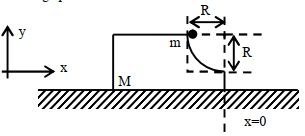
A block of mass $M$ has a circular cut with a frictionless surface as shown. The block rests on the horizontal frictionless surface of a fixed table. Initially the right edge of the block is at $x=0$, in a co-ordinate system fixed to the table. A point mass $m$ is released from rest at the topmost point of the path as shown and it slides down. When the mass loses contact with the block, its position is $\mathrm{x}$ and the velocity is $\mathrm{v}$. At that instant, which of the following options is/are correct?

(image)

$[A]$ The $x$ component of displacement of the center of mass of the block $M$ is : $-\frac{m R}{M+m}$.

[$B$] The position of the point mass is : $x=-\sqrt{2} \frac{\mathrm{mR}}{\mathrm{M}+\mathrm{m}}$.

[$C$] The velocity of the point mass $m$ is : $v=\sqrt{\frac{2 g R}{1+\frac{m}{M}}}$.

[$D$] The velocity of the block $M$ is: $V=-\frac{m}{M} \sqrt{2 g R}$.