MCQ
 Match the complex species given in Column $I$ with the possible isomerism given in Column $II$ and assign the correct code:
 
Column $I ($Complex species$)$
 
Column $II ($Isomerism$)$
$a.$ $[Co(NH_3)_4C_{l2}]^+$ $1.$
Optical
$b.$ $cis-[Co(en)_2Cl_2]^+$ $2.$
Ionisation
$c.$ $[Co(NH_3)_5 (NO_2)]Cl_2$ $3.$
Coordination
$d.$ $[Co(NH_3)_6][Cr(CN)_6]$ $4.$
Geometrical
    $5.$
Linkage
Code:
  • A
    $\text{A (1), B (2), C (4), D (5).}$
  • B
    $\text{A (4), B (3), C (2), D (1).}$
  • C
    $\text{A (4), B (1), C (5), D (3).}$
  • D
    $\text{A (4), B (1), C (2), D (3).}$

Answer

 
Column $I ($Complex species$)$
 
Column $II ($Isomerism$)$
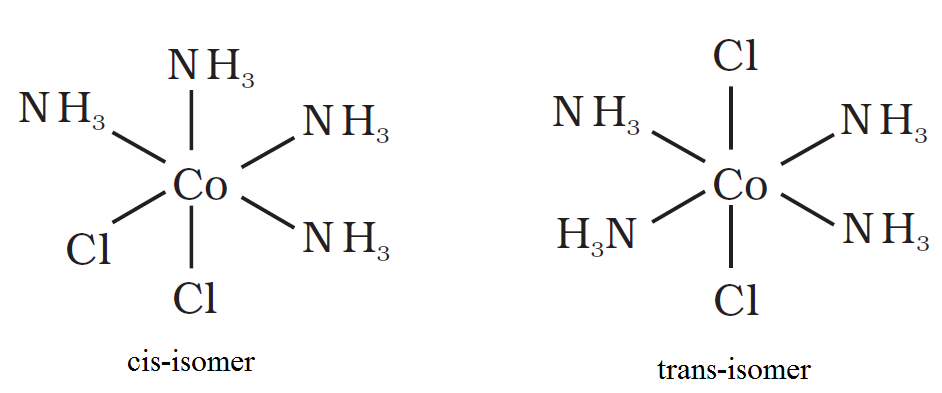
$a.$ $[Co(NH_3)_4C_{l2}]^+$ $4.$ Geometrical
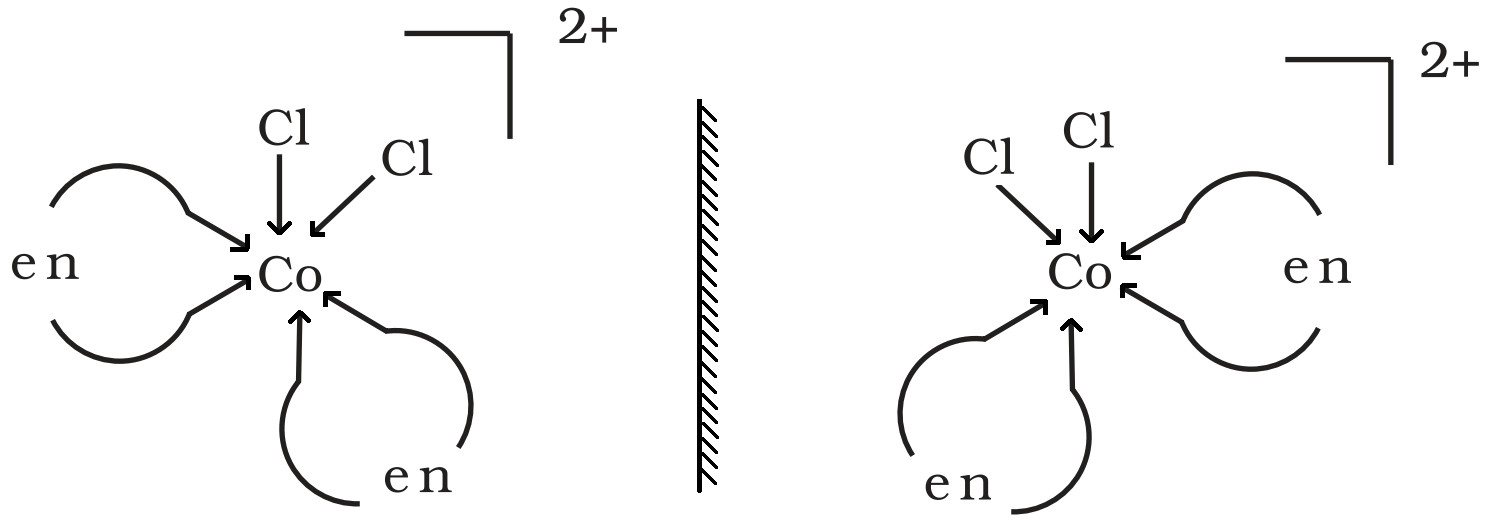
$b.$ $cis-[Co(en)_2Cl_2]^+$ $1.$
Optical
$c.$ $[Co(NH_3)_5 (NO_2)]Cl_2$ $2.$
Ionisation
$d.$ $[Co(NH_3)_6][Cr(CN)_6]$ $3.$
Coordination
Explanation:
Isomerism in coordination compound is decided by type of ligands and geometry of coordination and arrangement of ligands.
  1. $[Co(NH_3)_4Cl_2]+$ shows geometrical isomerism due to presence of two types of ligand whose $[Co(NH_3)_4Cl_2]+$ arrangement around central metal ion.
  1. cis$-[Co(en)_2Cl_2]+$ shows optical isomer due to its non$-$superimposable mirror image relationship.
  1. $[Co(NH_3)_5(NO_2)]Cl_2$ shows ionization isomer due to its interchanging ligand from outside the ionization sphere.
  2. $[Co(NH_3)_6][Cr(CN)_6]$ shows coordination isomer due to interchanging of ligand in between two metal ions from one coordination sphere to another coordination sphere.

Need a full question paper?

Generate a complete, print-ready paper with questions like this in minutes — across 16+ boards, with answer keys.

Start Generating Free

Similar questions

Write the rate law for a first order reaction. Justify the statement that half life for a first order reaction is independent of the initial concentration of the reactant.
The following results have been obtained during the kinetic studies of the reaction :
$2 A+ B \rightarrow C + D$
Experiment$[ A ] / mol L ^{-1}$$[ B ] / mol L ^{-1}$Initial rate of formation of D $/ mol L ^{-1} min^{-1}$
I0.10.1$6.0 \times 10^{-3}$
II0.30.2$7.2 \times 10^{-2}$
III0.30.4$2.88 \times 10^{-1}$
IV0.40.1$2.40 \times 10^{-2}$
Determine the rate law and the rate constant for the reaction.
Match the items of Column I and Column II.
  Column I   Column II
(i) Mathematical expression for rate of reaction. (a) Rate constant.
(ii) Rate of reaction for zero order reaction is equal to. (b) Rate law.
(iii) Units of rate constant for zero order reaction is same as that of. (c) Oder of slowest step.
(iv) Order of a complex reaction is determined by. (d) Rate of a reaction.
  1. Account for the following:
    1. $Mn$ shows the highest oxidation state of $+7$ with oxygen but with fluorine it shows the highest oxidation state of $+4.$
    2. $Cr^{2+}$ is a strong reducing agent.
    3. $Cu^{2+}$ salts are coloured while $Zn^{2+}$ salts are white.
  2. Complete the following equations:
    1. $2\text{MnO}_{2} + 4\text{KOH} + \text{O}_{2} \xrightarrow{\Delta}$
    2. $\text{Cr}_{2}\text{O}^{2-}_{7}+ 14\text{H}^{+} + 6\text{I}^{-}\xrightarrow{}$
What is adsorption isotherm? Describe the Freundlich adsorption isotherm.
A voltaic cell is set up at $25^\circ C$ with the following half$-$cells $Al^{3+} (0.001M)$ and $Ni^{2+} (0.50M).$ Write an equation for the reaction that occurs when the cell generates an electric current and determine the cell potential.
$(\text{Given:}\text{ E}^{\circ}_{\text{Ni}^{2+}/\text{Ni}}=-0.25\text{V,E}^{\circ}_{\text{Al}^{3+}/\text{Al}}=-1.66\text{V})$
What happens to most probable kinetic energy and the energy of activation with increase in temperature?
A mixed oxide of iron and chromium, $\ce{FeOCr_2O_3}$ is fused with sodium carbonate in the presence of air to form a yellow coloured compound $(A).$ On acidification the compound $(A)$ forms an orange coloured compound $(B),$ which is a strong oxidising agent.
  1. Identify the compounds $(A)$ and $(B).$
  2. Write balanced chemical equation for each step.
Why the reactivity of chlorobenzene towards nucleophilic substitution increase when electron withdrawing group ( $- NO _2$ ) is attached to the ortho and para positions? Explain.
The elements of $3d$ transition series are given as:
$\ce{Sc Ti V Cr Mn Fe Co Ni Cu Zn.}$
Answer the following:
  1. Write the element which shows maximum number of oxidation states. Give reason.
  2. Which element has the highest m.p?
  3. Which element shows only $+ 3$ oxidation state?
  4. Which element is a strong oxidizing agent in $+ 3$ oxidation state and why?